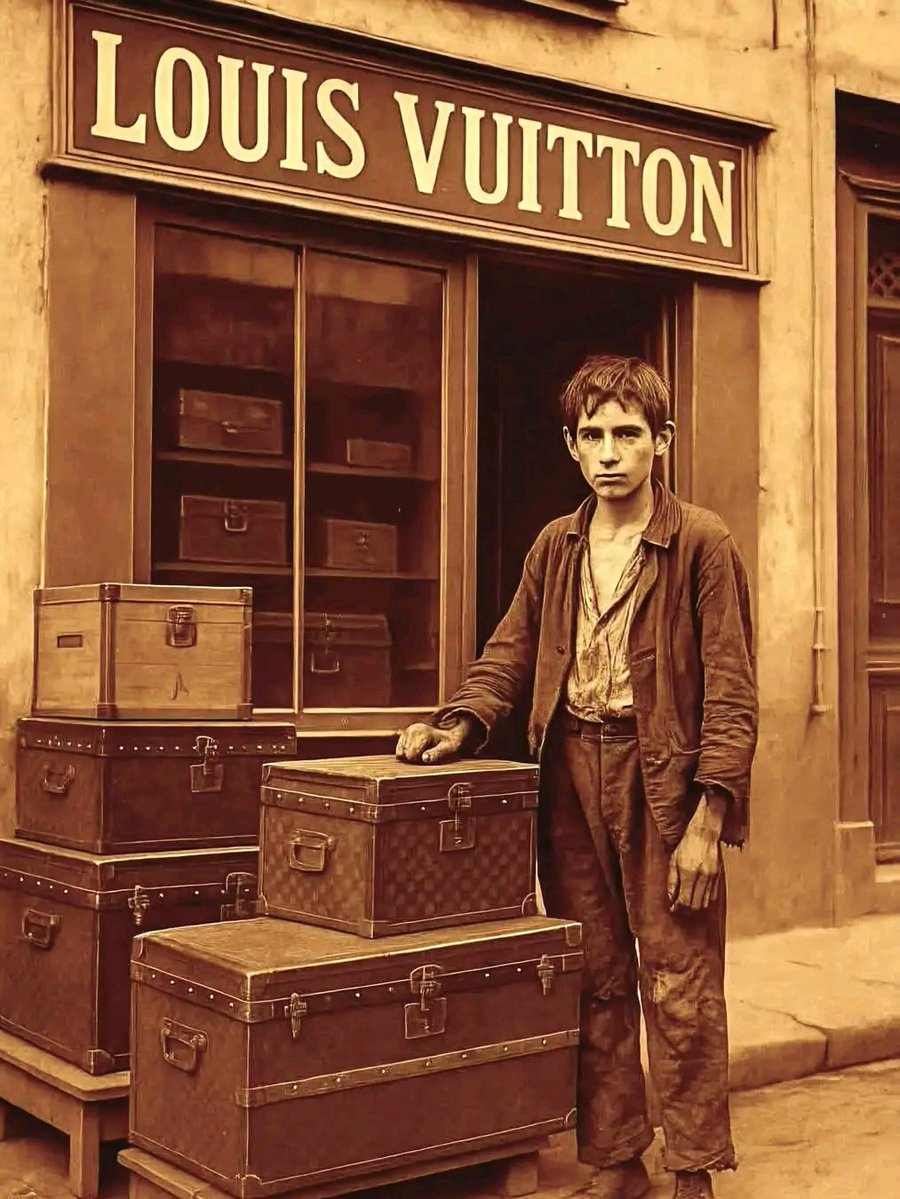
Louis Vuitton was born in 1821 in a small village in eastern France. When he was just 13 years old, he ran away from home and walked more than 400 kilometers to Paris. The journey took him nearly two years. Along the way, he survived by taking small jobs, sleeping wherever he could, and learning how to adapt. By the time he arrived in Paris, he had almost nothing — but he had determination.
In Paris, Vuitton became an apprentice to a box-maker and packer. This was an important job in the 19th century. Wealthy people traveled with many belongings, and everything had to be packed carefully by hand. Vuitton learned how to build strong wooden trunks and how to pack clothes so they would not wrinkle or get damaged during long trips.
His skills made him stand out. In 1854, he opened his own workshop in Paris. At the time, most trunks had rounded tops, which made them hard to stack. Vuitton introduced a flat-top trunk that was lighter, stronger, and easier to transport. This simple idea changed travel forever.
As his trunks became popular, copies appeared quickly. To fight this, Vuitton created special patterns and materials to make his trunks easier to recognize and harder to fake. This is how the famous Louis Vuitton designs began — not as decoration, but as protection against counterfeits.
Louis Vuitton died in 1892, but his work did not stop there. His son, Georges Vuitton, expanded the business and turned it into an international brand. Over time, the company moved from travel trunks to handbags, fashion, and accessories.
What makes Vuitton’s story interesting is that it did not start with luxury. It started with hard work, craftsmanship, and practical solutions to real problems.
I read that ants have no real concept of us because of their limited eyesight and how huge we are to them. They see us as moving shadows, wind, or obstacles, and I can’t stop thinking about what’s in front of all of us that’s too large for us to comprehend.
I have NEVER doubted that I will be successful. It was just a matter of timing. I have the work ethic, my portfolio of failures grows year on year, and I have a ridiculous bounce-back strength. Most importantly, I believe in my abilities to create the life I want. So, it’s gonna happen.
Boys, let me tell you something… Nothing is more important than family. During good times it may be tempting to celebrate with your friends & that’s fine but always reserve your best self & efforts for your family.
I don’t think we talk nearly enough about making room for mistakes and giving grace in relationships.
Almost everyone seems ready to cut people off and stay hyper-vigilant at the slightest misstep.
I saw video clips of Ugandan ministers doing site visits on poorly constructed roads and buildings, asking some questions ... and then arresting people right there on the spot.
No commissions of inquiry, no red tape. Just arrest.
In a relationship, you can't just do whatever you want. You have to always think about the other person. And that's what a lot of people don't understand. Too many people want the benefits of partnership without the responsibility. They want someone to come home to but freedom to do whatever. They want loyalty but refuse to be accountable. They want commitment but don't want to compromise. That's not a relationship, that's selfishness.
the first wealth you need is a mind that refuses to accept poverty, mediocrity or limitation as its permanent reality.
if everyone around you is broke, struggling and playing small, you'll eventually start believing that's just how life works. it isn't. sometimes you don't lack opportunity, you lack exposure. you haven't seen enough, learned enough or met enough people to understand what's possible.
get around people who think bigger. study how wealth is actually built.
expose yourself to better environments cos the moment your mind stops seeing wealth as something reserved for other people, you start moving differently.
your circumstances may be where you started but they don't have to be where you finish.
I am understanding to a fault. I can see patterns that even my partner cannot see, and I will often call her attention to them. The upside to this gift, and I suppose I can call it a gift, is that the women I date tend to become extremely free around me because they know I see them. I see beneath their masks. I understand why they do what they do, where certain behaviours come from, what wound or fear might be sitting beneath them. The downside, however, is that these same people end up emotionally unloading on me or behaving in ways that seem to say, “Shebi it’s Lukas, he’ll understand.”
The greatest challenge for me has been teaching them that understanding is not the same thing as permission. I can understand you. I can see why you do what you do. I can even understand the parts of you that you struggle to explain yourself. But you must also understand that I am a man in every sense of the word, a man with his own boundaries, his own non-negotiables, and no amount of understanding will make me abandon them. If you deliberately cross a line with that mindset of “he’ll understand,” I will not hesitate to walk away.
No amount of chemistry, attraction or feelings will be enough if your partner does not understand this one thing, "your home situation". I've been in a relationship for 6 years, and the most important thing I've realized is that no two people grow up in the same house. Maybe you grew up around domestic violence, financial stress and lack of love and affection. Or maybe you grew up around stability, love and people who made you feel safe, both situations shape everything, the way you love, how you think, how you handle conflict and how you see yourself. So when two people from very different backgrounds come together they're not just meeting each other, they're meeting years of beliefs, habits, experiences that they had no idea the other person was carrying. That's why it matters so much to have a partner that doesn't judge you for where you come from, someone who doesn't shame you for your story and realizes that some of the reactions started long before they actually walked into your life. So the right partner won't just try to understand your behavior, but they'll also try to understand the experience shape it.
Underrated life advice: Just be easy to work with. Show up on time. Do what you said you'd do. Bring solutions, not problems. Never create drama. Be responsive. Be emotionally consistent. Be kind. People will always want to support someone who just makes their life easier.
I was a bricklayer.
It was how I paid the bills when I first moved to America. Even the biggest title in bodybuilding, Mr. Olympia, only paid a thousand dollars back then.
It makes me proud that in March, the winner of our Arnold Classic and our Arnold Classic UK took home more than a million dollars. He can focus on bodybuilding.
But in our day, that wasn’t an option. Some guys were teachers. Some sold insurance. Franco and I laid bricks.
We put an ad in the paper and sold ourselves as European craftsmen. We figured if people heard the accents, they would picture old-world masonry instead of two bodybuilders with a wheelbarrow.
It worked.
The phone rang. And then we had to go out and actually do the job, which was the part nobody could fake. Luckily, Franco knew what he was doing.
The work was simple. Mix the mortar. Set the brick. Tap it level. Scrape the edge. Then do it again. And again. Nobody claps for you. There is no crowd, no music, no trophy. There is just the next brick sitting there waiting for you.
You can still find some of the walls we built in Venice.
That’s where my lesson today comes from.
One brick doesn’t look like anything. Ten bricks don’t look like anything. A hundred bricks, you’re starting to see something, but it doesn’t impress anyone.
You just keep laying bricks until the job is done.
And you know what happens after four or five hours on a wall?
You are so damn tired, or you feel so great that you stop measuring.
You are not standing back every ten minutes asking how far from finished it is. You are covered in mortar, your hands are raw, you’re schvitzing, and you are happy. The work took the question away from you.
That is the part nobody tells you about hard work: It doesn’t just build the wall. It terminates the voice that keeps asking when the wall will be done.
I think it’s an unwritten rule in life that you should never lose the courage to keep trying. And I ask everyone to take this to heart. You’ll never lose in life if you keep trying again and again and again.
The best way to keep reminding yourself of this is to repeat to yourself every time you stand in front of the mirror: “I’ll try again, no matter what happens.” And reframe every situation; no matter how unpleasant, into something positive, even if it’s something as small as a 1% improvement.
NSFAS does paid no matter the age even when you are 40 years as long as you meet requirements.While waiting for employment study something, i recommend UNISA even when you get a job you will continue with your studies. UNISA has exam centre almost everywhere, easy now their exams are written at home. Start now doing enquiries, let’s change our lives, this is going to be your personal race. i am talking from my experience. 🙏🏾
He studied Law at Rhodes. Banking is a regulated sector, Law puts you at the forefront of Governance, Risk and Compliance. Credit Agreements, Products, Regulatory Submissions and Disclosures, Financials, Codes of Conduct - are some of most important 🏦articles which use Legalese