JENSEN HUANG: “If you build a product or a service and you're not confident in its functionality, capability, or safety, then don't release it … The market forces are already there. We don't need any new laws. We don't need new regulations.”
Last month I wrote about how we can build a positive and safe future for everyone: https://t.co/eoLGVY8yad
Every lab has the responsibility and incentive to move at the pace required to train its models safely, and the ability to take its own actions to ensure that happens.
The reality is:
- People won't want to use agents that are misaligned with them and that don't do what they ask, so labs have a strong natural incentive to make their models more aligned.
There is a lot of debate about slowing progress on capabilities until alignment catches up. My view is that trust and alignment are quickly becoming the most important capabilities that will differentiate agents and models. Any lab that doesn't focus on alignment will fall behind.
- Labs face significant liability if their models cause harm, so they have a strong incentive to prevent this as well.
Meta delayed shipping Muse for several months to focus on safety and security. We didn't call for everyone else to do this before we would. We just did it as part of our day-to-day work because it was clearly the right thing for people and for us. I'm proud of the security foundations we've built.
- Engaging independent evaluators and advisors is industry best practice. MSL already does this today in several areas because it helps produce better work. Other labs can just do this too. In general, it would be helpful for there to be a larger and more diverse ecosystem of evaluators.
- Committing the significant majority of compute towards serving people rather than racing towards recursive self-improvement is one of the best ways to ensure we develop this technology safely. Meta has made this commitment and other labs can do this as well.
I believe the key to building a positive future for everyone is maintaining the right balance of power. This is within our power to do.
We’re honored to be recognized as a 2026 Top Consultant by Mployer Advisor!🏆This reflects real employer feedback and performance, making this award meaningful to us.
Thank you to our amazing clients and team for making this possible!
We need a bit more shame.
People used to avoid certain self-interested behaviors to avoid shame, private and public. Law and customs assumed this.
Now, 38% of Stanford students claim to be disabled. 40% of young women (under 35) claim mental illness, and SSI disability payments have gone up 400% in a single generation.
It isn't good for anyone, least of all people who are actually disabled, when everyone looks the other way as friends and family and peers con the system with a level of shamelessness no architect of our safety net ever imagined could be possible in America. When everyone is disabled, nobody is.
To the Americans:
I've travelled all over the world. I've familiarized myself with many places, and met many people. And I'm a Canadian, although I’m privileged to reside once again in the States.
And here's something I've noticed, and it’s a key element of America's continuing greatness:
You bloody Americans value success, and you believe in its existence.
This is something that doesn't really happen anywhere else in the world. Even in other free democracies—the United Kingdom; Finland, Sweden, and Norway; Australia, New Zealand and Canada; Germany, France, and the Netherlands (great countries all)—a counterproductive cynicism too often reigns.
Success is equated with exploitation.
Ambition is looked upon with contempt.
This happens sometimes in the United States too—particularly among the miserable progressives, who confuse their resentment, ingratitude and unearned skepticism with wisdom.
But in your great country, by and large, striving is admired and success celebrated.
This means that more people strive and succeed in the US than anywhere else. And it's increasingly obvious. You remain stunningly more innovative and productive than any people anywhere else on the planet.
And so I say, as all should who are fortunate enough to live in the western world, let alone America:
Thank God for the United States.
Thank God for the wisdom of its founders.
Thank God for its faith in the free market and in the natural rights of man.
Happy birthday, you damn Yankees and Southerners.
Long may your admirable country dominate the world.
Long may your freedom and hope provide an example to those suffering everywhere at the hands of their malevolent states.
May your two and a half centuries of unparallelled success be just the beginning.
Your country is the light of the world, and the city on the hill.
Thank God for the USA.
Happy 250th.
Dr. Jordan B. Peterson
I’m tired of the Senate’s evergreen excuse for inaction:
“We don’t have 60 votes.”
There are ways around the 60-vote cloture standard.
It’s time to start using them.
And stop disingenuously characterizing any refusal to do so as virtuous or conservative.
Share if you agree.
@mcuban Better yet, make it illegal to force the customer to use the insurance company owned PBM. No bundling allowed. You do that, and this whole market flips to a fiduciary model very quickly.
@STLChrisH Same for most service based businesses, regardless of industry. So many are focused on having a “lifestyle” that they lose sight of building a team that can grow equity and company value. What they end up with is a job, not a business!
🦔 I've been digging into the AI data center economics, and a hedge fund manager just discovered something that confirms my worst fears about this bubble. Harris Kupperman initially thought data centers were financially questionable, but after talking to industry insiders, he realized the situation is catastrophically worse.
What I Found Most Alarming
Kupperman originally assumed data center components would depreciate over 10 years, but learned from two dozen senior professionals that the actual lifespan is just 3-10 years due to rapid technology advances. His revised calculations show the industry needs $320-480 billion in revenue just to break even on 2025 data center spending alone. Current AI revenue sits around $20 billion annually.
The Industry Panic I'm Seeing
What strikes me most is that none of the senior data center professionals Kupperman spoke with understand how the financial math works either. These aren't outside critics but industry veterans who "shoulder a heavy burden" because they know the economics don't add up. When the people building the infrastructure can't explain the business model, I see that as the biggest red flag possible.
The Depreciation Treadmill
The 3-10 year component lifespan creates a constant capital expenditure cycle where companies must replace entire facilities before they've generated returns on initial investment. This isn't just chips becoming obsolete, it's physical infrastructure wearing out under high-powered usage while technology advances make older systems worthless.
My Take
This validates everything I've been tracking about the AI bubble being built on impossible economics. When you add 2026 projections with hundreds of new data centers, break-even revenue approaches $1 trillion. Kupperman concludes that "doing it at massive scale doesn't make the economics work any better, it just takes an industry crisis and makes it into a national economic crisis." When industry professionals privately admit the math doesn't work while publicly promoting expansion plans, I'm witnessing financial engineering disguised as technological progress.
Hedgie🤗
My friend Charlie Kirk was the best of America. A self-made man, a young husband and father, and a patriot, he was relentlessly positive about the future. He dedicated his life to making a difference with young people, drawing huge crowds everywhere he went. He was open to ideas and willing to debate anyone. That good-natured openness is what got him killed by an intolerant lunatic. Charlie was winning the debate, and for that, he had to be silenced, permanently. Our thoughts and prayers are with his wife Erika and his family.
Alex Karp is 100% correct. Large scale, enterprise SAAS is so accustomed to entrapping business with products that have recurring revenue ONLY because of insanely high switching costs. If these CRMs and other SAAS related products don’t evolve soon, it’s going to be a horrible outcome for their business models and investors.
🚨🔥🔮 $PLTR CEO Alex Karp responds to $CRM CEO Marc @Benioff on @tbpn:
“It always sounds like the guy in high school who’s like, ‘but I’m so nice, why don’t I get laid? I create all the value! I have such a big this, I have such a big that… we’re not trying dude. We’re here.”
You can tell a lot about someone from their reaction to other people's success
If their response is anything other than "Congrats, good for them", go ahead and throw their number in the trash - you're dealing with a world-class bum
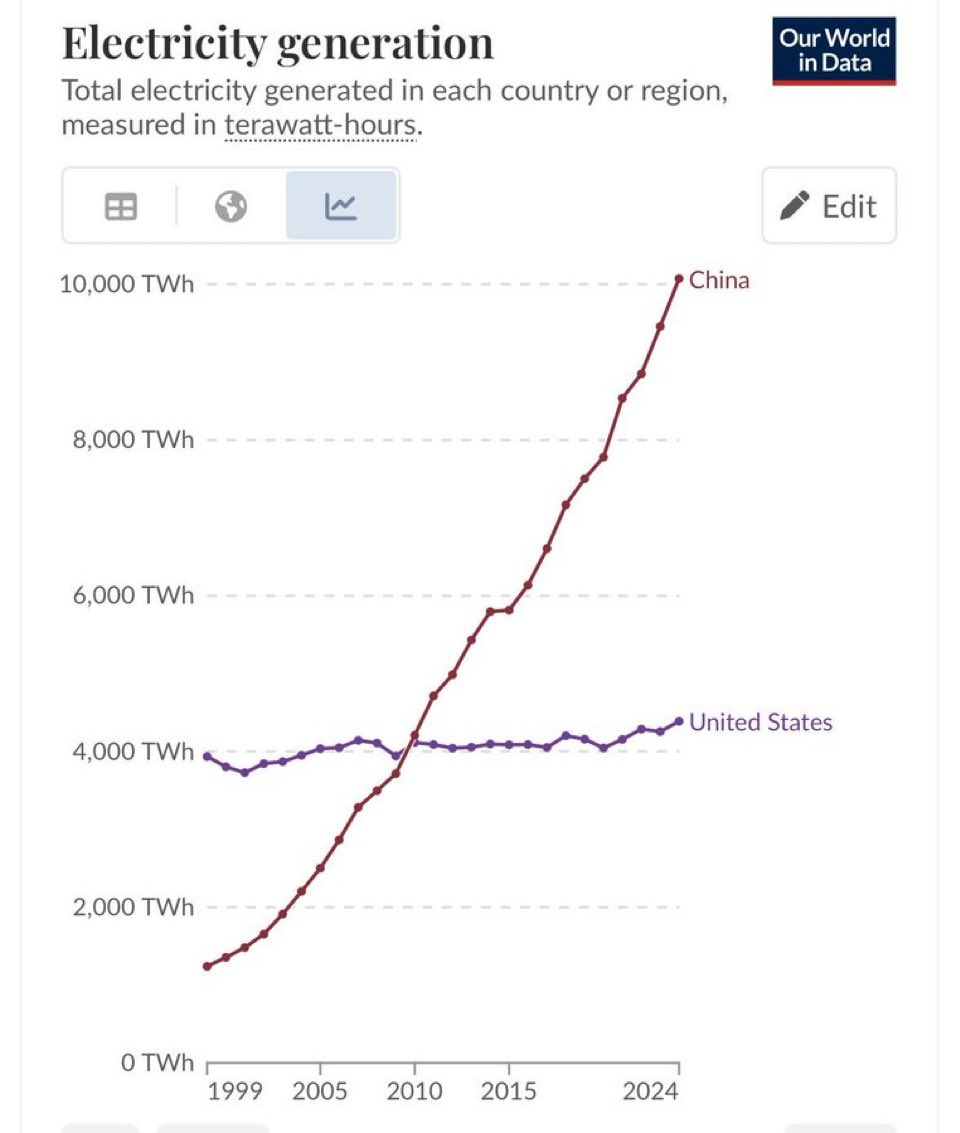
The big problem with this graph is that as AI gets reduced to computation power, it further gets reduced to electricity to power the data centers that house the computation.
The US is still ahead in model sophistication and quality but we are way behind on electricity generation which could catch up with us.
Need to pay close attention to this and make sure we incentivize every form of electricity generation, storage, transmission and distribution.