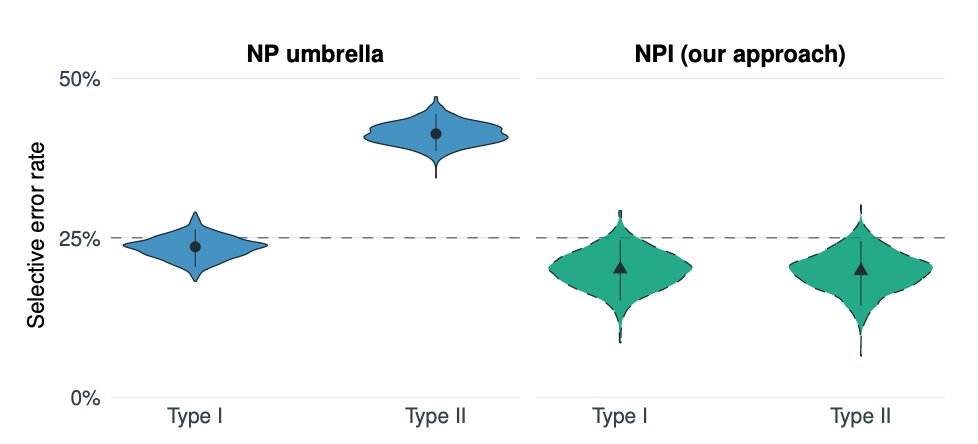
Even the best AI can make too many mistakes. Our new work, NPI, lets models defer difficult cases to humans. Martingale theory gives simultaneous, finite-sample, high-probability control of selective type I (false alarm) and type II (missed signal) errors.
https://t.co/nUpTtflTtu
Generative AI does not come with rigorous uncertainty quantification, but nevertheless, society trusts it more than most modern statistical methods. Our community has a strong role to play moving forward, but we need to adapt in order to achieve it.
their work in order to keep up with the pace of current research.
I fear that the people who will be hurt the most are junior researchers. More senior faculty members have years of non-AI work to demonstrate their abilities. However, junior faculty members no longer...
I am not sure what the answer is, but I do think we, as a community, need to actively solve these problems. If anything, generative AI has shifted my perspective on the true value of uncertainty moving forward...
everyone is racing to publish their next paper or to extend prior methods and theory, all based on our old benchmarks of high quality. However, in the age of generative AI, our old benchmarks seem inadequate. Most researchers I know feel forced to use generative AI to continue...
generate novel and accurate statistical methodology that is customised to a practitioner's specific problem, with theory to support it. If this is the case, we need to shift the value proposition that we offer and how we present our work. As it stands...
to adapt to this new environment.
Top journal articles that would have previously taken a year or more to write can now be completed in a fraction of the time, and with enough care, without sacrificing accuracy. If AI continues to progress, I suspect that we will be able to...
After years of hard work, my paper "A Burden Shared is a Burden Halved: A Fairness Adjusted Approach to Classification" has finally been accepted to JASA T&M!
https://t.co/qkMsOk1lyt
Curious to know more? Check out our research paper below!
https://t.co/InZf5z6MRd
Also feel free to see @jonstewart 's rant below (it starts around the 14 minute mark)
https://t.co/UG4H4ORq1C
Win probabilities can be surprisingly painful to interpret, just ask @jonstewart from the @TheDailyShow! He recently complained about ESPN’s win probability charts for the Chicago Bears vs the NY giants. Don't worry @jonstewart, it isn't your fault! Luckily, we have solutions.
In our paper “Irrational Exuberance: Correcting Bias in Probability Estimates” (with @GarethMJam and Peter Radchenko), we introduce an empirical Bayes approach called Excess Certainty Adjusted Probabilities (ECAP). ECAP adjusts probability estimates to better reflect reality.
@iCe_apps_Wey You can either build fairness directly into the algorithm, or you can take a powerful, existing model and apply a post-processing layer to adjust its outputs and enforce fairness. Both paths involve trade-offs, and my current research focuses specifically on the second approach
Even when algorithms are highly accurate overall, there is a danger that it makes far more mistakes for some groups than others, which could result in an unintended form of discrimination.
Check out a new article below about one way we can address this!
https://t.co/1cttGde9Qw
I will be giving a seminar in the Math Department at the University of Southern California on January 17th. I’d love to catch up with as many people as possible while I’m on campus. Also, feel free to attend the talk!
https://t.co/tvW892mFbR
This is a new pre-print with my coauthors @Ndaoud12 and Peter Radchenko. I’ll be giving a talk about it this Thursday at 5:45pm at the Meeting in Mathematical Statistics at the International Centre Meetings Mathematics in Marseille.
Your AI algorithm can be as confident as you want it to be! The key? Let AI handle what it’s confident at and involve humans for the hardest cases. It turns out, you can dramatically gain in accuracy for the price of little indecisions! https://t.co/VFKfhkTV71
Thank you to @Sydney_Uni & @Cornell for providing Dr. Dana Yang and I funding through the Global Strategic Collaboration Award. Our proposal was about the intersection of creativity, AI content generation, and rigorous statistical guarantees.
It’s great to see that my work on FASI is becoming a popular topic in the media! Check out this nice conversation about it below 😊.
Admittedly, this is AI generated! But I’m quite impressed with the results.
https://t.co/ZrKGZmQflu