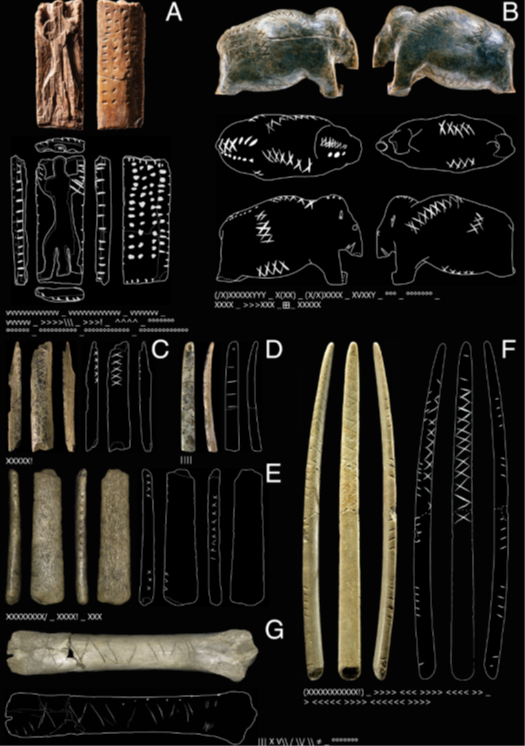
Humans might have developed a system of conventional signs already 40,000 years ago (with sign sequences having a complexity comparable to the earliest protocuneiform)
https://t.co/CFcivlP2ly
In episode 689, I talk with Dr. Michael Tomasello about his fascinating book, The Evolution of Agency: Behavioral Organization from Lizards to Humans. #Biology#psychology#Science
https://t.co/ofxmwD1Ya8
Link here to a preprint of my short article about consciousness, "biological naturalism," and electrical brain rhythms published by @IAI_TV earlier this year.
Preprint: https://t.co/4HgaLu9XP6
Original (no longer open access): https://t.co/YdFdWVQp4s
La bipedación y la expansión neuroanatómica se han identificado como probables impulsores clave de la lateralización humana, la preferencia por la mano derecha:
Bipedalism and brain expansion explain human handedness https://t.co/DDk5uayxIS
"cognitive differences between Neanderthals and amHs would have comfortably fit within the range found among modern human populations—which are generally not considered evolutionarily significant"
Neanderthal brain and cognition reconsidered https://t.co/k2eoHxYRNv
INTELIGENCIA NEANDERTAL
La comparación de los cerebros de neandertales y sapiens cuestiona la idea de que nuestra especie sustituyó a los neandertales por ser más inteligente
📰 https://t.co/GD6ddnn1kJ
vía @larazon_es#Paleoantropologia#Homininos
A global screen for magnetically induced neuronal activity in the pigeon brain by Gregory C. Nordmann, @spencerbalay et al
How do birds navigate?
This whole-brain screen suggests a route from inner-ear physics to neural activity.
https://t.co/TJ8LGmFTZV
“Not only do different orca groups have different cultures, they’ve evolved biologically in response to those cultures. This is the first confirmed case of gene-culture coevolution in a nonhuman animal.”
https://t.co/JP8E3LjPEc
Why do humans exhibit such a striking right-hand preference? We studied 41 anthropoid species, revealing #Homosapiens as an evolutionary outlier & identifying #bipedalism & #brain expansion as likely drivers of human lateralization @plosbiology.org 🧪 https://t.co/8KpBdau14I
Escaped the snow in Baltimore to go to the #Scialog conference in Neurobiology and Changing Ecosystems in Tucson, Arizona.
Excited for 4 days of networking and lots of science chats with other #ScialogFellows!
Thanks @RCSA1 for this opportunity!