Just heard a news article on the BBC about this review. Agree with ARUK on this I get the impression the authors had made their minds up before writing. The issues I have with it are (1) a reliance on absolute benefits rather than relative or modelled change over disease course…
Bombshell: Oliver Sacks (a humane man & a fine essayist) made up many of the details in his famous case studies, deluding neuroscientists, psychologists, & general readers for decades. The man who mistook his wife for a hat? The autistic twins who generated multi-digit prime numbers? The institutionalized, paralyzed man who tapped out allusions to Rilke? Made up to embellish the stories. Probably also: the aphasic patients who detected lies better than neurologically intact people, including Ronald Reagan's insincerity. https://t.co/77nQRF8kp6
We are hiring a substantive consultant neurologist to join our fantastic regional MND service. Please get in touch through the advert if you are interested
https://t.co/tOhR4MWbo8
NPTX2 is emerging as a key neurodegeneration biomarker, but measurement tools are limited. We developed a low-volume, automated Simoa assay for its quantification in CSF #biomarkers#neurodegeneration
https://t.co/tjukHVl7qd
👀Using an autonomous agent based on o3-mini and GPT-4.1, a team from Harvard, MIT & other institutions reproduced and updated an entire issue of Cochrane Reviews in two days… saving 12 person-years of work!
The AI reviews captured more papers & were more accurate than humans.
Manohar et al. show that wearable sensors tracking everyday movements combined with machine learning models can accurately capture symptoms and disease progression in cerebellar ataxias. https://t.co/9XwvsfwSam
Today @NEJM
Challenging dogma for routine surveillance imaging after cancer treatment
The results of 12 randomized trials show no survival benefit, despite scans leading to more chemotherapy, surgery and radiation
https://t.co/IBhYfgv7Vz
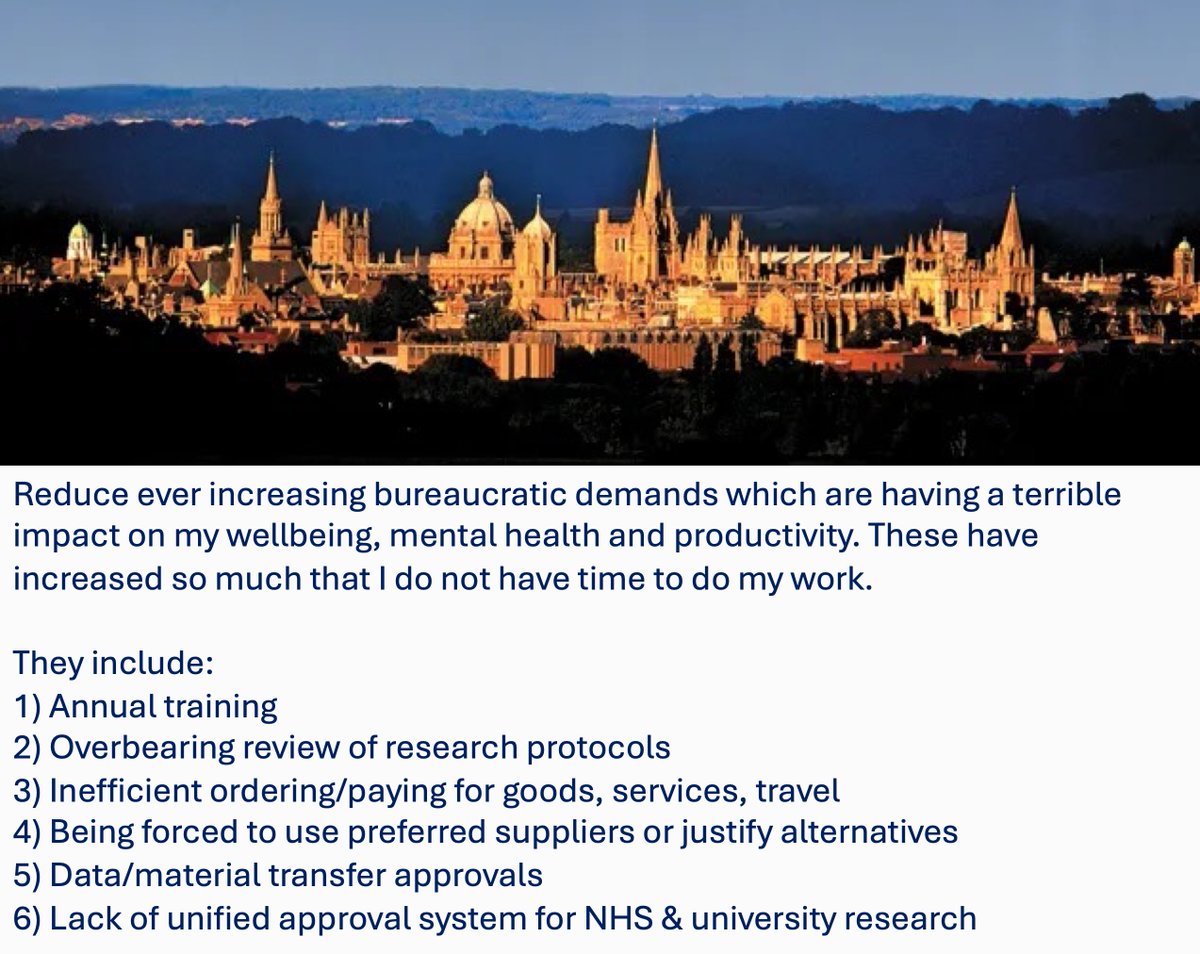
At @UniofOxford it's time for the staff survey. Here's my answer to: "What is the main thing the University could do to help you to progress your career?"
Please RT and respond similarly to the survey if you agree. It's the only way to get our points across!
New *Funded PhD opportunity* for UK students to work with me at UCL (London), researching auditory training interventions to improve speech understanding in noisy environments. Deadline 28th April. Full details: https://t.co/IWvQlE3WCG @SHaPS_UCL@UCLPALS [please RT]
Some people today are discouraging others from learning programming on the grounds AI will automate it. This advice will be seen as some of the worst career advice ever given. I disagree with the Turing Award and Nobel prize winner who wrote, “It is far more likely that the programming occupation will become extinct [...] than that it will become all-powerful. More and more, computers will program themselves.” Statements discouraging people from learning to code are harmful!
In the 1960s, when programming moved from punchcards (where a programmer had to laboriously make holes in physical cards to write code character by character) to keyboards with terminals, programming became easier. And that made it a better time than before to begin programming. Yet it was in this era that Nobel laureate Herb Simon wrote the words quoted in the first paragraph. Today’s arguments not to learn to code continue to echo his comment.
As coding becomes easier, more people should code, not fewer!
Over the past few decades, as programming has moved from assembly language to higher-level languages like C, from desktop to cloud, from raw text editors to IDEs to AI assisted coding where sometimes one barely even looks at the generated code (which some coders recently started to call vibe coding), it is getting easier with each step.
I wrote previously that I see tech-savvy people coordinating AI tools to move toward being 10x professionals — individuals who have 10 times the impact of the average person in their field. I am increasingly convinced that the best way for many people to accomplish this is not to be just consumers of AI applications, but to learn enough coding to use AI-assisted coding tools effectively.
One question I’m asked most often is what someone should do who is worried about job displacement by AI. My answer is: Learn about AI and take control of it, because one of the most important skills in the future will be the ability to tell a computer exactly what you want, so it can do that for you. Coding (or getting AI to code for you) is a great way to do that.
When I was working on the course Generative AI for Everyone and needed to generate AI artwork for the background images, I worked with a collaborator who had studied art history and knew the language of art. He prompted Midjourney with terminology based on the historical style, palette, artist inspiration and so on — using the language of art — to get the result he wanted. I didn’t know this language, and my paltry attempts at prompting could not deliver as effective a result.
Similarly, scientists, analysts, marketers, recruiters, and people of a wide range of professions who understand the language of software through their knowledge of coding can tell an LLM or an AI-enabled IDE what they want much more precisely, and get much better results. As these tools are continuing to make coding easier, this is the best time yet to learn to code, to learn the language of software, and learn to make computers do exactly what you want them to do.
[Original text: https://t.co/HdI3Jb9HmF ]
@MasudHusain@NIHR@wellcometrust@UKRI_News And this makes it incredibly difficult to run clinical observational studies that are not drug trials. The institutions have no financial incentives to support them.
Clinical research in the UK is under threat, partly because it takes so long to get a study or trial approved. Here are some of my suggested solutions in this BMJ Opinion piece @NIHR@wellcometrust@UKRI_News
https://t.co/WGUSjJL7qa
Compare this ridiculous example with statements on ~40% of dementia can be prevented by changing lifestyle factors. This fact seems almost universally accepted by the dementia field, but RCTs are not so convincing (almost all negative).
Wow. I cannot believe it. Just asked Claude to make the dogfight ultra realist!
✅ hit impacts
✅ smoke when damaged
✅ explosion on death
✅ free-fall with smoke
It feels so good to fly! + awesome plane and controls, 100% in Cursor with 0 code edition from me. LOOK AT THIS!
Why academia is sleepwalking into self-destruction. My editorial @Brain1878 If you agree with the sentiments please RT. It's important for all our sakes to stop the madness
https://t.co/5S5rL8Yda1