@ideologicalized I’m researching that Leucovorin is to treat folate deficiency, which is a separate disorder from ASD, though 60% of kids who have ASD have FRAA (folate deficiency). It’s not treating autism, it’s treating FRAA
America chose the rapist, not the woman.
America chose the racist, not the Person of Color.
America chose the criminal, not the prosecutor.
America chose division, not unity.
America chose regression, not progress.
America chose fascism, not democracy.
Absolutely shameful.
BREAKING: https://t.co/JQWy2gTfhs just dropped a new track titled "Yes She Can"—and yes, “She” is Kamala Harris.
This is the anthem America needs to hear right now.
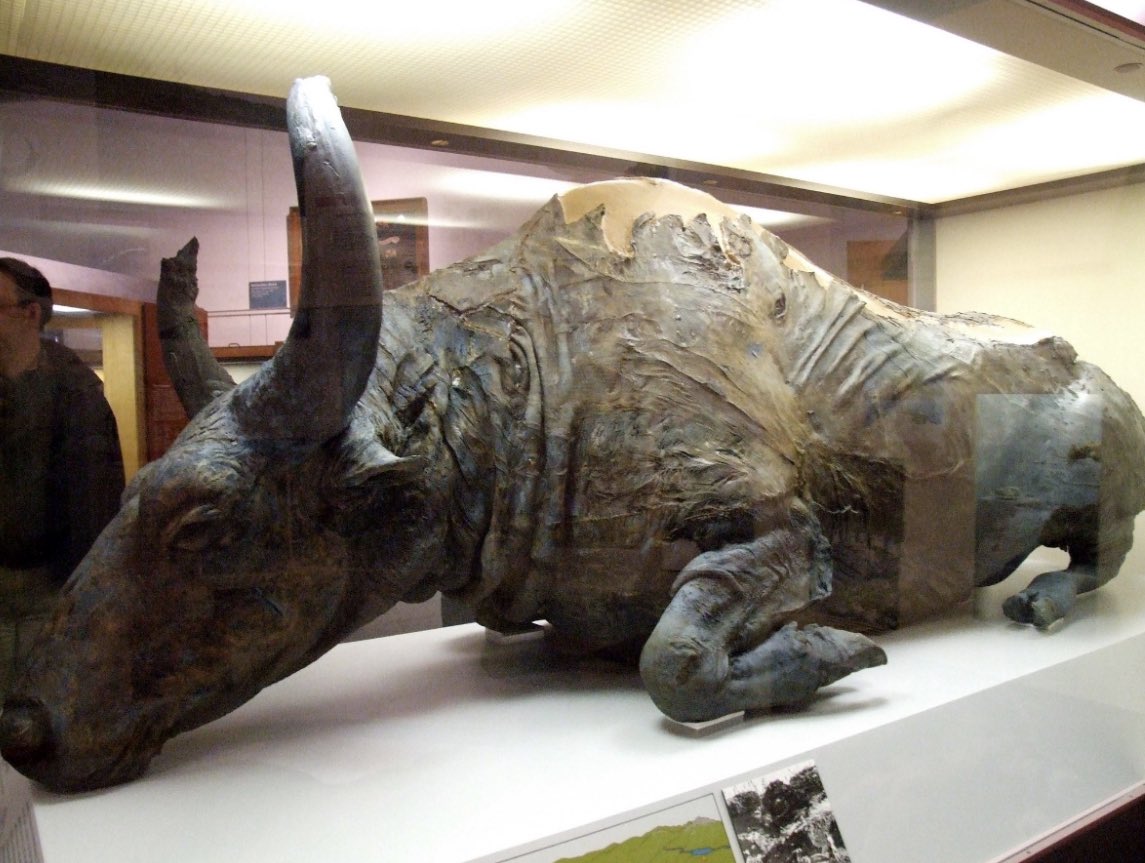
In 1979, a remarkable discovery was made by gold miners in the vicinity of Fairbanks, Alaska. Instead of gold, they stumbled upon a frozen specimen that turned out to be an exceptionally well-preserved creature from the last ice age. Extensive examination at the University of Alaska initially estimated its age to be around 36,000 years old, but more recent evaluations suggest that the animal actually lived at least 55,000 years ago.
The creature, known as an ice age steppe bison, was unearthed by the gold miners and is now permanently exhibited at the University of Alaska Museum of the North. Evidence indicates that it met its demise at the jaws of the extinct Ice Age American lion, Panthera leoatrox. During the excavation, a chalky blue substance, resulting from the interaction between phosphorus from the animal tissue and iron in the soil, was discovered. It was this peculiar find that earned the creature the nickname "Blue Babe."
While the discovery of frozen animals from the last ice age is uncommon but not unprecedented, it never fails to provide an unparalleled window into the past. In the case of the frozen ancient animal found in Alaska, there arose a curious question: What would such an animal taste like after millennia in deep freeze? In 1984, Dale Guthrie, a paleontologist from the University of Alaska Fairbanks, decided to satisfy his curiosity and invited some friends to join him in an unconventional tasting experiment.
Inspired by the Russian scientists who had successfully consumed frozen bison and mammoth found in a similar state, Guthrie and his team embarked on their culinary endeavor.
They cut a small portion of meat from Blue Babe's neck, which had freeze-dried while still fresh, and once thawed, emitted a faint beef-like aroma. Approximately a dozen individuals attended the dinner party, where they collectively partook in the preparation and consumption of the ancient meat stew. The verdict? The stew, made from the meat of the ice age bison, was deemed "okay" in taste, and fortunately, no one fell ill from indulging in this extraordinary Ice Age meal.
If you really want it, you’ll make it happen, says Dr. Danielle May of @NASA_Langley.
Learn about her journey of perseverance: https://t.co/sXcYJFgyJC #WomensHistoryMonth
@RonFilipkowski It’s their whole angle, act out in court until the judge reprimands them and then call foul. That’s not how it works. There’s a certain way to object, testify, and present evidence in court, and defense is purposefully doing it wrong to creat problems
@nicksortor What if they’re at the surface and trying to bang through the hull to get out? The sub can only be opened from the outside so if they’re at the surface they can still suffocate
@TalkTV@JuliaHB1 What if they’re at the surface and trying to bang through the hull to get out? The sub can only be opened from the outside so if they’re at the surface they can still suffocate
@MelanieMoore What if they’re at the surface and trying to bang through the hull to get out? The sub can only be opened from the outside so if they’re at the surface they can still suffocate