I built a 3D game engine that pushes browser performance to its limits. A new algorithm, written with Claude Fable 5.2, lets the browser use GPU and CPU more efficiently for objects, textures, and lighting. Demo: a night walk in Midtown.
Play: https://t.co/H6c7urQFVG
I built a 3D engine that pushes browser performance to its limits, and developed a new algorithm, written with Claude Fable 5.2, that lets the browser allocate GPU and CPU resources more efficiently for rendering objects, textures, and lighting.
Play: https://t.co/H6c7urQFVG
I built a Deadlock card game with Claude that runs in the browser: 22 heroes, 150+ item cards, an AI rival, an 8-lesson tutorial and a story run across New York. Free and unofficial, a fan project not affiliated with Valve.
Play: https://t.co/gUY0nZVdYM
I built an open-source Mac app in the style of Claude Code, written with Claude. Its Dreaming reads my past sessions once a day and proposes new skills, memory and mods for me to keep, so the app gets better the more I use it.
Try it: https://t.co/KdD6zQEGM9
I built an open-source Mac app like Claude Code that runs any model, fully local with Ollama or hosted. Once a day it dreams over my past sessions and proposes new skills, memory and mods, so it gets better the more I use it.
Try it: https://t.co/KdD6zQE8WB
I built an open-source Mac app like Claude Code that gets better the more you use it. Once a day it dreams over my past sessions and proposes skills, memory and mods. Here it adds rate limiting, runs the tests, then builds itself a new panel.
Try it: https://t.co/KdD6zQEGM9
I made a free Deadlock card game you can play in your browser. Draft three heroes, build a deck from the item shop, spend souls to gear them up and push down the rival's Patron. Unofficial fan project, not affiliated with Valve.
Play: https://t.co/gUY0nZUG9e
I used Claude Fable 5.2 to build a 3D engine that pushes browser performance to its limits. Its new algorithm lets the browser allocate GPU and CPU resources more efficiently for objects, textures, and lighting. One demo, Night NYC Walk:
Play: https://t.co/H6c7urQ868
I built a 3D engine in Claude Code that pushes browser performance to its limits. With Fable 5.2 I developed a new algorithm so the browser spends GPU and CPU more efficiently on objects, textures, and lighting. Here is a night walk in it.
Play: https://t.co/H6c7urQFVG
I built a game engine optimized for browser games with @claudeai Fable 5.2. Here's one demo, Night NYC Walk: Midtown's buildings in 3D from OpenStreetMap data with PBR scans, clustered lights, volumetrics, ray-marched reflections, TAA and bloom.
Play: https://t.co/H6c7urQ868
I built Silo Harness: a RSI agent harness that can learn and adapt to my daily FDE job patterns.
Once a day it "dreams" over your past sessions and proposes skills, memory and mods.
#builtwithclaude
https://t.co/EWOkob5c6J
@ustare Pretty smooth. The height data is ground-only, so buildings don't make bumps, and I smooth each street so the roads stay clean. Past the playable area it's just distant hills.
The Bay Bridge is exactly where it should be. That was harder than making the car fly.
A browser game over real San Francisco: OpenStreetMap streets, USGS hills, 250 AI cars that stop at the lights. Hold Space to lift off.
Play it: https://t.co/woy1U7ZIH5
@mappingthings Both, mostly the tags. OpenStreetMap marks which roads are bridges, and the game works out their heights so slopes stay gentle and cars fit underneath. Only the Bay Bridge's main span is set by hand.
@Joel_mystec Thanks! The streets come from OpenStreetMap. I download them once and save them as one small file, and the game builds the roads from that when it loads.
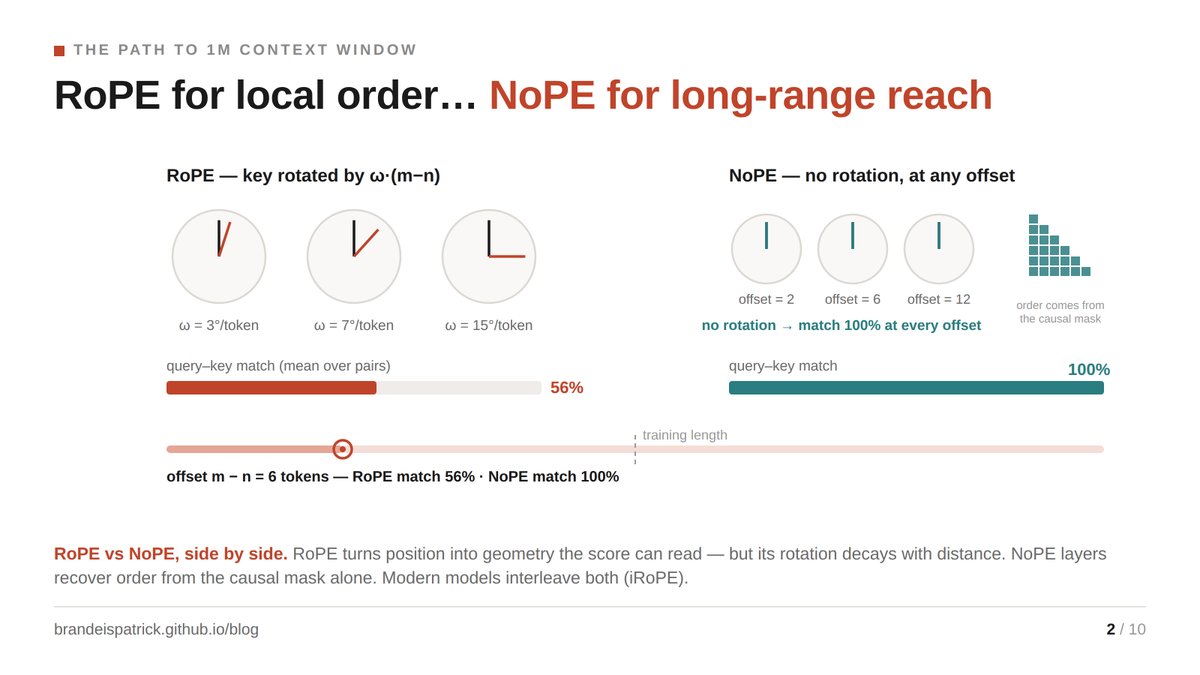
Advertised context is not effective context. Single-needle retrieval survives to the edge of the window; reasoning over the whole context gives out far earlier. The 1M window is here - its post-training is not.
Full essay (19 figures): https://t.co/Oc8To5LBtE
The context window is the most important parameter in modern LLMs. It determines how long a model can reason, how many rounds of iteration a task can get, and how much post-training can specialize. In five years it grew from 2K tokens to 1M. A thread on what had to change.
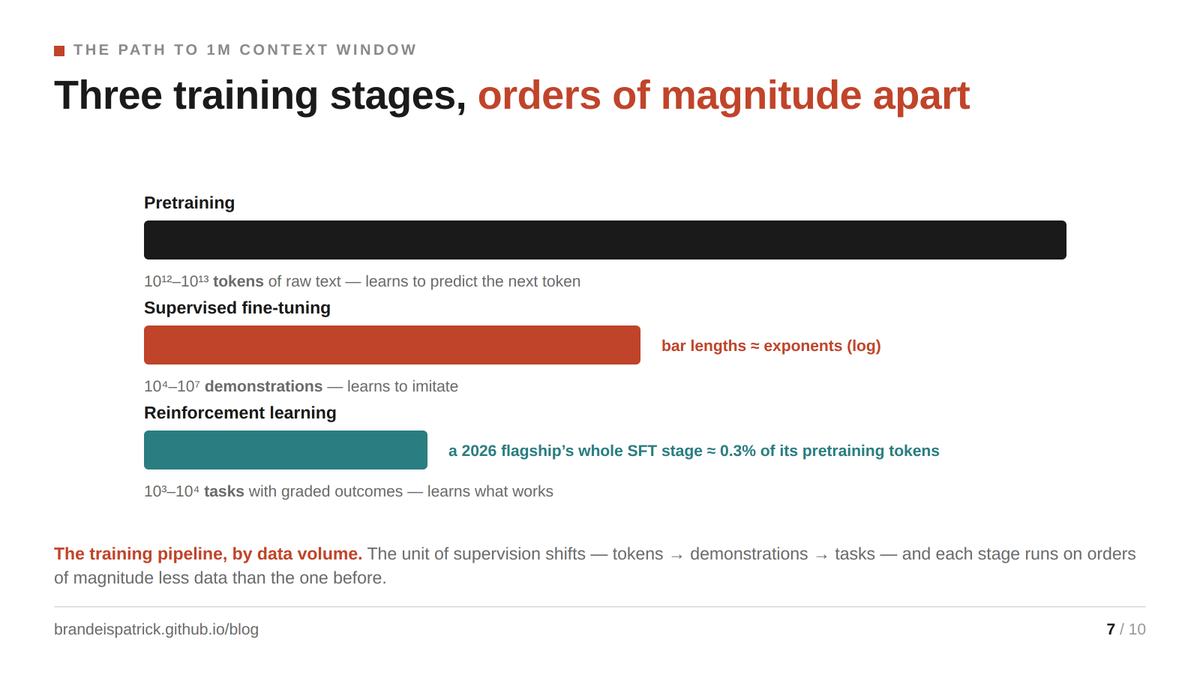
The data tells its own story. Pretraining runs on trillions of tokens; SFT on thousands to millions of demonstrations; RL on thousands of tasks. The longest published post-training samples stop at 4K-512K while shipped windows grew to 10M. Windows outran the data behind them.