PA Gov. Shapiro signed an EO today converting his voluntary GRID standards into binding requirements which include local approval before state permits, bring-your-own-power, and community benefit agreements.
The tightening of datacenter permitting standards only makes approved and permitted capacity more valuable. I expect cap rate compression for stabilized datacenters and a valuation premium for sites with ample natural gas availability that can be tapped for behind-the-meter expansion capacity. $CIFR $HUT $KEEL $CORZ
https://t.co/hHDKoiPTkX
Unlikely candidate behind some anti-datacenter movements: other datacenters
"There could be smaller games being played where competition at the frontier is fierce." says @BrandonKBailey_, @Dimetrics_ founder
One of the most interesting things from this manifesto to me was Zuck’s comment that $META will offer “a dynamic auction mechanism that will guarantee that everyone gets the lowest price possible” for compute.
This sheds some light on how they may be thinking about monetizing excess compute. Instead of building a cloud or a GPU rental business like a traditional neocloud they will build an auction house for compute.
Why go for an auction, because selling compute the neocloud way makes you a price-taker on a commodity. A handful of counterparties, thin spreads, and you’re competing with everyone who owns a datacenter.
With an auction you need thousands or tens of thousands of bidders, continuously. Neoclouds have five customers. Meta has 3B+ users and millions of advertisers already sitting inside a bidding interface. Meta is the only company that can stand up a liquid compute market on day one, because it already runs one of the largest auctions with its ads auctions.
The compute auction would effectively be the inverse of its ad auction. Instead of advertisers bidding for scarce attention, users bid for scarce FLOPs. Same clearing engine, same billing rails, same second-price logic.
Two major benefits of this model / approach:
1. Latency becomes the bid dimension. “Answer now” clears at peak. “Have it by morning” clears in the 3am trough. Meta monetizes capacity a fixed allocation contract can’t reach.
2. Meta’s own workloads bid too. ads ranking, self-improvement, consumer inference. That produces an internal shadow price for compute, which turns capex from committee judgment into arithmetic. Clearing price above all-in cost per GPU-hour, build more. Below it, stop or slow growth.
Zuck framed it as directing capacity toward what people collectively find most valuable. I interpret that as: he’d rather set the price of intelligence than sell it wholesale.
Structurally, this is a power market. Supply is fixed short-run. So price is at the marginal cost until demand hits the ceiling, then spikes. Jobs that can wait get scheduled for overnight or a lower demand timeframe. Free-tier requests get bumped when paying demand shows up.
The power and energy market has a name for every one of those: scarcity pricing, demand response, interruptible load. Meta is going for ERCOT for inference with their auction model.
More than that Meta wants to be Henry Hub for compute. As the spot price from their auction becomes the backbone from what the forward curve gets built on. Giving Meta a chance to become the de facto clearing house.
I believe everyone should have access to superintelligence, and I wrote a long piece about Meta's philosophy and values for building a positive future for everyone. https://t.co/2ZoNZXZ39T
Anti-datacenter community pushback can miss this bigger picture: massive new tax revenue & community investment
@BrandonKBailey_ says this applies "especially in smaller counties"
I’m getting pretty bullish on $META AI and compute business prospects, this is a long race and I think they have a lot compelling opportunities in the medium to long-term.
It’s ironic to me that coldcard users and bip-110 supporters probably overlap quite a bit.
If there wasn’t such strong opposition for keeping Blockspace a free market (ie hatred for JPEGs), we would have likely had some covenants software activation like CTV+CSFS which would have allowed us to create vaults. Which would provide for materially better security for self-custody.
But now here we are, the status quo has risk, doing nothing has risk. Asking users to TRUST 3rd parties for the security or with self-custody is much riskier imo than improving the protocol to give users and companies better tools for security and self-custody.
Ossification sounds nice in theory but it isn’t realistic. Bitcoin isn’t a complete piece of software and these type of incidents to me only prove that bitcoin isn’t ready yet to be a true SOV for people’s savings or wealth at least in a sovereign way with any type of scalability.
It’s time for covenants on bitcoin, the coldcard hack is worse than any theoretical “bugs” or gamification related to CTV + CSFS https://t.co/SlG2bLzDF1
Bullish on $HUT I also believe @ashergenoot has a few tricks up his sleeves. I’m thinking pretty critically about what the company can do with highrise ai especially given Huts recent lease signings with $NVDA and their new financing programs for compute and neoclouds. Plus the playbook they used with their mining operations and $ABTC
Hut 8's 500 MW Logan Prairie campus has been stuck in Logan County, IL politics for 8 months. The county passed a 12-month moratorium in May. Its own State's Attorney recently declared it invalid.
Now $HUT gets two attempts to move the project forward in one week:
Aug 3: the Village of Latham votes on annexing the site bypassing the county entirely, with an $8–11M/yr community benefit agreement on the table.
Aug 6: the county ZBA hears the refiled application, grandfathered from any new ordinance. The full board vote would occur some time in Aug–Sep.
The upside case: Hut 8 just fully leased its 1 GW Beacon Point campus 704 MW IT, $19.6B in base-term contract value, $50B+ with renewals. Apply those economics to 500 MW and Logan Prairie is a ~$10B TCV asset sitting behind a single land-use vote with an Ameren interconnection agreement already secured.
Hut 8 has said further delay risks the Ameren agreement expiring. So next week could be make or break for the Logan Prairie project.
For jurisdictions restricting data center development we track it live at https://t.co/MmhogsQIHe
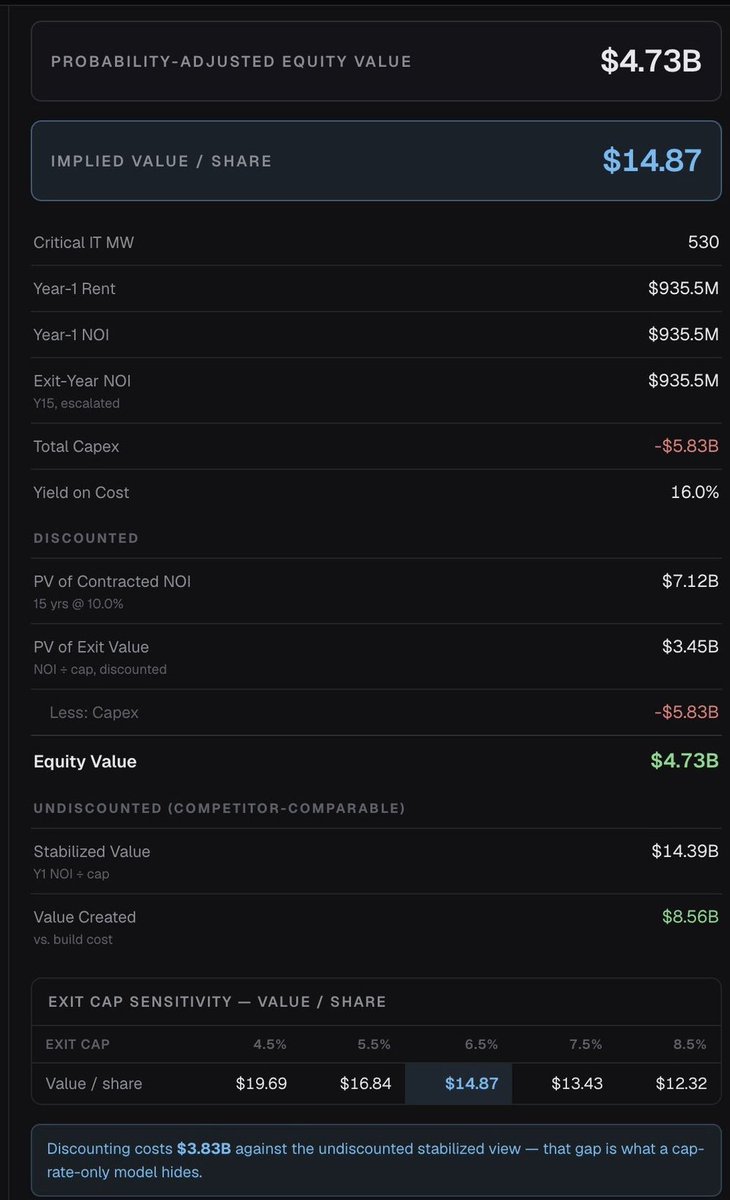
Estimated equity value of $CORZ new $AMD lease assuming its triple net.
Get access to dimetrics HPC and GPUaaS lease calculator at https://t.co/FSslQZbuJe
$ANY is the only green Bitcoin Miner / power shell company on the day. @mikealfred recently initiated a starter position on the company with 199,000 shares after a constructive meeting with the CEO Joel Block.
https://t.co/ZaAYYEQ5DV
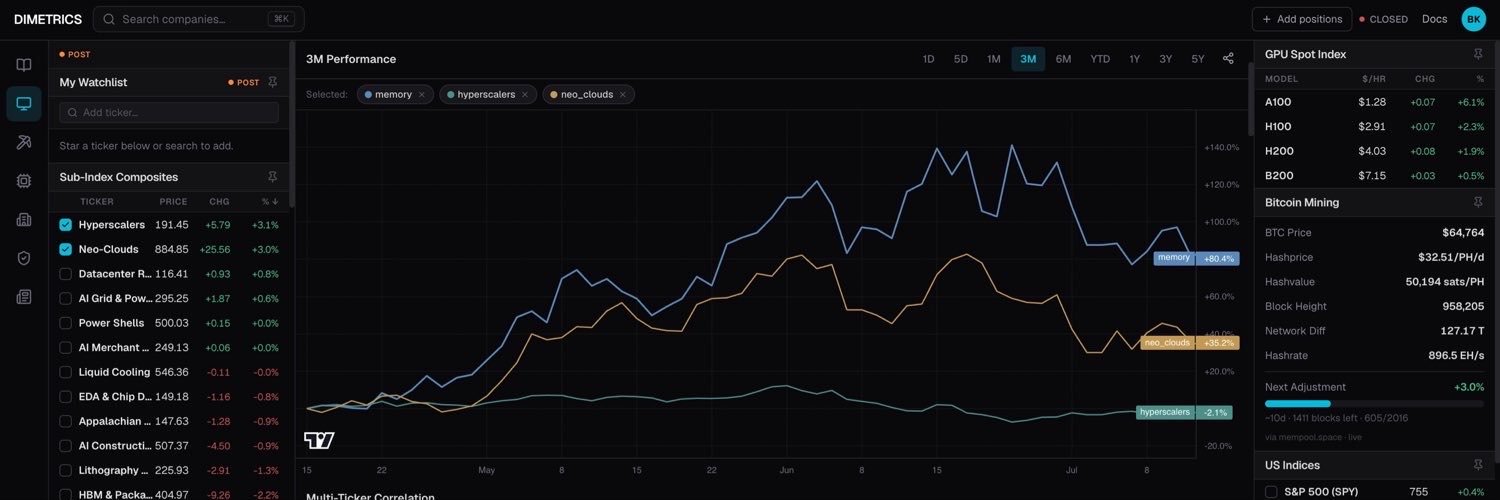
$BTC vs the AI trade over the last month. BTC continues to be largely inversely correlated with the AI trade. This is a trend to continue to watch in the near to medium term especially if this earnings season continues to produce several capex revisions higher (which i think it will) we may see a more aggressive rotation trade back out of $BTC and crypto back into certain AI related names.
With $GLXY latest round of financing there’s a pretty clear trend of a 3-4% spread between hyperscaler offtake and neocloud offtake for colocation leases.
$GLXY prices $3.5B at 9.875% for Helios Phase II with CoreWeave as tenant…compare to $CIFR at 6.125% (Black Pearl/AWS) and 6.0% (Stingray/AWS), $APLD at 6.75% with an IG hyperscaler at Polaris Forge 2 vs 9.25% on its CoreWeave buildings, $WULF at 7.75% with Google standing behind Fluidstack at Lake Mariner. Theres a about 3-4% spread between hyperscaler offtake and neocloud offtake.
Dimetrics Pro plan gives you access to the MCP with every HPC lease linked to the debt that finances it, SEC-sourced, queryable in Claude/ChatGPT https://t.co/ZwYZr7PQJ8
Neclouds revenue backlog continues to grow at an impressive clip with $GOOG and other hyperscalers likely increasing capex forward guidance $NBIS $IREN $CRWV $WYFI stand to benefit.
Create a free account at https://t.co/Vs4bNnA1eP