🧠Estamos Interpretando Bien la PIC? 👀
〰️Morfología de Onda
🤯Compliance Cerebral
🩸Autorregulación
📊Neuromonitoreo Multimodal
📖Intensive Care Medicine 2026
Artículo Completo👇🏻✅🆓
https://t.co/aR5SFK2xfj
A clinician’s guide to corticosteroid therapy in pneumonia and critical illness: agent selection, dosing, monitoring, and interactions
CCR Journal Watch
https://t.co/Sp06oA6IDG
Today's Paper of the Day is:
Mechanical Ventilation in Patients with Acute Brain Injuries: A Pathophysiology-based Approach
https://t.co/JKgcYjlUQ5
Join us to read 1 paper per day and stay up-to-date as we cover the spectrum of critical care across 2026
🫁 Not every patient who meets ARDS criteria actually has classical ARDS.
A very practical 2026 article in Intensive Care Medicine addresses an important problem in the ICU: the ARDS mimicker.
Modern ARDS definitions are intentionally clinical. This makes them useful at the bedside, but it also means that very different diseases can produce the same syndrome of acute hypoxemic respiratory failure and bilateral pulmonary opacities.
Approximately 8% of patients meeting ARDS criteria have no identifiable classical risk factor. In these patients, simply labeling the condition "ARDS" may delay recognition of a potentially treatable underlying disease.
When should we suspect an ARDS mimicker?
The authors emphasize three important clues: absence of a conventional ARDS risk factor, a subacute presentation, and extrapulmonary manifestations or diffuse alveolar hemorrhage.
The differential diagnosis can be organized into four major groups:
Immune mediated disease: inflammatory myopathies, ANCA associated vasculitis and anti GBM disease.
Drug induced lung injury: particularly amiodarone, chemotherapy, mTOR inhibitors and immune checkpoint inhibitors.
Malignancy: including hematologic malignancies, carcinomatous lymphangitis and lepidic adenocarcinoma.
Idiopathic inflammatory lung disease: particularly acute eosinophilic pneumonia and organizing pneumonia.
The diagnostic strategy should therefore extend beyond oxygenation and ventilatory mechanics.
History and physical examination remain fundamental. Look specifically for skin, renal, muscular and articular manifestations, and perform a meticulous medication review.
Chest CT and bronchoscopy with BAL can then help identify patterns suggesting diffuse alveolar hemorrhage, organizing pneumonia, hypersensitivity pneumonitis or other processes. Importantly, these radiological and BAL patterns are not disease specific and must be interpreted within the clinical context.
Some findings should trigger an urgent diagnostic pathway.
Diffuse alveolar hemorrhage should prompt ANCA and anti GBM testing.
Muscular, cutaneous or articular manifestations should trigger investigation for connective tissue disease and myositis specific antibodies.
Suspected drug induced injury requires careful exclusion of infection, particularly in immunocompromised patients.
One particularly important mimicker is inflammatory myopathy associated lung disease. Antisynthetase syndrome and anti MDA5 dermatomyositis can present with rapidly progressive respiratory failure, sometimes without obvious extrapulmonary manifestations. In critically ill patients the prognosis is poor, with ICU mortality approaching 50% in the cited cohort.
Reference 📚
Bay, 2026. https://t.co/m1EM3o0TNd
Today's Paper of the Day is:
Lance–Adams syndrome or chronic post-hypoxic myoclonus in adults
https://t.co/JKgcYjlUQ5
Join us to read 1 paper per day and stay up-to-date as we cover the spectrum of critical care across 2026
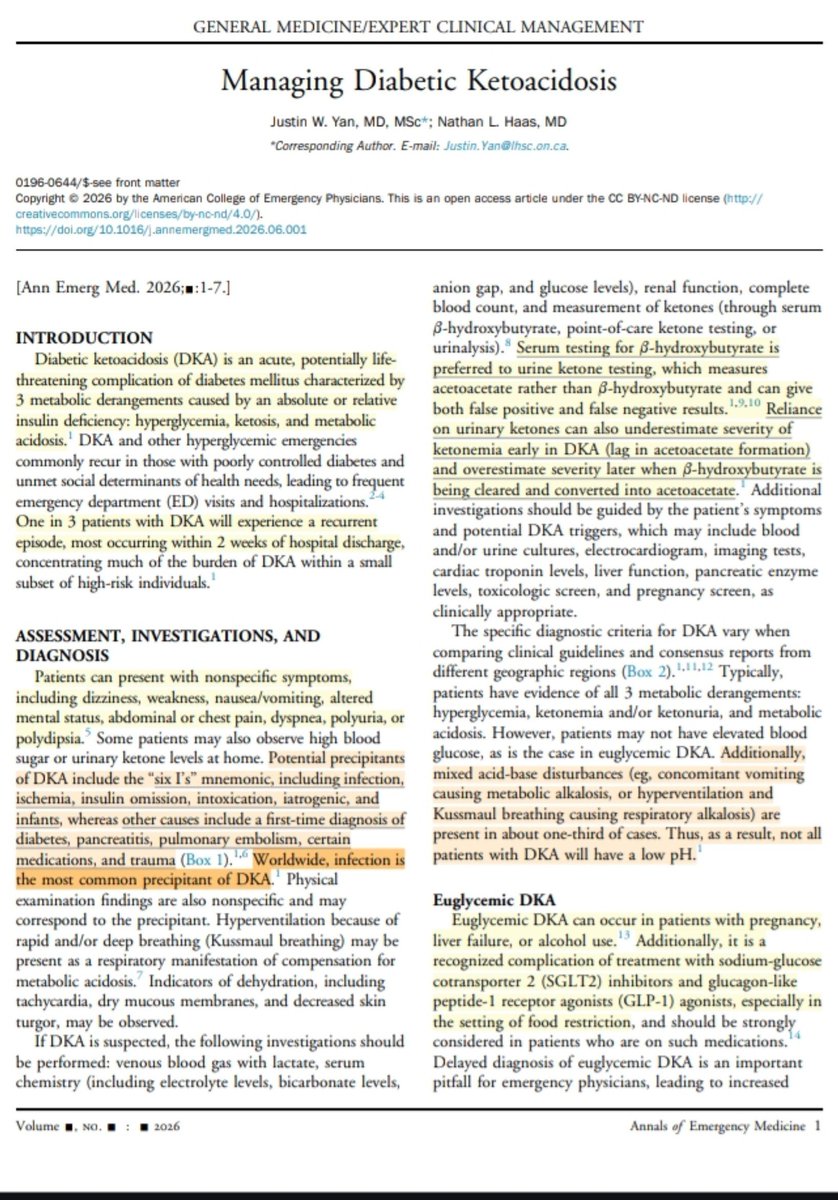
🩸CAD..No Todo es “Líquidos + Insulina"
💧Qué Solución Elegir?
💉Cuándo Inicio Insulina?
⚡Y el Potasio?
🧪β-hidroxibutirato o Cetonas Urinarias?
🍬Y si la glucosa NO está Elevada?
📖Revisión 2026 en Annals of Emergency Medicine
Artículo completo🆓✅👇🏻
https://t.co/aR5SFK2xfj
🔥 Los #iSGLT2 han cambiado el abordaje cardiorrenal.
Nacieron para ⬇️ glucosa y hoy son pilares en:
❤️ Insuficiencia cardiaca
🫘 Enfermedad renal crónica
🩸 DM2 con alto riesgo CV
¿Pero cómo consiguen tantos beneficios más allá de la glucemia?
+info ⤵️
https://t.co/6fSiOFfYk1
Today's Paper of the Day is:
Necrotizing soft tissue infections: challenges and opportunities to improve patient outcomes
https://t.co/JKgcYjlUQ5
Join us to read 1 paper per day and stay up-to-date as we cover the spectrum of critical care across 2026
🟥Acoplamiento Ventrículo-Arterial izquierdo [VAC]. 🔎🫀💥
🔴El VAC describe que tan bien están coordinados el ventrículo izquierdo y el sistema arterial durante la eyección. Esta relación se expresa como: VAC = Ea/Ees.
🔺️Ea (elastancia arterial): representa la carga arterial global o poscarga que enfrente el VI. Integra la resistencia vascular, distensibilidad arterial y FC. Una Ea ⤴️ sugiere mayor carga para el VI.
🔺️Ees (elastancia telesistólica): representa la capacidad contractil del VI para generar presión. Una Ees ⤵️ sugiere menor capacidad contractil.
📐Actualmente puede estimarse de forma no invasiva mediante ecocardiografía, utilizando el método se "un sólo latido", descrito por Chen et al.
📊Valores normales:
🔺️Ea: 2.2 ± 0.8 mmHg/mL.
🔺️Ees: 2.3 ± 1.0 mmHg/mL.
🔺️Ea/Ees: 1.0 ± 0.36
*En sujetos sanos, el sistema tiende fisiológicamente hacia un VAC ~0.5, asociado con una eficiencia metabólica óptima y una FEVI ~66%.
✅️VAC ~0.5 = máxima eficiencia energética. 👌🏻💓
⚠️VAC ~1.0 = máximo trabajo sistólico.
🚫VAC >1.3-1.4 = desacoplamiento.
https://t.co/rvQd0x1XtY
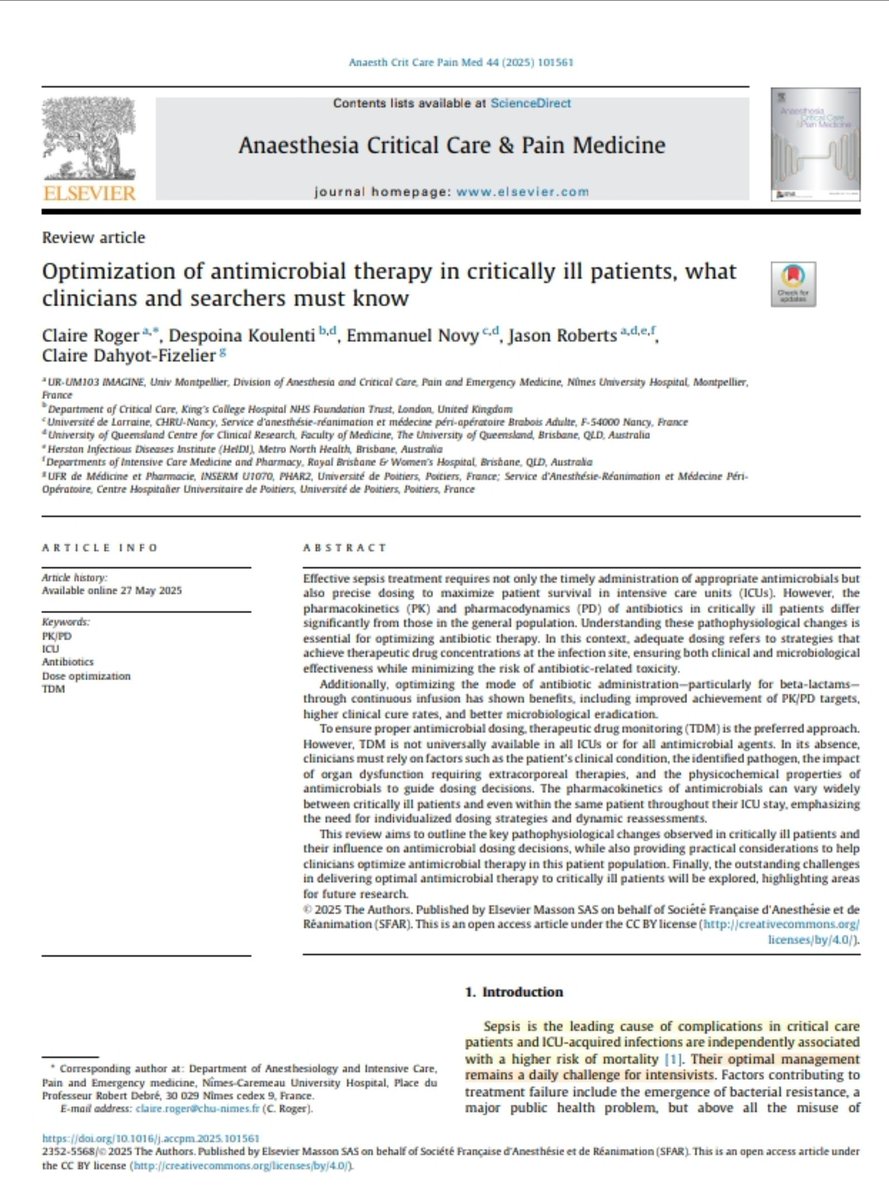
💊 ¿Estás Seguro de que tu Paciente Recibe la Dosis Correcta de Antibiótico?
🦠Sepsis y Choque séptico
🧬PK/PD
💉Optimización de Dosis
🎯Monitoreo Terapéutico
🔰📚Anaesthesia Critical Care & Pain Medicine
Artículo Completo👇🏻🆓✅
https://t.co/xumUMHaxVK
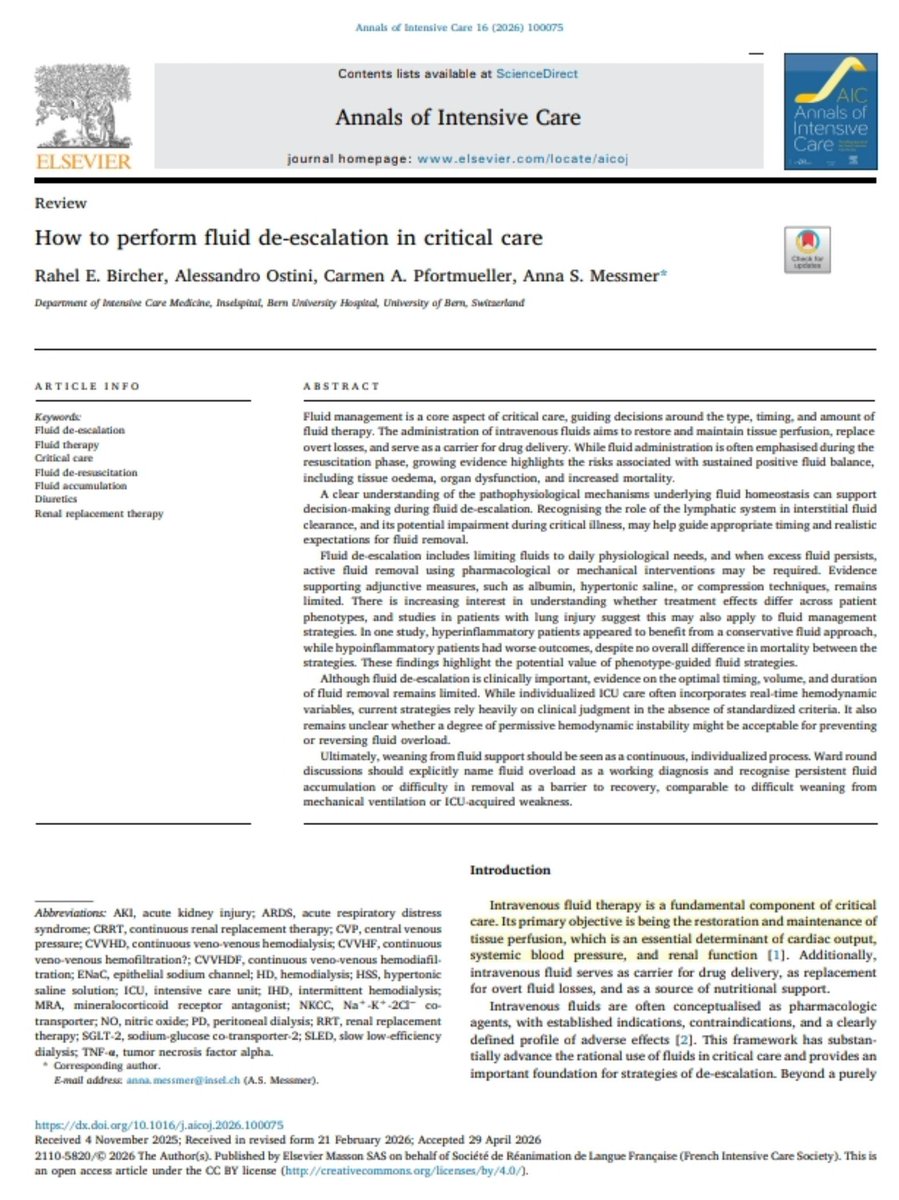
💧 ¿Sabemos Cuándo Dar Líquidos… Pero También Cuándo Empezar a Quitarlos?
🔄 De-resucitación
💊 Diuréticos
🫀 Congestión
🎯 Balance hídrico individualizado
📚 Annals of Intensive Care 2026
Enlace al artículo completo👇🏻🆓✅
https://t.co/xumUMHaxVK
🫁 Acute respiratory failure in the immunocompromised patient is not simply ARDS occurring in a different host. It is a distinct syndrome that requires a different diagnostic and therapeutic mindset.
Advances in oncology, transplantation, immunology, and critical care have dramatically improved survival among immunocompromised patients. As a result, intensivists are caring for an increasing number of these patients, with acute hypoxemic respiratory failure remaining the leading reason for ICU admission. Yet applying the same algorithms used for immunocompetent patients risks overlooking fundamental differences in disease biology and management.
In this excellent review, Azoulay and colleagues summarize ten reasons why respiratory failure in immunocompromised patients deserves its own clinical framework. The differential diagnosis extends far beyond bacterial pneumonia. Opportunistic infections, drug-induced pneumonitis, diffuse alveolar hemorrhage, leukemic pulmonary infiltration, organizing pneumonia, and immune-mediated lung disease frequently coexist, making early etiological diagnosis one of the strongest determinants of outcome. Delayed or missed diagnosis not only postpones appropriate therapy but also exposes patients to unnecessary empirical treatments and their associated toxicity.
The review also challenges several common assumptions. Bronchoscopy should not be viewed as a routine diagnostic procedure but rather as an intervention requiring careful individualized risk-benefit assessment. Likewise, although high flow nasal oxygen and noninvasive ventilation remain attractive first-line strategies, clinicians must closely monitor for treatment failure because delayed intubation is consistently associated with worse outcomes. Current prediction tools such as ROX and HACOR perform less reliably in this population than in general ICU cohorts.
The discussion on extracorporeal support is equally important. VV ECMO cannot simply be extrapolated from general ARDS practice. Patients with hematologic malignancies, profound thrombocytopenia, or recent allogeneic stem cell transplantation have markedly different risk profiles, emphasizing that patient selection remains critical. Similarly, corticosteroid therapy must always be guided by the underlying etiology. While steroids are lifesaving in conditions such as severe Pneumocystis jirovecii pneumonia or certain hematologic emergencies, indiscriminate use may substantially increase the risk of secondary bacterial, fungal, and viral infections.
Perhaps the most valuable message is that immunocompromised patients require precision medicine rather than standardized protocols.
Reference 📚
Azoulay E, Van De Louw A, Ferreyro BL. (2026). Ten reasons why acute respiratory failure is different in the immunocompromised host. Intensive Care Medicine. https://t.co/FsFccoZlhG
VENTILACIÓN MECÁNICA EN PACIENTE CON OBESIDAD 2026 🫁‼️
📌 El tejido adiposo altera la mecánica respiratoria por:
⬆️la elastancia de la pared torácica
⤵️ la capacidad residual funcional
➡️ generando el cierre de la vía aérea, la atelectasia y el deterioro del intercambio gaseoso
Today's Paper of the Day is:
Point-of-Care Echocardiography in the Difficult-to-Image Patient in the ICU: A Narrative Review
https://t.co/JKgcYjlUQ5
Join us to read 1 paper per day and stay up-to-date as we cover the spectrum of critical care across 2026
📌 Terapia nutricional en pacientes críticos con lesión renal aguda sometidos a terapia de reemplazo renal
🔄 Revisión de la evidencia en #RevistaNefrologia
🔗 https://t.co/dms8Xwmul9
✍️ Iván Armando Osuna-Padilla, Francisco Gerardo Yanowsky-Escatell, Jonathan S. Chávez-Iñiguez








![javier20ch's tweet photo. 🟥Acoplamiento Ventrículo-Arterial izquierdo [VAC]. 🔎🫀💥
🔴El VAC describe que tan bien están coordinados el ventrículo izquierdo y el sistema arterial durante la eyección. Esta relación se expresa como: VAC = Ea/Ees.
🔺️Ea (elastancia arterial): representa la carga arterial global o poscarga que enfrente el VI. Integra la resistencia vascular, distensibilidad arterial y FC. Una Ea ⤴️ sugiere mayor carga para el VI.
🔺️Ees (elastancia telesistólica): representa la capacidad contractil del VI para generar presión. Una Ees ⤵️ sugiere menor capacidad contractil.
📐Actualmente puede estimarse de forma no invasiva mediante ecocardiografía, utilizando el método se "un sólo latido", descrito por Chen et al.
📊Valores normales:
🔺️Ea: 2.2 ± 0.8 mmHg/mL.
🔺️Ees: 2.3 ± 1.0 mmHg/mL.
🔺️Ea/Ees: 1.0 ± 0.36
*En sujetos sanos, el sistema tiende fisiológicamente hacia un VAC ~0.5, asociado con una eficiencia metabólica óptima y una FEVI ~66%.
✅️VAC ~0.5 = máxima eficiencia energética. 👌🏻💓
⚠️VAC ~1.0 = máximo trabajo sistólico.
🚫VAC >1.3-1.4 = desacoplamiento.
https://t.co/rvQd0x1XtY](https://pbs.twimg.com/media/HPTUpUiWcAEdJEw.jpg)