MIT just made every AI company's billion dollar bet look embarrassing.
They solved AI memory. Not by building a bigger brain. By teaching it how to read.
The paper dropped on December 31, 2025. Three MIT CSAIL researchers. One idea so obvious it hurts. And a result that makes five years of context window arms racing look like the wrong war entirely.
Here is the problem nobody solved.
Every AI model on the planet has a hard ceiling. A context window. The maximum amount of text it can hold in working memory at once. Cross that line and something ugly happens — something researchers have a clinical name for.
Context rot.
The more you pack into an AI's context, the worse it performs on everything already inside it. Facts blur. Information buried in the middle vanishes. The model does not become more capable as you feed it more. It becomes more confused. You give it your entire codebase and it forgets what it read three files ago. You hand it a 500-page legal document and it loses the clause from page 12 by the time it reaches page 400.
So the industry built a workaround. RAG. Retrieval Augmented Generation. Chop the document into chunks. Store them in a database. Retrieve the relevant ones when needed.
It was always a compromise dressed up as a solution.
The retriever guesses which chunks matter before the AI has read anything. If it guesses wrong — and it does, constantly — the AI never sees the information it needed. The act of chunking destroys every relationship between distant paragraphs. The full picture gets shredded into fragments that the AI then tries to reassemble blindfolded.
Two bad options. One broken industry. Three MIT researchers and a deadline of December 31st.
Here is what they built.
Stop putting the document in the AI's memory at all.
That is the entire idea. That is the breakthrough. Store the document as a Python variable outside the AI's context window entirely. Tell the AI the variable exists and how big it is. Then get out of the way.
When you ask a question, the AI does not try to remember anything. It behaves like a human expert dropped into a library with a computer. It writes code. It searches the document with regular expressions. It slices to the exact section it needs. It scans the structure. It navigates. It finds precisely what is relevant and pulls only that into its active window.
Then it does something that makes this recursive.
When the AI finds relevant material, it spawns smaller sub-AI instances to read and analyze those sections in parallel. Each one focused. Each one fast. Each one reporting back. The root AI synthesizes everything and produces an answer.
No summarization. No deletion. No information loss. No decay. Every byte of the original document remains intact, accessible, and queryable for as long as you need it.
Now here are the numbers.
Standard frontier models on the hardest long-context reasoning benchmarks: scores near zero. Complete collapse. GPT-5 on a benchmark requiring it to track complex code history beyond 75,000 tokens — could not solve even 10% of problems.
RLMs on the same benchmarks: solved them. Dramatically. Double-digit percentage gains over every alternative approach. Successfully handling inputs up to 10 million tokens — 100 times beyond a model's native context window.
Cost per query: comparable to or cheaper than standard massive context calls.
Read that again. One hundred times the context. Better answers. Same price.
The timeline of the arms race makes this sting harder. GPT-3 in 2020: 4,000 tokens. GPT-4: 32,000. Claude 3: 200,000. Gemini: 1 million. Gemini 2: 2 million. Every generation, every company, billions of dollars spent, all betting on the same assumption.
More context equals better performance.
MIT just proved that assumption was wrong the entire time.
Not slightly wrong. Fundamentally wrong. The entire premise of the last five years of context window research — that the solution to AI memory was a bigger window — was the wrong answer to the wrong question.
The right question was never how much can you force an AI to hold in its head.
It was whether you could teach an AI to know where to look.
A human expert handed a 10,000-page archive does not read all 10,000 pages before answering your question. They navigate. They search. They find the relevant section, read it deeply, and synthesize the answer.
RLMs are the first AI architecture that works the same way.
The code is open source. On GitHub right now. Free. No license fees. No API costs. Drop it in as a replacement for your existing LLM API calls and your application does not even notice the difference — except that it suddenly works on inputs it used to fail on entirely.
Prime Intellect — one of the leading AI research labs in the space — has already called RLMs a major research focus and described what comes next: teaching models to manage their own context through reinforcement learning, enabling agents to solve tasks spanning not hours, but weeks and months.
The context window wars are over.
MIT won them by walking away from the battlefield.
Source: Zhang, Kraska, Khattab · MIT CSAIL · arXiv:2512.24601
Paper: https://t.co/bQEHMCRSEj
GitHub: https://t.co/vR6Pz8FQHD
Anthropic pays $750,000+ a year for engineers who can build LLMs from scratch.
Not how to prompt them.
Not how to fine-tune them.
Not how to build RAG pipelines.
But how to build them from scratch.
This 2-hour Stanford lecture teaches you everything.
Scaling laws.
Data collection.
Architecture design.
Post-training alignment.
Free. From Stanford.
Watch first. Then read this.
The lecture is the theory.
And this article shows you how to actually build it (with code) ↓
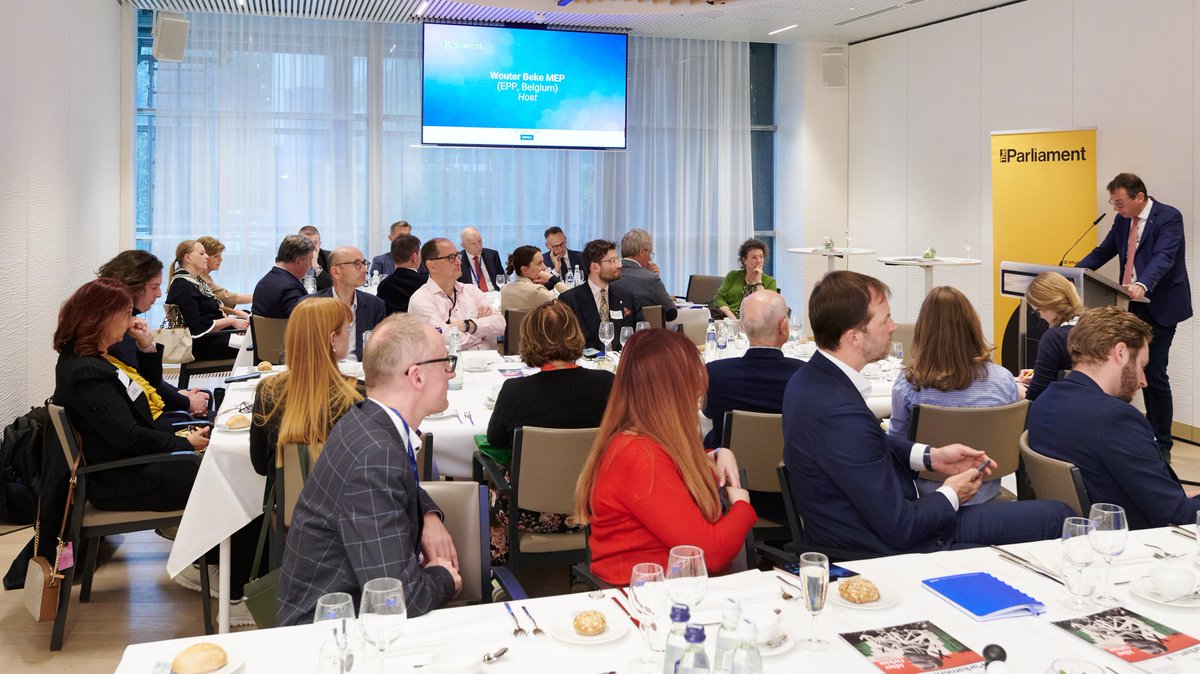
Why do Europe's most promising biotech talents keep leaving for better funding elsewhere? With US health-biotech attracting 9x more capital than Europe, anchoring innovation at home has never been more urgent, speakers said at HIPRA’s event. Partner content
Hamel Husain (creators of the AI Evals course) :
"The data scientist is back. Reliable AI isn't built on vibes or a 1–5 LLM score — it's built on looking at your data."
in an 18-minute they break down why the LLM eval harness is really data science: error analysis, validated judges, real synthetic data.
Watch the talk, then read the article below.
That’s worth more than a $500 course on agent engineering.
All over the world, women are considered more beautiful than men, especially in the eyes of other women.
Writers from Darwin to Dawkins have noted that, in humans, women are considered the ‘beautiful sex’, whereas in most species, it is males who display more elaborate, visually striking traits. In most sexually reproducing species, females have evolved to be the choosy sex, placing selective pressure on males to compete for their attention. However, in contrast to examples from the animal kingdom, this dynamic appears to be reversed in humans.
[According to evolutionary psychology, human males pay closer attention to female beauty than nonhuman males because they invest much more in raising their offspring and therefore have to be more selective in choosing mates who promise greater reproductive fitness.]
Here, we present a large-scale cross-cultural meta-analysis of same- and opposite-sex ratings of facial attractiveness. This study draws on the largest worldwide collection of facial-attractiveness data assembled to date, which we make openly available to facilitate future research.
Our findings provide robust evidence for a gender attractiveness gap, with female faces rated more attractive than male faces across rater sexes, cultures, races and age groups. Surprisingly, the gap is more pronounced among female raters, who rate other women substantially higher than male faces, while male faces receive similarly low ratings from both sexes. While men, as expected, rate female faces more favourably than male faces, women show an even stronger preference for female faces. Notably, the gap persists in female ratings, holds across sexual orientations and is stable across rater age.
The female-to-female generosity may be explained by sociocultural norms. Across many societies, girls and women are socialized from an early age to place high value on physical appearance and are more frequently exposed than men to media that reinforce idealized standards of female beauty [107,108]. As a result, women may be culturally permitted, or even encouraged, to evaluate one another’s appearance more favourably. This may also reflect a sense of peer solidarity and mutual recognition…
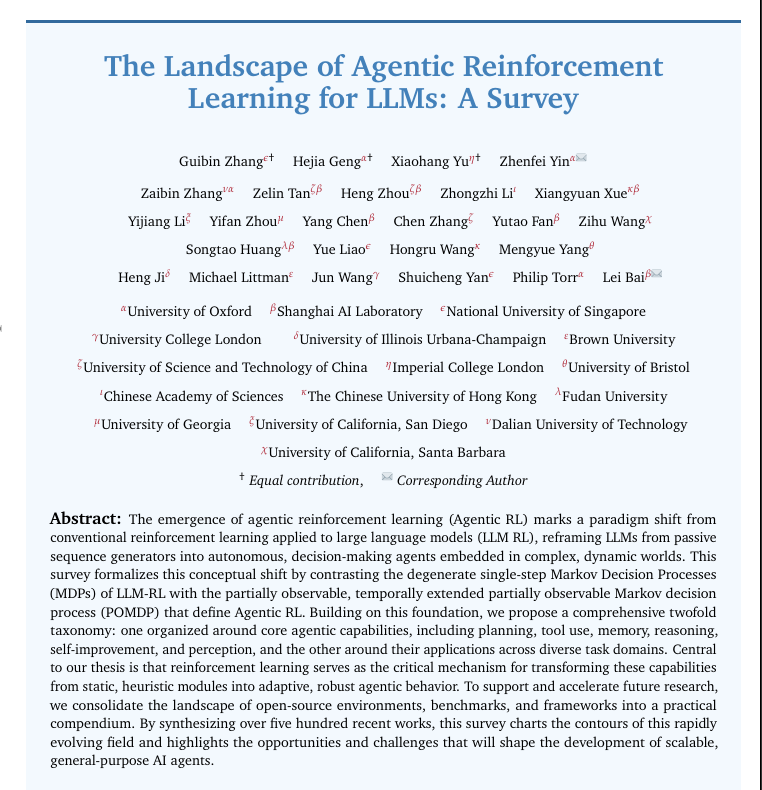
Nice survey paper mapping agentic reinforcement learning for LLMs, showing how models learn by acting across time.
Covers 500+ works and groups them into a 2-part map of capabilities and applications.
The problem is that common LLM training rewards a single answer once, then stops learning.
Real tasks need many steps, partial information, and choices that affect what happens later.
The survey formalizes that setup as an agent that sees a bit, chooses an action, and gets feedback.
That perspective uses memory to track context, planning to pick sequences, and tools to affect the world.
It also includes reasoning for constraint handling, perception for multimodal inputs, and self-improvement to refine policies.
Reinforcement learning links all of this, because rewards arrive after sequences, so the policy learns what to try next.
----
Paper – arxiv. org/abs/2509.02547
Paper Title: "The Landscape of Agentic Reinforcement Learning for LLMs: A Survey"
Startup ideas often get too much enthusiasm and not enough structured validation.
Startup Skill is an open-source set of startup-analysis skills for Claude Code and other agents that support skills.
It helps you pressure-test a startup idea by turning a prompt into structured research, strategy, competitor analysis, positioning, financial planning, validation experiments, and pitch prep.
Key features:
• Startup design workflow – 8 phases from intake to validation, with progress tracking for interrupted sessions.
• Competitor intelligence – battle cards, pricing landscape, feature matrix, and strategic report.
• Positioning support – April Dunford-style positioning, alternatives map, market category analysis, and messaging implications.
• Pitch preparation – 10-min, 5-min, 2-min, 1-min elevator, and email formats, plus scoring and Q&A prep.
• Flexible installation – Claude Code plugin, https://t.co/pETP5BCGyT skill files, npx, SkillKit, clone/copy, or Git submodule.
It’s open-source (MIT license).
Link in the reply 👇
SOMEONE TURNS FAMOUS NOVELS INTO WALKABLE 3D WORLDS AND SELLS THEM FOR $2,000-$10,000 EACH
he feeds the entire book to Kimi and it maps every location, color and street in one pass.
then Claude Fable 5 builds the world in your browser - writing its own code, testing itself, fixing its own bugs across parallel agents.
by nightfall you can walk from the green hills of the Shire to the black gates of Mordor and feel the scale shift under your feet.
a single fandom of 5,000 pays $3 a head to step inside it - $15,000 from one afternoon.
the tool is three weeks old and free until June 22, which is the only reason the niche is still open.
the full build is in the article below.
once Fable becomes available again, I'm not gonna sleep
instead, I will create roadmaps and long-term plans for:
> all areas of my life
> all startup ideas I have
> all potential features for all of my softwares
> long-term forecasts for geopolitical events
> personalized SWE courses
> deep summaries of all books I wanna read
> in-depth analysis of my business data
and any other ideas I'll get.
this is the only way to escape the permanent underclass.
🚨 @Karpathy predicted the power of the "LLM Wiki." Google just formalized it.
Meet Open Knowledge Format (OKF): a vendor-neutral standard for giving foundation models the curated context they need.
I can genuinely see this replacing Notion, Obsidian, or traditional wikis for developer teams, and the reason comes down to bookkeeping.
Traditional wikis fail because humans inevitably abandon the tedious work of updating them.
As Andrej Karpathy pointed out recently, LLMs don't get bored.
They don't forget to update a cross-reference, and they can touch 15 files in a single pass.
OKF standardizes the interoperability layer so agents can actually do that heavy lifting autonomously.
Because the format is minimally opinionated, it doesn't dictate what you write, it just dictates how it's structured. You get:
→ Human-readable documents that live right alongside your code in version control
→ Cross-links that map out complex entity relationships without needing a graph database
→ A system that survives moving between different tools and organizations
There is no complex compression scheme.
No central registry.
If you can cat a file, you can read it.
If you can git clone a repo, you can deploy it.
This is how we stop rebuilding context pipelines from scratch every time a new model drops.
Announcement + spec file in 🧵↓
This is right.
The old marketing playbook optimized for trust in a low-information market.
The new one optimizes for proof in a high-information market.
That is why so much feels broken at the same time.
Buyers learn from individuals before brands.
Product proof travels faster than abstract positioning.
Speed matters because attention cycles keep getting shorter.
Consensus takes too long because the market is learning in public faster than most teams are aligning in private.
The advantage goes to teams that use judgment to make faster contact with reality.
Instead of watching an hour of Netflix, watch this 2 hour hour Stanford lecture will teach you more about how LLMs like ChatGPT and Claude are built than most people working at top AI companies learn in their entire careers.
Microsoft says it just caught up to Anthropic's frontier - with a model 1/10th the size.
Their new MAI Thinking 1 has just 35B active parameters, yet hit 53% on SWE Bench Pro - right alongside Claude Opus 4.6 on the hardest coding benchmark. Independent human raters on Surge even preferred it over Sonnet 4.6.
The twist: they claim it was trained from scratch with zero distillation - no copying a bigger model - so the data lineage is clean and commercially safe.
"It has climbed entirely from the bottom, with absolutely zero distillation."
"With MAI you don't rent intelligence from a shared model that learns from everybody."
real catch-up - or a vendor grading its own homework? you decide.
Fable is banned. Long live local AI.
Full episode breaking down exactly how to get good at local models. the runtime, the hardware, quantization, connecting it to Hermes agent and local AI startup ideas (25 minutes)
A senior Google engineer just dropped a 421-page doc called Agentic Design Patterns.
Every chapter is code-backed and covers the frontier of AI systems:
→ Prompt chaining, routing, memory
→ MCP & multi-agent coordination
→ Guardrails, reasoning, planning
This isn’t a blog post. It’s a curriculum. And it’s free.
🚨 Anthropic just showed a 27-minute workshop on how to actually do prompts for Claude.
Taught by the people who built it.
Free. No registration. No paywall.
I've seen $300 courses that don't cover what they teach in the first 8 minutes.
Watch it and bookmark it now.
AI has now solved a major open problem -- one of the best known Erdos problems called the unit distance problem, one of Erdos's favourite questions and one that many mathematicians had tried.
https://t.co/SD1vVPkrHR
- Drafted a blog post
- Used an LLM to meticulously improve the argument over 4 hours.
- Wow, feeling great, it’s so convincing!
- Fun idea let’s ask it to argue the opposite.
- LLM demolishes the entire argument and convinces me that the opposite is in fact true.
- lol
The LLMs may elicit an opinion when asked but are extremely competent in arguing almost any direction. This is actually super useful as a tool for forming your own opinions, just make sure to ask different directions and be careful with the sycophancy.