2026 Themes
1. Agents for every niche imaginable
2. TPU's/ASIC's becoming more performant over general purpose GPU's for AI workloads
3. Robots replacing more jobs, esp industrial blue collar jobs
4. SpaceX IPO will send every space related idea into absurd levels of hype
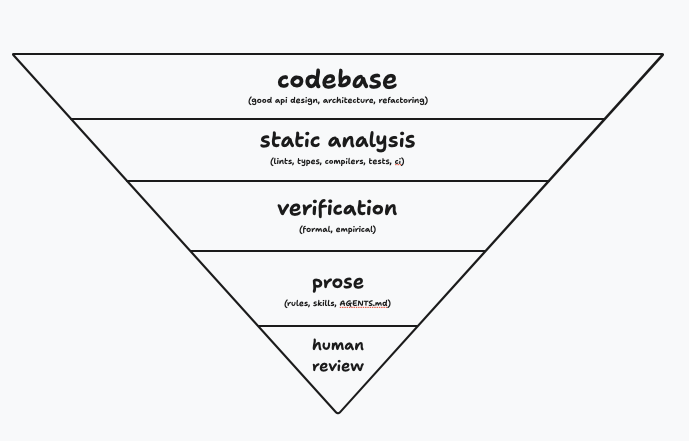
hot take: you don't need a software factory, and i don't love the term. it's just marketing
all you need is good software engineering and investing your tokens in the right places. the more deterministic the better (and token efficient)
the silliest way to lose a lot of money in 2026 is to hold onto stupid priors for dear life
the second silliest is to make “safe” bets behind prestige vs. first principles evaluation of tech/business. if a company has fancy pedigree but is just losing…don’t fight the tape
When I was writing Unreal Engine 1, my time was divided as follows:
- Around 30% went to seriously deep coding on hard problems: assembly language texture mappers, C++ BSP trees, data persistence, object oriented systems design, and networking.
- Around 70% was just typing and refactoring large bodies of code needed for a complete engine feature set. This was not hard, and while I was doing it my mind was mostly on the deeper coding topics, thinking and planning for what's next. It didn't feel much different from vibe coding today, except that it was just me typing code on an IBM Model M keyboard rather than prompting it and reviewing the results.
So, it has always seemed perfectly logical that we would rely on AI for that 70%, once the AI could do it with a similar quality standard as we could, which has never been perfection. It came as no surprise that, after a few years of AI model evolution, it was able to take the reigns on that 70% and free up programmers' time for more valuable tasks.
What's more of a surprise is the emergence of AI as a sort of insta-Carmack able to solve hard technical problems quite cleverly and often cleanly, and that it's able to reason about and work in complex 3D scenes both by operating the tools and by directly understanding the raw data files.
I abandoned assembly language in 1998 when out-of-order CPUs made much simpler C/C++ code faster, and never I missed it. If prompting through architectural documents, concept art, and design plans can transcend typing code and tweaking vertices, that will enable developers to spend their time on higher-level, higher value technical and creative tasks.
What matters is the end product, whether it's a game or an engine. Anything developers can do to try out more ideas and make better software and games faster is a win for everyone.
String theory is what happens when an intelligent system is starved of sensory input and starts hallucinating. Intelligence needs grounding.
For this reason, intelligence is practically never the bottleneck to solving impactful problems. The bottleneck is iterated contact with reality.
say it with me now. experts are fake, smart generalists rule the world, everything is designed by people no smarter than you, and courage is in shorter supply than genius
codebases have always contained slop. we have always been okay with this because code rarely needs to be perfect, outside of mission critical "hard" (eg embedded) software.
swe is a unique form of engineering because you're often building something that constantly evolves and is almost organic - user tastes change, your mental models evolve, and features come and go.
admittedly, i and many others who've been coding for a long time were initially (like back in 2024) skeptical that agents would write production code. "but what about all the slop that would enter our beautiful codebase?".
well, even before, we had human slop, and there was a lot of it! if we're being truthful, most people call "code i didn't write" slop. the reality is that 99% of people (i include myself in that number) don't even know what Good Code looks like, let alone be capable of writing it. i would propose that Good Code is:
• correct
• bug free
• fast and cost efficient to run
it has always been exceedingly difficult and expensive to write truly Good Code, because for the longest time (maybe @bendlang will change that), code was not something you could cheaply and formally guarantee to have all 3 of these properties. this is why writing hard software is much more difficult and expensive, because depending on the use case, you may only get one chance and so you have to be right from the start.
but the vast majority of software we use does not need to be Good Code to provide value to users. in fact, it is very likely that most software we use is not formally verifiable! we accepted some bugs in exchange for velocity and progress, so we rely on tests and o11y instead and have adopted a more incremental approach. this is a good thing!
agents help us move faster, and if you're open to the idea, are capable of helping us write better code. it won't be Good Code (that is still expensive), but it is likely to be much better on average at scale.
the new craft of swe is to figure out how to do this. it's your job now! if your productivity with and without agents is not significantly different, you're doing something wrong. but it's not too late to embrace it and use it as an opportunity to learn a whole new skill tree
Few things more enjoyable in work and life than discovering new talent. Seeing greatness in people, sometimes even before they fully see it themselves.
“Cryptography is a subfield that’s extremely conspicuous by its absence from OpenAI’s list of 376 papers!
But my sources tell me that the AI cos have now started, gingerly and discreetly, investigating whether their latest internal models can break important cryptographic protocols and primitives.”
- Scott Aaronson, CS chair at UT Austin
@0xrwu Unit tests are free. No reason to not have the agent add those. Same benefit as agent reviews. It has a different goal when trying to break its own code and the two generate a better output. Also sometimes a dep has a counterintuitive interface or bug that surfaces in a unit test
@nikunj I guess my point was that they are actively talking about how they automated shipping 2k+ PR's per month per dev while maintaining solid product taste/design
So there does seem to be a fully agentic coding path that doesn't sacrifice product experience
one of the exceptions
Agents can be AI, but agency is human. It is every individual’s responsibility to empower our own agency, with the help of tools. But the North Star should always remain human centered.