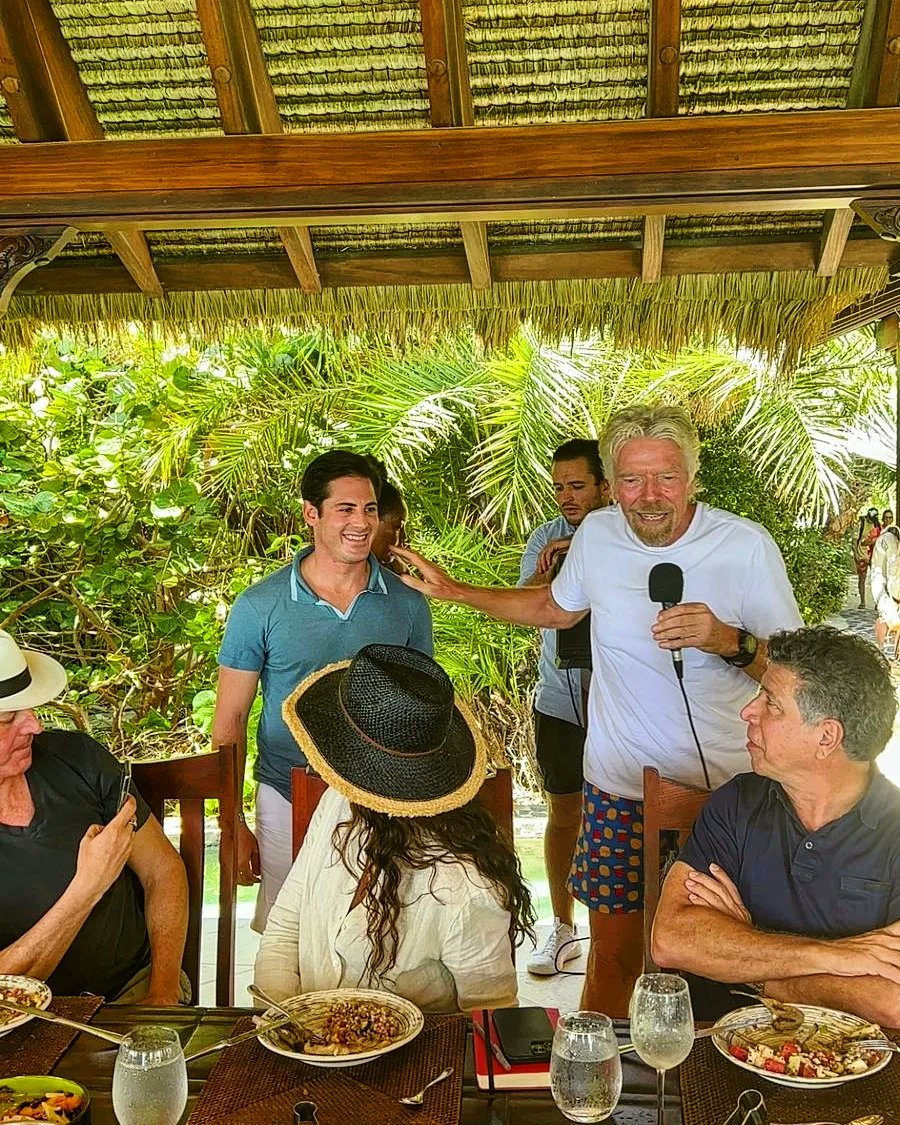
An immense treat to be with @richardbranson on Necker Island and to chat with some of the sharpest entrepreneurs and leaders from Latin America and the world about creating a more unified and connected hemisphere 🌎🏝️
Infrastructure is never only technical. In constrained geopolitical environments, science and technology can create shared spaces where politics alone cannot -- and empower ordinary people in the process.
Ten years after the first U.S.-Cuba internet agreements, I reflect in Science & Diplomacy @SciDip@aaas
Take a look at #scidip's newest In the Field piece, where @BrettPerlmutter recounts his role negotiating the first-ever internet agreements between the U.S. and Cuba, and reflects on lessons learned from this experience ten years on: https://t.co/dVtMrK7HEm
What is happening here?
The US birthrate is now down -30% since pre-2008 levels while financial wealth is at record highs.
Why? Because only asset owners are able to afford this economy.
As shown in our below analysis, this crisis accelerated in both 2008 and 2020.
And, with every recession and every round of inflationary economic stimulus, the crisis simply accelerates even further.
Now, we are seeing the biggest divergence between the S&P 500 and the US birth rate in history.
The result? Tons of young Americans simply cannot afford to have kids in another sign of the "K-Shaped" economy.
The US is facing a massive demographic crisis.
1/ My friend @richardbranson and I wrote in the @washingtonpost@PostOpinions that “the responsibility to alleviate human suffering cannot be left to governments alone.”
As US-Cuba relations reach their most fraught moment in decades, we cannot lose sight of ordinary Cubans on the ground.
Please read: https://t.co/g0pmJ0NTs6
2/ Cuba is at a geopolitical crossroads. But while politics remain uncertain, ordinary Cubans need food, medicine, fuel, and power.
In @PostOpinions, @richardbranson and I call upon US business leaders to utilize legal, nonpolitical pathways to save lives and preserve human dignity.
My friend @richardbranson & I argue in @washingtonpost@PostOpinions that Cuba’s humanitarian crisis is urgent -- and should not wait for politics to resolve.
Ordinary Cubans need food, medicine, fuel, & power. There are legal, nonpolitical ways to save lives & preserve dignity.
"The responsibility to alleviate human suffering cannot be left to governments alone," writes @richardbranson and @BrettPerlmutter.
"Business leaders and humanitarian organizations can act, through existing legal pathways." https://t.co/tiJ8h7iqGK
@RubensteinAdam@TheFP Definitely not! A wise mentor of mine told me to change as many diapers as I could – and to smell them – because it helps the man bond with the baby!
Maimonides was born in 1135 in Muslim-ruled Cordoba and lived in what is now Morocco, Israel, and Egypt, where he died in 1204. He wrote dozens of works on logic, metaphysics, medicine and astronomy (including a debunking of astrology); distilled Jewish faith into thirteen principles; served as the court physician of the Sultan Saladin; wrote The Guide for the Perplexed, which tried to reconcile scripture with reason, and Jewish theology with Aristotelian philosophy; and codified Jewish oral law into his Mishneh Torah (“second Torah”), the work in which he presented ...