A Stanford psychologist spent 4 years proving that the simple act of walking generates 60% more creative ideas than sitting, and the experiment she designed to kill every alternative explanation is one of the most decisive findings in modern psychology.
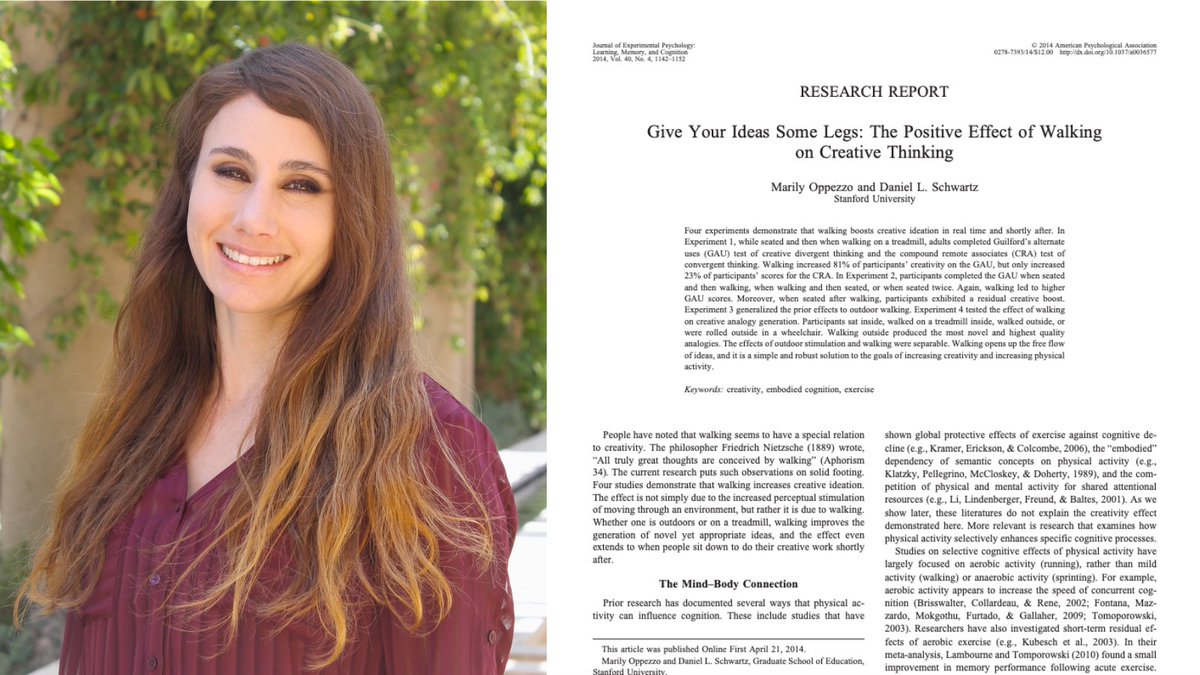
Her name is Marily Oppezzo.
She got the idea for the study while walking with her advisor at Stanford to discuss her thesis topic, and the paper she eventually published in the Journal of Experimental Psychology in 2014 is sharp enough that it should have ended the seated meeting on the day it came out.
She ran 4 experiments on 176 people. Same person tested twice. Once sitting, once walking. The creativity tasks were the standard ones psychologists have used for decades to measure how good a brain is at generating novel useful ideas.
The result was almost too clean to publish.
81% of participants in the first experiment produced more creative ideas while walking than while sitting. In the second experiment, 88%. In the third, 100%. Every single person walked into a more creative version of themselves.
On average, people generated 60% more novel useful ideas the moment their legs started moving.
The skeptical question is the obvious one. Maybe it was the fresh air. Maybe it was the scenery passing by. Maybe it was the change of environment doing the work, not the walking itself.
Oppezzo killed every one of those explanations with one experimental decision.
She put people on a treadmill facing a blank wall. No scenery. No fresh air. No environmental change. Just legs moving in place while staring at white drywall. The 60% boost held.
Then she ran the experiment that closed the case completely. She took participants outside in two conditions. Half of them walked through a Stanford courtyard. The other half were pushed through the exact same courtyard in a wheelchair. Same outdoor stimulation. Same scenery passing at the same speed. The only difference was whether the legs were moving.
The walkers produced dramatically more novel high-quality ideas than the wheelchair group. The outdoors did almost nothing on its own. The walking did everything.
This is the part of the study that hit hardest when I read it the first time.
She also tested the opposite kind of thinking. Convergent thinking. The kind where there is one right answer and you have to narrow down to it.
Word puzzles where 3 words share a hidden fourth word that connects them. The seated participants did slightly better on these. Walkers got slightly worse.
Walking is not a general intelligence enhancer. It does one specific thing. It opens up the divergent search inside your brain. The part that generates options. The part that produces unexpected connections. The part that takes a problem and finds five ways into it instead of one.
When you need to converge on the single right answer, sit down. When you need to find the answer in the first place, get up.
The mechanism is now well understood. Walking selectively activates what neuroscientists call the default mode network, the system inside your brain that runs when you are not consciously focused on anything. The DMN is where mind-wandering happens. Where memories cross-reference each other. Where ideas that have been sitting in separate folders inside your head finally bump into each other.
When you sit at a desk and force yourself to concentrate, you suppress the DMN. When you walk at a natural pace, the executive part of your brain gets just busy enough handling the walking that the DMN comes online and starts doing the work that focus was blocking.
The most useful finding in the entire paper is the one almost nobody quotes.
The boost did not turn off the moment people stopped walking. Participants who walked first and then sat back down stayed elevated. Their next round of seated creativity work was still significantly better than people who had been sitting the whole time. The rest lingered for at least several minutes after the legs stopped moving.
You do not need to do creative work while walking. You need to walk before the creative work. The brain holds the state.
The history of this is the part that should haunt anyone who still does meetings in chairs.
Charles Darwin built a gravel loop behind his house in Kent called the Sandwalk and walked it 3 times a day for the rest of his life. The theory of evolution was developed one lap at a time on that path.
Nietzsche walked up to 10 hours a day during the years he wrote his most important books and openly said the work was conceived on his feet.
Beethoven composed for the morning and walked for 5 hours every afternoon with a pencil in his pocket for when something landed.
Kahneman said the best thinking of his Nobel Prize-winning career happened on leisurely walks with Amos Tversky. Steve Jobs refused to take important conversations sitting down. He held them on foot.
Every one of them was using the system Oppezzo would not measure until 2014. They just did not know what to call it.
The question worth sitting with is the one almost nobody asks.
Every meeting you have ever attended sitting around a table was a meeting held at a fraction of the brain power that was actually available to the people in the room. Every brainstorm that got stuck inside a conference room. Every problem you tried to solve at a desk and gave up on. Every idea you could not quite get to.
The intervention is the easiest one in modern science. No supplement. No app. No subscription. No training program. Just a pair of legs and 15 minutes.
The Stanford lab proved it. The philosophers knew it. The neuroscience explains it.
And almost everyone reading this is still trying to think their way out of problems sitting completely still.
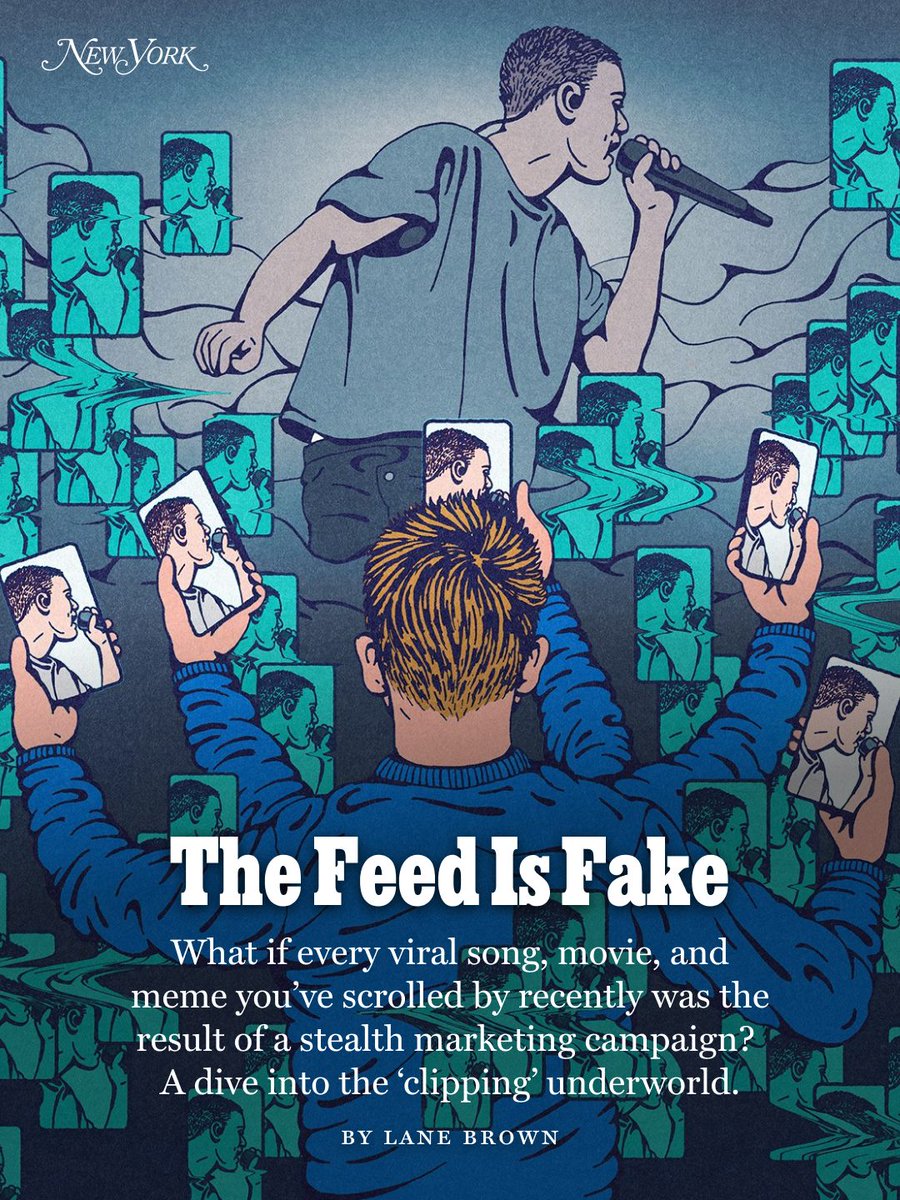
Joe Lim estimates that 90 percent of what you see on the internet is advertising in disguise, and he should know. For three years, Lim ran a company called Floodify, which at its peak operated 65,000 dummy social-media accounts used to drum up attention on behalf of paying clients.
The point of this kind of marketing is that nobody is supposed to notice it. But lately, the machinery has started to show.
In April, Justin Bieber headlined two consecutive weekends at Coachella. Coachella is the biggest stage in pop music save only for the Super Bowl, the kind of event that in theory generates its own attention. And yet on both weekends, a Discord server writer Lane Brown had been monitoring hosted paid campaigns for Bieber’s Coachella performances, offering clippers — people who are hired to turn a song, trailer, interview, stump speech, or whatever into short, social-media-friendly fragments — as much as a dollar per thousand views.
“On social media, popular opinion is being formed, measured, and manipulated all at once, and every signal the platforms produce — a trending song, a backlash, a talking point, the feeling that ‘everybody’ is suddenly talking about the same thing — can now be fabricated by unseen actors with hidden agendas,” writes Brown.
“Everybody is doing this now,” Lim says. “And if you’re not, you’re behind.”
Brown reports on how the same techniques are now being used to fool people on every app they go to in order to find out what other people think, not just in music but across entertainment, politics, consumer products, and celebrity gossip: https://t.co/hlcdfSmzPc
If @Revolut does go ahead with the rumoured $100bn secondary sale, crowdfunders will be sitting on an 850x return.
They would have turned £2k into £1.7m.
The greatest crowdfunding success story of all time?
Italian director Franco Zeffirelli once said “When I feel depressed, I return to Florence and look at Brunelleschi’s dome: if the genius of man has reached such heights, I too must try to create, act, and live.”
Nunca había pensando a fondo la frase de El Principito: "Si vienes, por ejemplo, a las cuatro de la tarde, comenzaré a ser feliz desde las tres"
Hasta que me pasó, y me di cuenta de cuanta razón tenía el autor
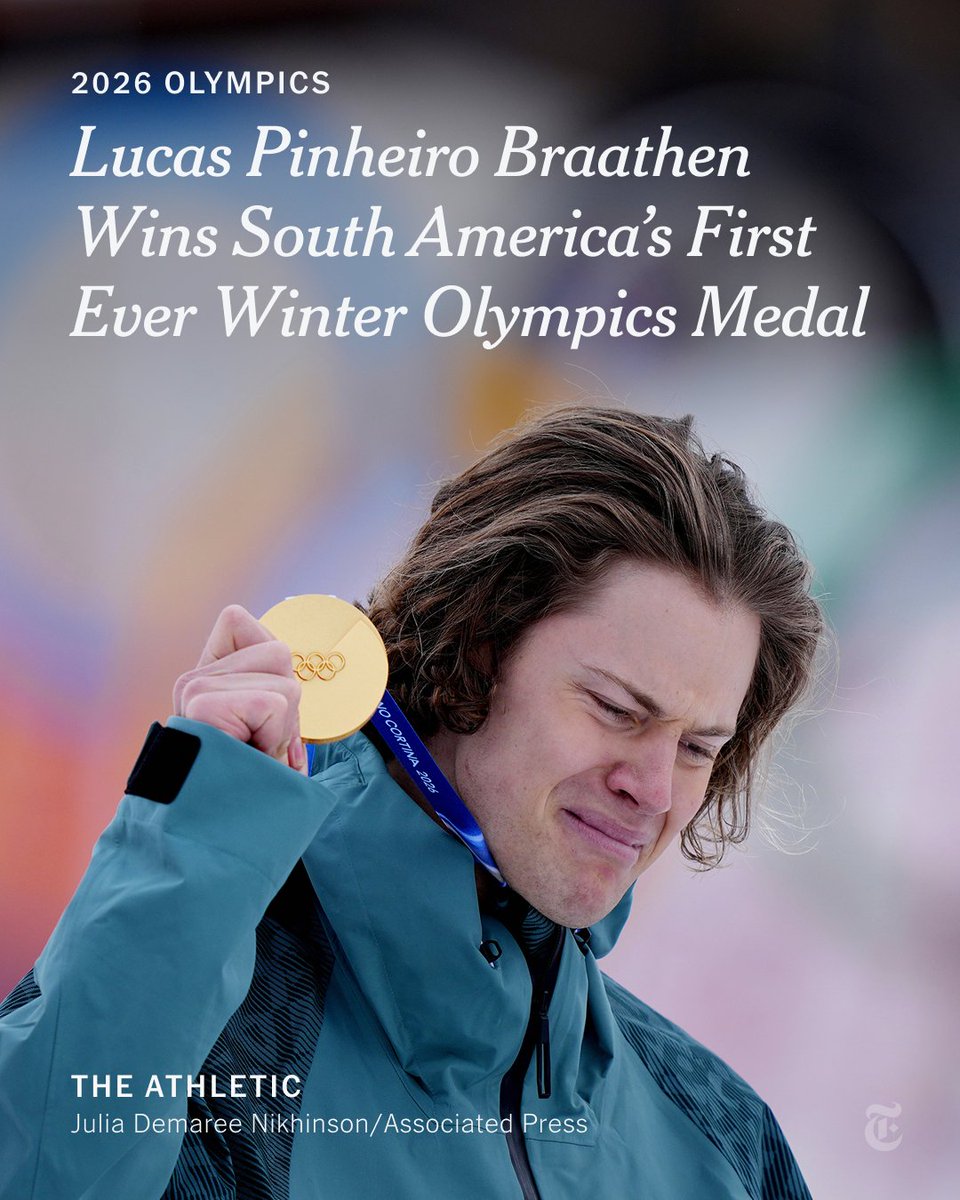
From @TheAthletic: Lucas Pinheiro Braathen made history for Brazil and for South America — he became the first athlete from the continent to win a medal at the Winter Olympics. https://t.co/VWLWNo8oWF
So here’s the issue you get influencers like this guy have a quarter million followers and they claim they don’t know why it is declining… it’s because they don’t understand basic mechanics of price discovery.
They don’t understand that the marginal buyers or the float determines price they think the onchain bitcoin is that is the price discovery
Well, it was once upon a time but now..
Once you can synthetically manufacture the supply, the asset is no longer scarce and once scarcity is gone, price becomes a derivatives game, not a supply-and-demand market.
This is exactly what has happened to Bitcoin.
This is the same structural break that occurred in gold, silver, oil, and eventually equities once they became derivatives-dominated.
The original premise that no longer exists
Bitcoin’s entire valuation logic was built on finite supply (21M) and inability to be rehypothecated.
That died the moment:
•Cash-settled futures
•Perpetual swaps
•Options
•ETFs
•Prime broker lending
•Wrapped BTC
•Total return swaps
were layered on top of the chain.
From that moment forward:
Bitcoin supply became theoretically infinite.
Not on-chain in price discovery.
The metric that explains the collapse
Synthetic Float Ratio (SFR)
Once you can synthetically manufacture the supply, the asset is no longer scarce — and once scarcity is gone, price becomes a derivatives game, not a supply-and-demand market.
That is exactly what has happened to Bitcoin.
This is the same structural break that occurred in gold, silver, oil, and eventually equities once they became derivatives-dominated.
Why Wall Street can now “trade against” Bitcoin
They do exactly what they’ve done in every commodity market:
1.Create unlimited paper BTC
2.Short into rallies
3.Force liquidations
4.Cover lower
5.Repeat
They are not “betting” — they are manufacturing inventory.
The same 1 BTC can now support:
•An ETF unit
•A futures contract
•A perpetual swap
•An options delta
•A broker loan
•A structured note
All at once.
That is six claims on one coin.
That is not a market.
That is a fractional reserve price system.
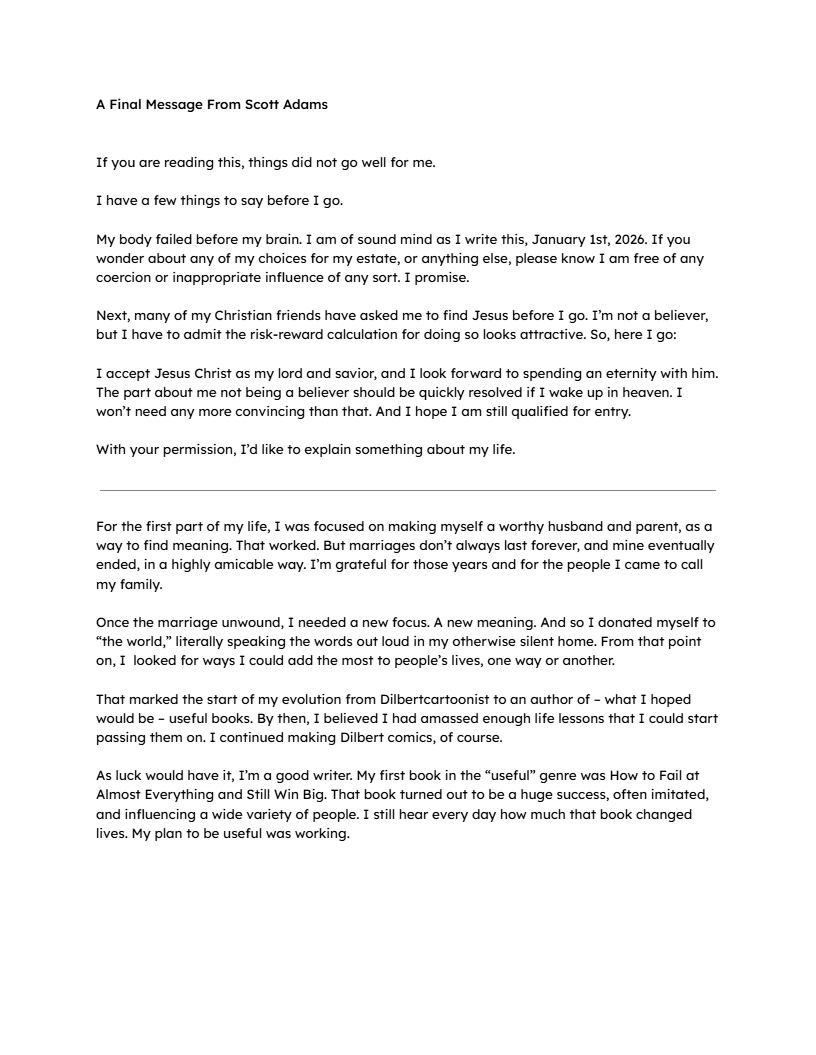
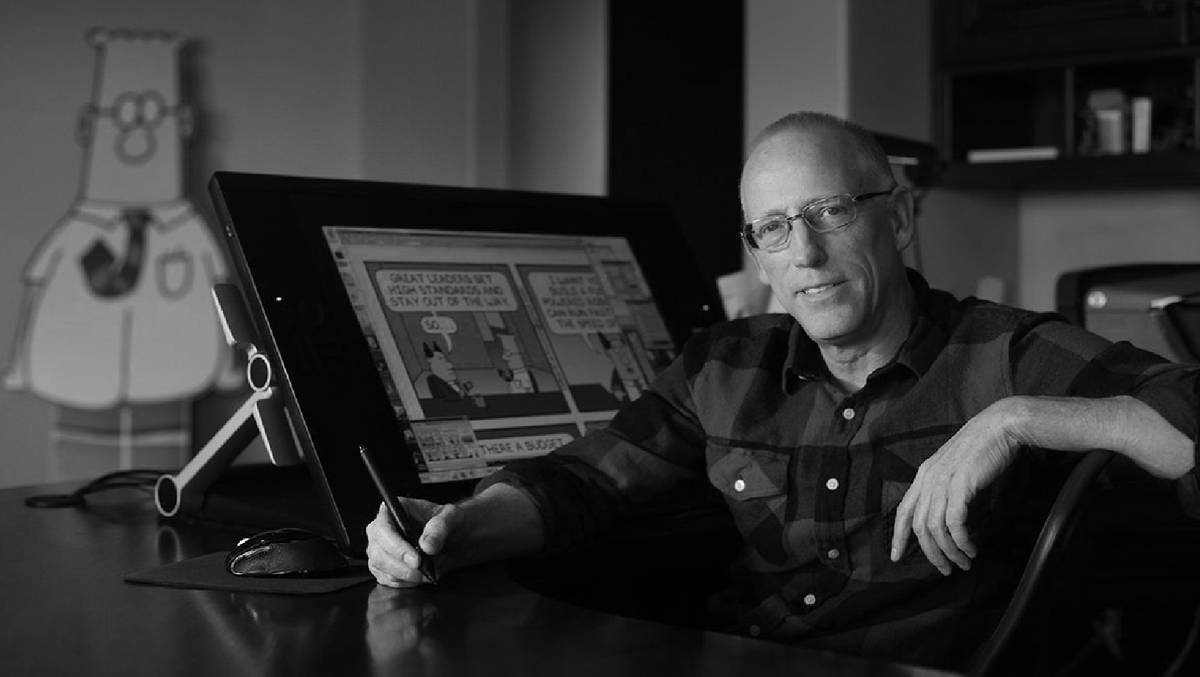
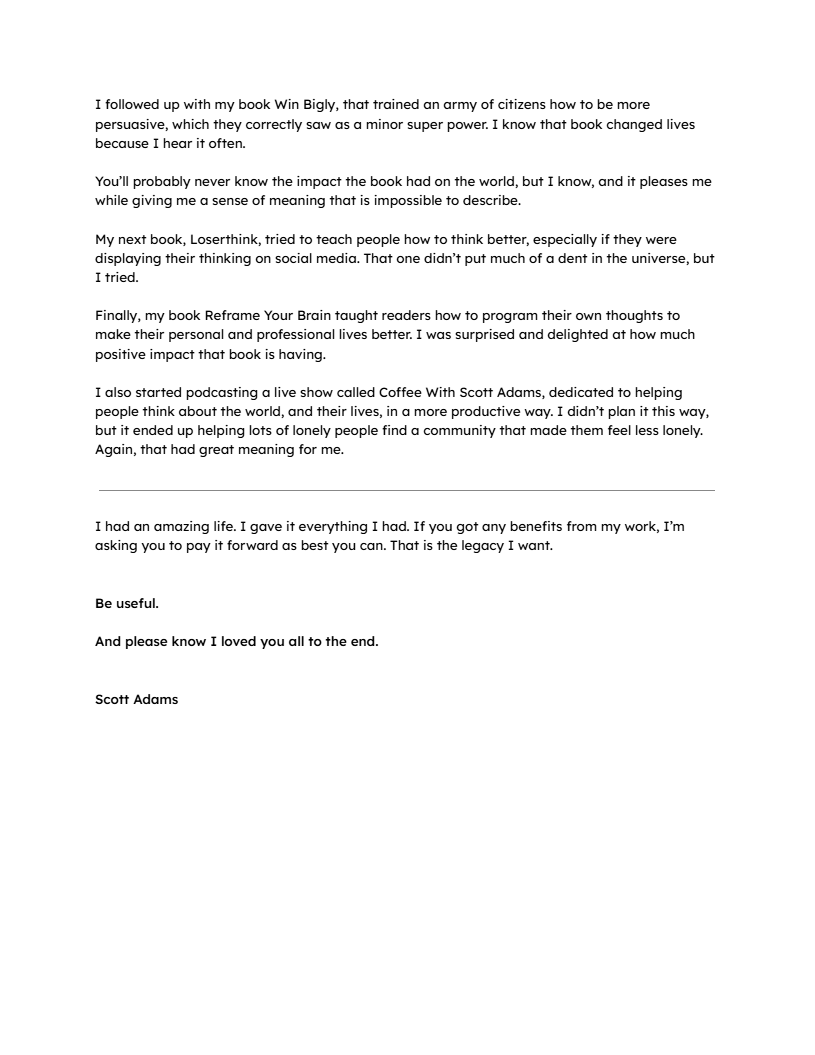
JUST IN - Scott Adams dies from cancer at 68, his final statement: "I accept Jesus Christ as my Lord and Savior, and look forward to spending an eternity with Him."
My hot take about the Louisiana Purchase was that Bonaparte got a fine deal for it considering
1) there was only ever going to be one buyer
2) the land was cash flow negative to the Empire
3) America would have taken it by force eventually anyway
Cosmo Pharmaceuticals NV has soared 44.85% in the past 5 days, rising to 91.40 CHF.
The rally comes after the company released its Phase III trial results for the new Clascoterone 5% solution, which showed highly promising outcomes, delivering a remarkable 539% increase in hair growth compared to placebo
Flight attendant comes over intercom: “your flight is oversold, I need two volunteers to take a flight this afternoon for a $300 voucher.”
I spring into action. I was born for these moments. This is why I studied game theory. Literal tingles. I pull out my megaphone and address our boarding gate: “guys, they absolutely must off board at least two passengers or this bird isn’t taking off. Every 3 minutes they will increase their bid by $200. If we all hold out for 45 more minutes, 2 of us can make nearly 5 grand each. Textbook prisoners dilemma, this is (3,3) in its most visceral representation. I’m not even going to give up my ticket but I know value when I see value. Let’s make Nash proud ladies and gentlemen. Do not acquiesce. Do not defect.”
Anyhow 2 people immediately accepted $500 and I called them retards on my megaphone and was placed in a detention room by airport police. This is why we study game theory.