🚨 This work is out now in @PLOSCompBiol! 🚨🧠
This work was a huge labor of love and curiosity during grad school working with @TheColeLab and I'm so pleased to finally share the peer-reviewed study with our community! Enormous gratitude to coauthors @TheColeLab @RUBENSARO @taku_ito1@BrianKeaneLab@RaviMill 🙏🤘
https://t.co/fGFkTXrLn9
@social_brains At Rutgers, there was a popular philosophy course on how to reason effectively about fraught political issues: Current Moral and Social Issues. Try emailing the legal philosopher there, Doug Husak.
There are tons of papers on functional dysconnectivity of psychosis, so why are we so excited about this one in Molecular Psychiatry? The reason is that we coalesce network-wise patterns to form a highly discriminating AND highly robust biomarker ...https://t.co/i1itBEnZCy
The effect size is large (d=1.0-1.2) and the test retest reliability is much better than most other brain-based markers (ICC=.62). We also rule out a whole list of potential confounds (stress, antipsychotics, anxiety, comorbidities, etc)...
📢📢We are hiring!!
At least one postdoc research position.
If you are interested in brains, speech, language, oscillations, computational modeling, multisensory integration, predictive perception, please see the ad below.
RTs appreciated.
Many visual studies of special populations ensure that compared groups have "normal or corrected-to-normal vision", but do not report if the groups are actually matched on acuity within the normal range. Here, we show why this practice is problematic and how it can be remedied...
The Vision and Psychosis Lab and Active Perception Lab are now hiring! We are looking for a full-time Research Assistant who can assist in an NIH study that investigates fine-scale eye movement differences in psychosis. Check it out (Job ID: 242211): https://t.co/zWoc8pwtrv
@HolmesLab_BHI is thrilled to announce the long-awaited Transdiagnostic Connectome Project, TCP 🎉🚨🧠 Data on OpenNeuro (BIDS MRI, behavior) & preprinted on medRxiv! A true “team work makes the dream work” effort, huge thanks to co-1st authors @SidChop @ConnorLawhead, as well as…[1/10]
https://t.co/vBOcdoQEar https://t.co/nDSdWHU1ZS
These results also motivate a search for the underlying causes such as abnormal gyrification during prenatal development, unregulated synaptic pruning during adolescence, or NMDA receptor hypo-functioning during the illness itself.
Very excited to have this new paper out! Using HCP data, we found that early psychosis patients exhibited more heterogeneous functional connectivity patterns across the entire brain and within multiple large-scale networks as compared to controls…. https://t.co/HDLozUEvKB
...heterogeneous connectivity patterns and working memory task activations compared to ADHD and healthy control subjects. These findings may help explain why it has been so challenging to use fMRI patterns to classify a person as having or not having psychosis…
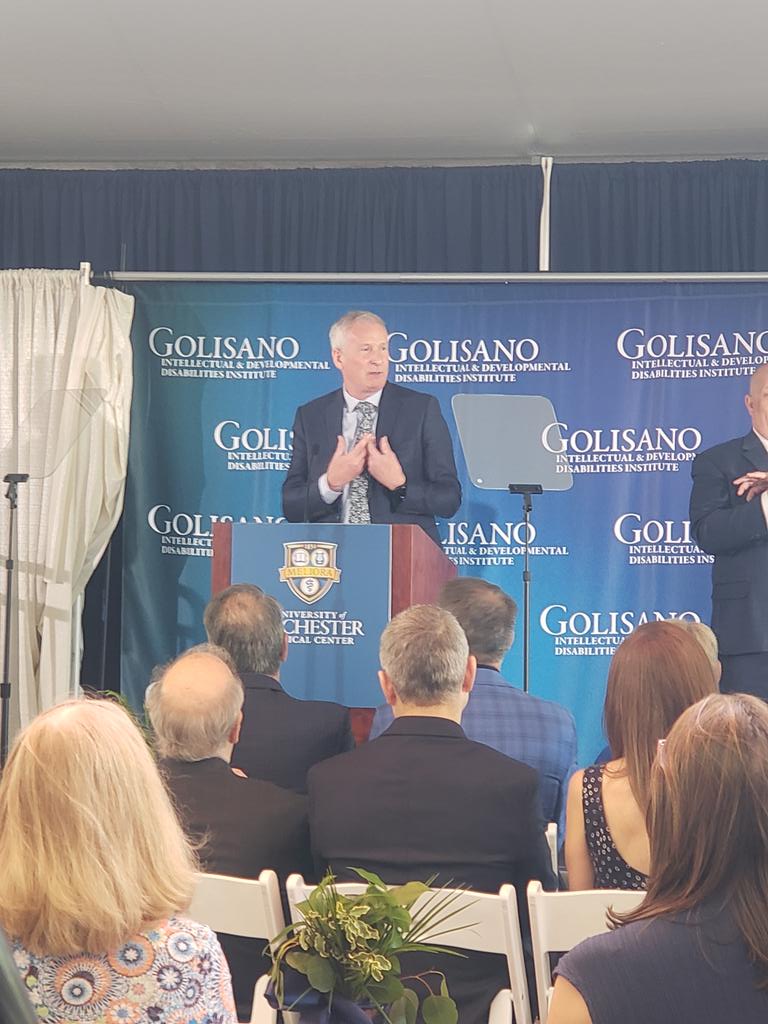
Tom Golisano makes $50 million commitment to the @UofR@UR_Med to build the new Golisano Intellectual and Developmental Disabilities Institute
Our own @JohnnyFoxe will lead the new Golisano IDD Institute
Read More⬇️ https://t.co/so70ErP2Xm


![carrisa_cocuzza's tweet photo. @HolmesLab_BHI is thrilled to announce the long-awaited Transdiagnostic Connectome Project, TCP 🎉🚨🧠 Data on OpenNeuro (BIDS MRI, behavior) & preprinted on medRxiv! A true “team work makes the dream work” effort, huge thanks to co-1st authors @SidChop @ConnorLawhead, as well as…[1/10]
https://t.co/vBOcdoQEar https://t.co/nDSdWHU1ZS](https://pbs.twimg.com/media/GQoSenRakAMgkSq.jpg)