JUST IN: Virginia’s Loudoun County expects $1.3 billion in data center tax revenue next year, helping the county cut residents’ property taxes by roughly 30% over the past decade.
Scientists found a way to flush Alzheimer’s plaque out of the brain in minutes.
Without any surgery and drugs.
Your brain has a waste-clearance network called the glymphatic system. It flushes out toxic proteins and dead cells.
But it only really activates during deep, slow-wave sleep.
If you don't sleep, the trash piles up. Over time, that buildup leads to cognitive decline and Alzheimer's.
Until today.
Researchers just published a paper proving they can manually trigger this cleaning cycle.
Without you ever going to sleep.
They used 40.68 MHz ultrashort waves (USW) beamed non-invasively into the brain.
Within 10 minutes, the brain's fluid flow rapidly accelerated.
The waves artificially synchronized the neurons into a Delta state, the exact frequency of deep sleep. This forced the brain's water channels to open and start flushing out the system.
They tested it on mice with traumatic brain injuries and Alzheimer's pathology.
The brain swelling dropped. The toxic proteins were cleared out. Cognitive deficits actually improved.
No surgery. No massive chemical interventions. Just a frequency.
Introducing Ardia, the open-source Arc
I've been working on this for a few months now. It's feature-complete, already used by a bunch of former Arc users, and extremely performant.
https://t.co/GNHbOaxdFO
There’s a world of difference between user-authorized agents (Muse, Instinct, Grokbot, etc.) and true unauthorized/rogue agents that could constitute cyberattacks.
Most of the activity described in the Axios story appears to be the former: customers sharing credentials with agents so they can take actions on their behalf. This may violate bank terms requiring humans to log in themselves, but these are in no way cyberattacks.
The direction banks should go is to support user-directed agents. For example, Amex is an authorized connection in Muse, making it easy for users to grant, limit, and revoke access.
Read-only permission levels are a sensible interim step. Several banks already support or are moving toward them. Full write access (with user credentials) is a different risk category and should be approached carefully.
Frightening the public by blurring the line between user-authorized agentic behavior and cyberattacks is irresponsible.
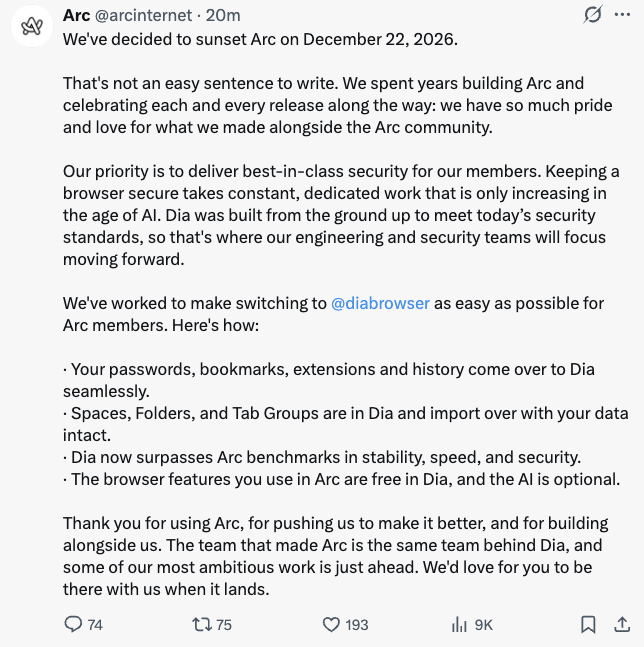
Generational fumble by @browsercompany:
Had a truly good browser, lots of power users who loved it.
Couldn't tackle "technical debt" on Arc so they started fresh with "Dia" which was worse in every way whenever I tried it.
Spent an absurd amount of money on staff, cosplaying as a real company when they weren't making money at all.
Got acquired by everyone's favorite issue tracker Atlassian.
If they had just held out until fable 5.1 and opus 5.5 probably could have actually tackled whatever tech debt they had and kept their actually good product.
SMH
when the cybersecurity team finds out there are actual vulnerabilities and they have to do their jobs instead of trying to trick someone into clicking a phishing email