🚨 Anthropic's own team just showed how to actually use Claude Code properly.
30 minutes. free. the person who created Claude Code.
watch the workshop. bookmark it.
worth more than every $500 course you almost bought.
you've been using Claude without knowing 40 of its commands.
Then read the guide below.
Siamo disinformati da giornalisti e commentatori moralisti che non sanno leggere e spiegare quello che sta accadendo.
Il presidente americano ha ripetuto più volte la frase chiave: «Xi è una persona che ha bisogno di petrolio. Noi no».
In queste poche parole sta tutta la questione.
Ogni giorno di blocco o rallentamento a Hormuz colpisce duramente l’economia cinese (che dipende in misura significativa dal petrolio mediorientale che transita da lì), il Giappone, la Corea del Sud e, in misura minore ma comunque rilevante, anche l’Europa.
È realpolitik pura: chi controlla i flussi energetici controlla la politica estera.
In Italia, però, questa dimensione geopolitica viene quasi sistematicamente ignorata. Sui principali talk show e nei commenti di molti opinionisti prevale un altro refrain: Trump è aggressivo, imprevedibile, sta «distruggendo le alleanze» e «attacca Meloni».
Pochi giornalisti inquadrano la manovra per quello che è: un classico esercizio di potere di una superpotenza che sfrutta il proprio vantaggio strutturale (l’indipendenza energetica) per spostare gli equilibri globali a proprio favore, mettendo in difficoltà il principale rivale strategico, la Cina.
Ma nei nostri media si preferisce il framing morale: la «follia di Trump», il rischio di «guerra mondiale», l’Europa vittima innocente.
Il risultato è una povertà informativa deprimente: il pubblico italiano riceve un ritratto caricaturale del presidente americano, privato della sua logica strategica, mentre le conseguenze concrete sui prezzi dell’energia e sulla sicurezza delle rotte marittime vengono presentate come frutto di un capriccio personale piuttosto che di una partita tra grandi potenze.
Capire Trump non significa approvarlo. Significa però riconoscere che dietro le sue mosse c’è una visione coerente di America First applicata all’energia e alla competizione con la Cina.
Ignorare questa realtà non rende l’Italia più sicura: la rende solo più impreparata.
Nobody talks about this. A free 1-hour masterclass from Warren Buffett that quietly beats most paid courses. MUST BOOKMARK📌
Watch this before your next investment decision.
Leadership + Investing breakdown. 1+ hour. Real-world wisdom. Must Watch.
The market doesn’t reward effort. It rewards clarity.
Most people stay average because they copy noise.
🚨 Sam Altman literally gave a 43-minute masterclass on turning ideas into billion-dollar companies.
Most people will never watch it.
And instead of hype, he broke down what actually makes startups work.
No fluff. Just reality.
He explained that ideas don’t matter nearly as much as execution. The difference between something small and something massive isn’t the idea it’s how relentlessly it’s built and improved over time.
He also emphasized that the best founders don’t chase everything. They focus on one thing that truly matters and push it forward with extreme clarity. Distraction kills more startups than competition ever will.
And then there’s scale. Truly big companies aren’t built for a niche they solve problems that millions of people care about. If the market isn’t large enough, the outcome won’t be either.
His biggest insight? Startups don’t win because they’re smarter they win because they stay in the game longer and iterate faster.
That’s why this masterclass stands out.
Because while most people are waiting for the perfect idea…
The best ones are already building.
🚨 In 1992, a MIT lecture quietly revealed more about product and sales than most 2-year MBAs ever will.
Most people have never seen it.
It came from Steve Jobs and instead of teaching theory, he broke down how great products actually win.
Watching it today feels unreal.
He explained that people don’t buy products they buy meaning. The best products aren’t just functional, they connect with how people see themselves. That’s why some ideas spread effortlessly while others die, even if they’re technically better.
He also made it clear that marketing isn’t about features. It’s about clarity. If you can’t explain why your product matters in simple terms, it won’t matter at all. Complexity doesn’t impress it confuses.
And his biggest edge? Obsession with experience. Not just what the product does, but how it feels. The small details, the simplicity, the story that’s what separates good from unforgettable.
That’s why this MIT lecture still hits hard.
Because while most people are building products…
Very few understand why people actually buy them.
A powerful scene in the Odyssey happens when Odysseus finally returns to Ithaca after twenty years of war and wandering.
You would expect the story to end with celebration, with the hero coming home, the family reunited, and order restored.
Homer does something far stranger.
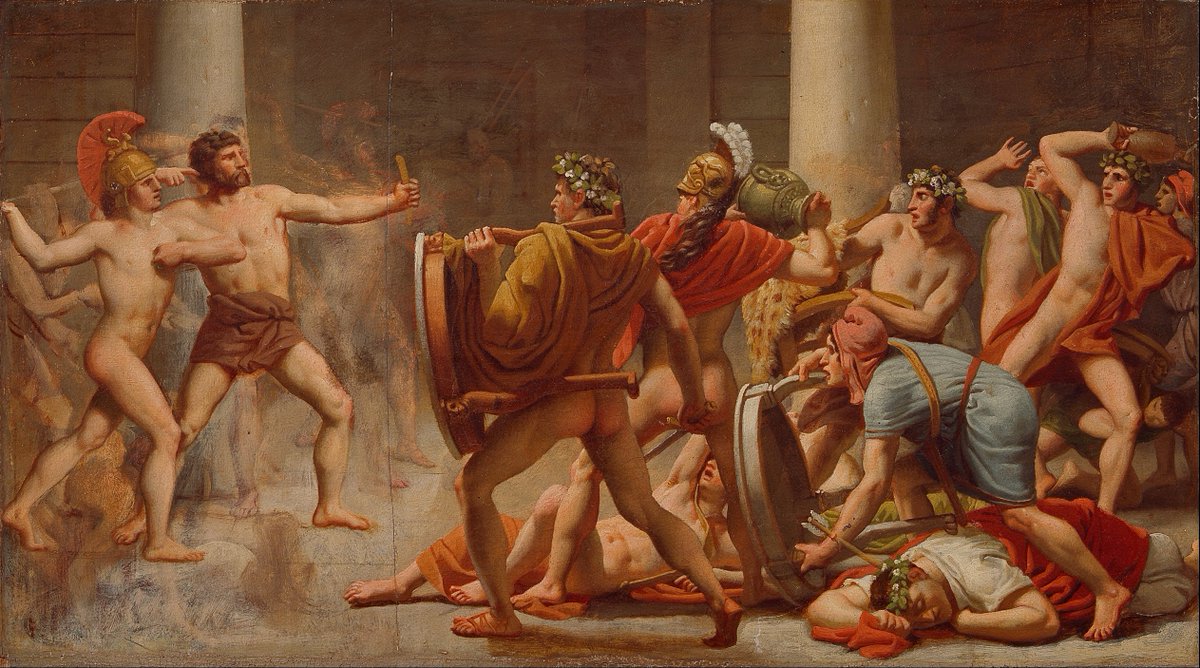
Odysseus arrives disguised as a beggar, because Athena warns him that the palace has been taken over by more than a hundred suitors who have been living there for years, eating his food, drinking his wine, and pressuring his wife Penelope to marry one of them.
They believe Odysseus is dead and in their minds the kingdom is already theirs.
So the king of Ithaca walks through his own halls dressed in rags while the men stealing his house sit comfortably at his tables. They mock him, throw scraps at him, and one of them even strikes him, and Odysseus takes it. That is the remarkable part, because the same man who blinded the Cyclops and survived twenty years of disasters now stands quietly while strangers insult him in his own home. Homer tells us his heart burns inside his chest and that he wants to attack them immediately, yet he restrains himself and waits.
Instead of striking, Odysseus studies the room carefully. He counts the men, watches their habits, and quietly observes which servants remain loyal and which have betrayed him. The hero of the Odyssey does something most people cannot do, which is delay revenge until the moment is right.
Eventually Penelope announces a contest and brings out Odysseus’ great bow, declaring that she will marry the man who can string it and shoot an arrow through twelve axe heads lined up in a row. One by one the suitors try and fail, because none of them can even bend the bow. Then the beggar asks for a turn. The suitors laugh at first, but the bow is eventually handed to him.
Odysseus takes it in his hands and strings it effortlessly. Homer says the sound of the bowstring tightening rings through the hall like the note of a swallow. Then he places an arrow on the string and sends it cleanly through all twelve axe heads.
In that moment the beggar disappears. Odysseus turns the bow toward the suitors and reveals who he is.
What follows is one of the most brutal scenes in Greek literature. The doors are sealed and the suitors realize too late that they are trapped inside the hall. Odysseus, his son Telemachus, and two loyal servants begin killing them one by one. There is no escape, no mercy, and no negotiation. The men who spent years consuming another man’s house die inside it.
It is a violent ending, but Homer wants you to understand something important. The real danger to Odysseus was never just the monsters and storms on the long journey home. It was the possibility that someone else might take his place while he was gone. When Odysseus finally returns, he reminds everyone in Ithaca of a simple truth: a man’s home is not truly his unless he is willing to fight for it.
Yesterday, I explained how seven insurance firms in London shut down one-fifth of the world's oil supply.
Today, Trump may have just made the most aggressive sovereign insurance play in modern history.
Here's what happened and why it matters:
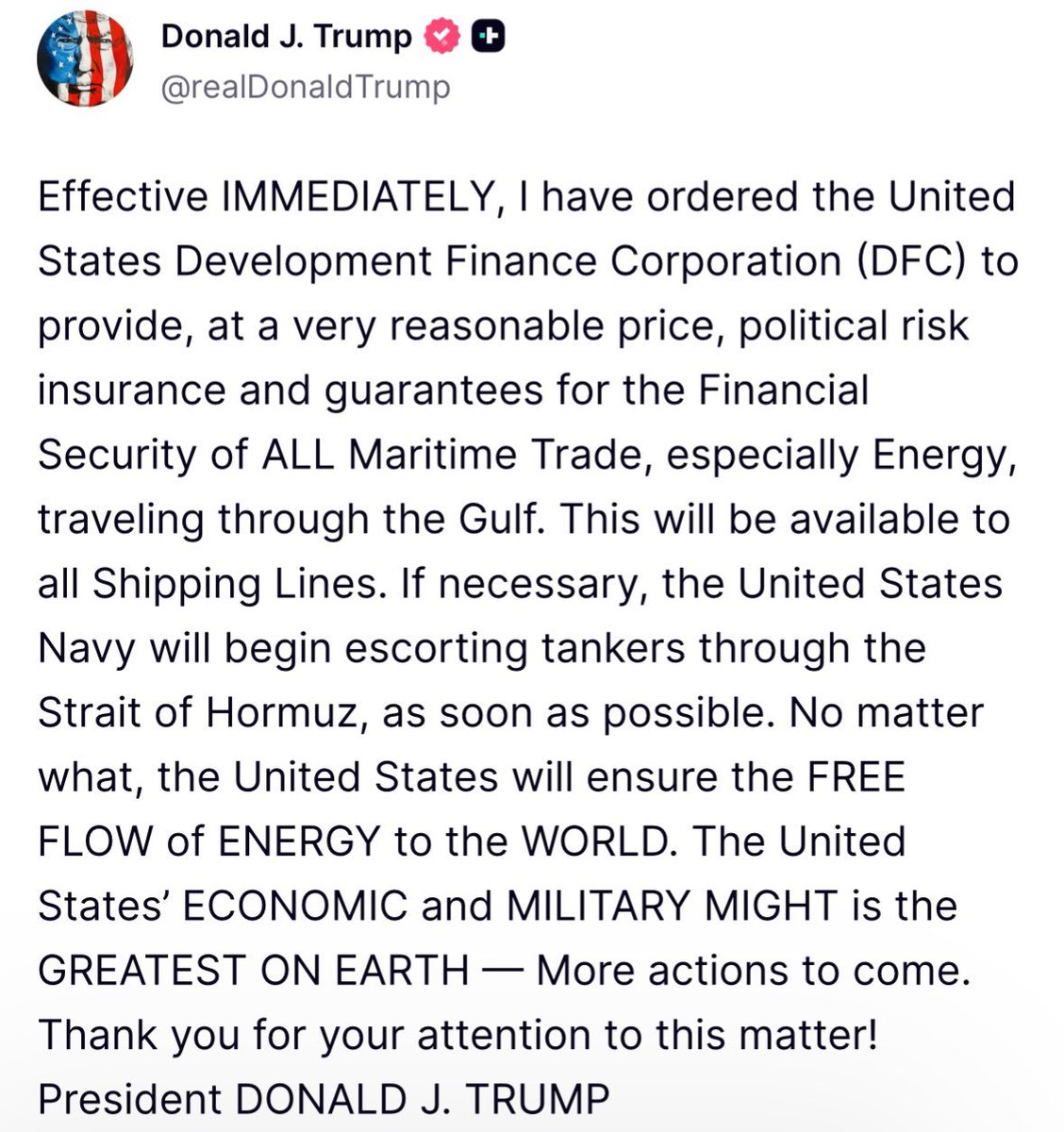
Trump ordered the U.S. Development Finance Corporation to immediately offer political risk insurance and guarantees to all maritime trade through the Gulf. Especially energy. Backed by Navy escorts if needed.
Read that through the lens of what I described yesterday.
The Strait didn't close because of missiles. It closed because the insurance market collapsed. P&I clubs pulled coverage, reinsurers withdrew, and the entire commercial shipping architecture froze.
This move doesn't address the military problem. It addresses the actuarial one.
The DFC is stepping into the void that Lloyd's and the London reinsurance market created when they pulled out. The U.S. government is effectively saying: we will underwrite what the private market won't.
No sovereign has attempted to replace the global marine war risk market in real time during an active conflict. Here's why the structural implications are significant:
1. It challenges Lloyd's dominance.
For centuries, London has been the center of gravity for marine insurance. Lloyd's and its reinsurers controlled pricing, terms, and risk appetite for global shipping.
That concentration is exactly what made the actuarial blockade possible. A handful of firms in one city froze global oil flows.
The DFC offering competitive political risk coverage to all shipping lines is a direct challenge to that architecture. If American-backed insurance proves cheaper and more reliable during crises, shippers may not return to London when the dust settles.
2. It breaks the actuarial blockade.
I said yesterday that China has massive leverage over Iran but zero leverage over Lloyd's. The same was true of every oil-producing and oil-consuming nation watching their economies choke.
This goes around the insurance market entirely. If the DFC covers the voyage and the Navy escorts the tanker, the ships sail. Oil flows. The spreadsheet blockade breaks.
3. It redirects billions in premium revenue.
War risk premiums in the Gulf are currently running at extreme multiples — 3× to 5× pre-conflict rates. Those premiums were flowing to London reinsurers who then pulled coverage anyway.
Now those premiums flow to Washington. At rates the DFC can set below the panicked London market, while still generating substantial returns. The same shippers get cheaper coverage. The revenue just changes continents.
4. It creates a chokepoint within the chokepoint.
The Strait of Hormuz is already the world's most critical energy bottleneck. If the U.S. is both insurer and naval escort, America controls access at two levels: physical security and financial coverage.
No other nation can replicate that. You need the world's dominant navy and a sovereign balance sheet large enough to backstop the risk. Only one country has both.
5. It reassures every stakeholder simultaneously.
Gulf producers were watching exports freeze. Asian and European consumers were watching energy prices spike. Both feared the Iran campaign would wreck their economies.
One announcement addressed all of them: your oil will move, your ships will be covered, and the rates will be reasonable.
Yesterday I described a system with no TARP, no Fed equivalent, no backstop at global scale.
This may be the first attempt to build one in real time, during the crisis itself.
The actuarial blockade just met a sovereign counterparty.
Bill Clinton: “I killed myself trying to give the Palestinians a state. I had a deal they turned down that would have given them all of Gaza and 97% of the West Bank. You name it. They turned it all down.”
Palestinians don’t want peace.
Tears streaming down my face listening to this audio out of Iran. They are saying it’s a massacre worse than the mind can fathom. That the 12,000 estimate is a joke in comparison to the numbers killed. And above all, that they outside help… and they need it NOW
BREAKING: Iranians able to gain communication describe the extent of the massacre perpetrated by the Islamic Republic.
“The 12,000 estimate is a joke in comparison to the numbers killed.”
TERRIFICANTE! IN IRAN È IN CORSO UNA CARNEFICINA DI GIOVANI! Il numeri dei morti aumenta esponenzialmente di ora in ora. Secondo fonti interne di personale medico e di organizzazioni umanitarie i morti sarebbero circa 3.500 e oltre 10.000 feriti. Questo è il numero totale dei manifestanti uccisi registrato dal personale ospedali degli ospedali del paese.
Aggiornamenti a breve...
#IranianRevolution2026 #IRGCterrorists
@RadioRadicale #Turchia
This is Tehran. Let that sink in. You are watching a revolution unfold live while the world’s media stays dead silent. Legacy media has become nothing more than a propaganda machine, because what news could possibly be bigger than this?
@FoxNews@CNN https://t.co/1X5PlzQAhw
“Sparare a Martin Luther King e sparare a un esponente di #Maga sono due cose molto diverse”.
Il professor #Odifreddi dice queste idiozie mentre il corpo ancora tiepido di Charlie Kirk è in obitorio.
È uno schifo che #La7 continui a dare il microfono a certa gente.
#CharlieKirk #11settembre
@Maximix1970 Meglio fare come la Germania che dopo aver speso 500 miliardi di euro per installare 140 GW di eolico e fotovoltaico, ha le emissioni tra 5/8 volte superiori a quelle francesi dato che preferiscono chiudere il nucleare e consumare lignite/carbone. Le ren sono gratis giusto?