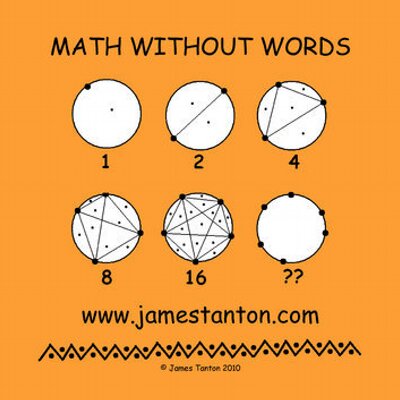
@BigGingerYeti Thanks! This is actually intended. One way to define a circle is to know its center and one point it passes through. From the equation: the center is (0,1). What's a point it passes through that is a pair of integers? (Hint: 1^2+2^2 = 5)
Ever since we moved our tutor to Wafer, the responses feel near-instant.
We didn’t expect things to get this fast so soon.
Thanks to @gpuemi and the @wafer_ai team! Love using a product built by a founder who grew up on Brilliant :)
i grew up in Mexico, where it wasn’t always easy to find really high-quality educational resources that pushed me intellectually.
i knew pretty early that i wanted to eventually go to one of the best universities i could in the US, and i spent a lot of time trying to get sharper on my own.
@brilliantorg was a very meaningful part of that.
i still remember being in early high school and absolutely spamming their logic courses. i loved them. they genuinely made me better at thinking, especially around math and logic, and helped build a lot of the skills that eventually got me where i wanted to go.
so there is something very surreal about @wafer_ai now serving Brilliant :)
their AI tutor, Koji, needs to respond incredibly quickly while students are working through math and coding problems. before Wafer, Brilliant was speculatively prefetching AI-generated responses so students wouldn’t have to wait.
on our dedicated GLM-5.2 endpoint, they’re now getting ~250ms time to first token and 300+ output tok/s, 3x the throughput of their previous provider!
that let them remove the prefetching layer entirely and cut inference costs by 50%.
it’s hard to describe how gratifying it is to help power a product that helped me become a better thinker when i was a kid.
very full circle moment.
🧵 Brilliant’s full story in thread.
This is an awesome customer story (I’m a proud @brilliantorg investor and a huge supporter of their mission).
We heard the same themes over and over again when speaking to @wafer_ai customers.
i grew up in Mexico, where it wasn’t always easy to find really high-quality educational resources that pushed me intellectually.
i knew pretty early that i wanted to eventually go to one of the best universities i could in the US, and i spent a lot of time trying to get sharper on my own.
@brilliantorg was a very meaningful part of that.
i still remember being in early high school and absolutely spamming their logic courses. i loved them. they genuinely made me better at thinking, especially around math and logic, and helped build a lot of the skills that eventually got me where i wanted to go.
so there is something very surreal about @wafer_ai now serving Brilliant :)
their AI tutor, Koji, needs to respond incredibly quickly while students are working through math and coding problems. before Wafer, Brilliant was speculatively prefetching AI-generated responses so students wouldn’t have to wait.
on our dedicated GLM-5.2 endpoint, they’re now getting ~250ms time to first token and 300+ output tok/s, 3x the throughput of their previous provider!
that let them remove the prefetching layer entirely and cut inference costs by 50%.
it’s hard to describe how gratifying it is to help power a product that helped me become a better thinker when i was a kid.
very full circle moment.
🧵 Brilliant’s full story in thread.
Give a kid a potato and they’ll eat for a day.
Teach them to plant potatoes and you’ll have to teach them crop rotation next.
Teach them to teach themselves and you’ll never have to talk to them again.
"Using AI as a way to skip the part where you learn is like bringing a robotic arm to the gym to lift weights for you.
We're really losing the plot of why you went to the gym in the first place."
From Sue, co-founder of @brilliantorg:
"We believe technology can and should be making our kids smarter, not dumber. AI today is mostly used by students for cheating."
"So when we built our AI tutor, we wanted to use it to protect the time and effort that the student spends thinking for themselves, just like a great teacher would."
Watch the full episode: https://t.co/jzogacrhiK
It sounds trivial, but explaining the answer to the specific problem at hand is miles different from breaking down the process for solving a similar problem.
When you say, “Here’s how you solve this exact problem,” you communicate that the objective is getting that problem answered.
What you want is to perma-install the package that can arrive at the solution, while keeping responsibility for the problem at hand in the learner’s hands.
Even better if you can coach them to get there without spoonfeeding a procedure (even for a similar problem), but that’s not always practical. Much of great tutoring is about weighing that tradeoff, for the specific learner and circumstance.
“Cheating and explaining the answer [to your child] are closer than you’d think.”
Here’s my new episode with @suekhim, co-founder of @brilliantorg, who showed me how AI can help kids think for themselves. We talked about:
→ Why better grades don’t always mean more learning
→ How to help kids enjoy doing hard things vs. only trying to please adults
→ Why her #1 product principle is “Never tell the learner the answer”
Some quotes from Sue:
“Using AI to skip learning is like bringing a robotic arm to the gym to lift weights for you.”
“Learning isn’t about the answer. It is about strengthening that part of you that can concentrate and struggle, that’s unafraid of trying new problems.”
“When building AI products, try to find areas where you have unique data that makes your product better over time.”
📌 Watch the full episode: https://t.co/jzogacrhiK
Thanks to our sponsors:
@linear: The AI agent platform for modern teams https://t.co/tgWf9oL4bs
@RiversidedotFM: All-in-one AI studio for podcasts and video https://t.co/uWnS6aiMPE
AI changed how we code. So we mapped the skills programmers need now.
Brilliant’s Durable Coding Skills Framework provides a complete map from foundational CS to effective coding with AI:
Foundations: 7 Big Ideas, 42 learning objectives, 196 skills
Coding with AI: 7 Big Ideas, 37 learning objectives, 106 skills
Much of coding now happens through natural language: describing a task, setting constraints, and directing an AI agent. But natural language is ambiguous, and generated code still needs to be tested, debugged, and judged.
This means the foundations of computer science still matter. They’re what let you tell an AI what to build, recognize when it’s wrong, and make it better.
In Brilliant fashion, we made the framework visual and interactive, so you can see how we break down categories of skills when we design our curriculum.
Check it out at https://t.co/KJaCujh9J2 and let us know what you think!
I've been running an informal math circle for preschoolers, and it's amazing what 5 yo's can do.
Combinatorial reasoning, backward induction, beginnings of proof... the concepts are there even before mastering arithmetic.
If you have kids 5-7 you can try these games at home too.
Here's what we did our first session 🧵
The default use of AI for students today is cheating. This seems bad on the surface, but will ultimately force changes we should make anyway.
One obvious one is to stop grading homework.
It's like we've been afraid to test students on what they know, so we weight things like attendance and homework completion to boost grades.
This makes everyone less accountable for whether students actually reach proficiency.
In many other countries, homework is ungraded. It’s a gift from the instructor that guides you toward useful practice before the exam.
Awarding academic credit for completion rather than mastery didn’t make much sense before AI. It’s completely nonsensical now.
Family plans are new + we don’t currently offer monthly.
The price there is the monthly equivalent, for an apples-to-apples comparison across all 3 plans - but it's billed annually as noted there.
If you DM us the email address your wife signed up with, we’ll see what we can do to further assist.
The week that we launched our AI tutor Koji, “AI” as a topic was getting commencement speakers booed off stage.
We were worried the launch was doomed, but instead it went super viral.
Why?
It turns out people aren’t “anti-AI”.
They’re anti-idiocracy, anti-job replacement, anti-slop.
But if you show them a product that will help them and their kids be better thinkers, they’ll embrace it.
A positive, pro-social vision of AI is hugely resonant.
Thanks @Jason@twistartups for having me on!