@francispouliot_ I bought today sub 6k and persuaded two friends\ nocoiners to buy for the first time and this Ponzi went sub 5k. They gonna shot me ☠️
Everyone's coming up with theories on what caused this market capitulation, here was really happend:
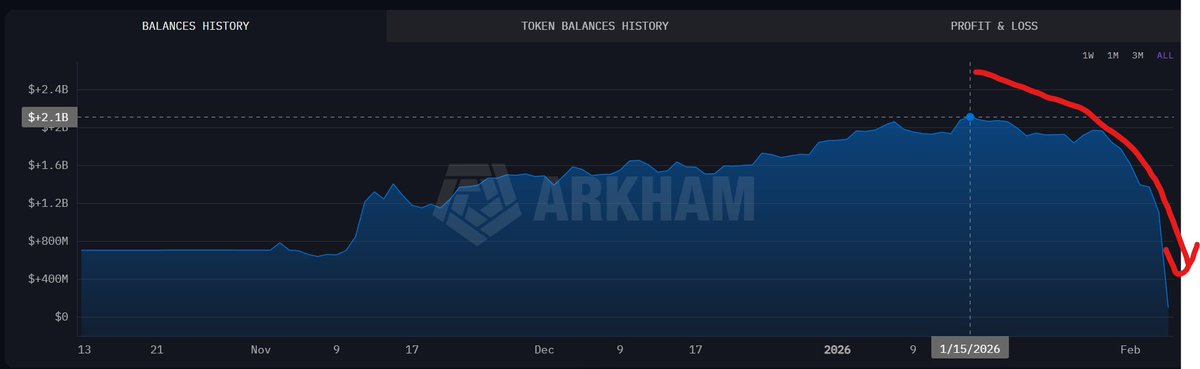
Shanghai based firm Trend Research Blew out a 2 billion dollar leveraged ETH position for a total PnL of -686 mil
This is how it unfolded:
Trend Research Fund is a secondary investment institution focused on blockchain and cryptocurrency markets, operating as part of LD Capital, a broader venture capital firm founded by Jack Yi in 2016. LD Capital, which oversees Trend Research, is based in Shanghai, China, and has been active in crypto investments since Yi entered the industry in 2015. Trend Research itself appears to have been established more recently, likely around 2025, as a specialized arm for secondary market strategies, including large-scale positions in assets like Ethereum (ETH). The fund emphasizes high-conviction bets during market cycles, with Yi publicly stating bullish views on ETH for the first half of 2026, even amid volatility. By late 2025, Trend Research was already accumulating ETH aggressively, positioning itself among the largest known holders, and Yi announced plans to deploy an additional $1 billion into ETH dips, warning against shorting the asset.
Regarding the ETH trade that unraveled in early February 2026: Trend Research built a massive leveraged long position on ETH, starting accumulations as early as late 2023 but ramping up significantly during the October 2025 selloff and continuing into January 2026. By January 20, 2026, the fund held approximately 636,815 ETH valued at around $1.98 billion, with an average entry price of about $3,180 per ETH (some reports cite $3,150). The position was leveraged on Aave, a decentralized lending protocol, where ETH served as collateral to borrow stablecoins like USDT. Leverage details aren't explicitly quantified in multiples (e.g., 5x or 10x), but on-chain data shows high debt levels relative to collateral—for instance, at one point, $939 million in loans against $1.33 billion in ETH collateral, implying a collateralization ratio around 1.4 (typical for Aave, where liquidation risks kick in below health factors of 1.0-1.05). This setup created vulnerability to price drops, with liquidation thresholds adjusting based on repayments.The position began unwinding rapidly starting around February 2, 2026, as ETH prices fell sharply below $2,000 amid broader market turmoil (including geopolitical tensions, ETF outflows, and liquidation cascades wiping out $5.4 billion in longs across crypto). This drop pushed the fund's health factor toward critical levels, forcing proactive deleveraging to avoid automated liquidations on Aave. Trend Research started selling ETH in batches to repay USDT loans and lower the liquidation price:
- On February 2: Sold 53,589 ETH ($123 million) and repaid $121 million in USDT, dropping the liquidation price to ~$1,810.
- By February 4: Additional sales, including 15,000 ETH ($33 million) and up to 188,500 ETH total ($426 million), with $385 million repaid, adjusting liquidation to ~$1,640.
- On February 5: Further deposits to Binance (e.g., 11,000 ETH at $20.78 million), part of a cumulative 215,588 ETH ($477 million) sold, with liquidation risk at ~$1,830 for an $862 million cascade.
- On February 6 (yesterday): Transferred 20,000 ETH to Binance and sold 47,000 ETH ($89.29 million) in the prior 6 hours, updating the liquidation range to $1,509–$1,800. Reports indicate over $600 million in ETH sold in the last 48 hours alone, reducing holdings to around 488,000 ETH (~$1.05 billion).
The unwind was forced by ETH's price crash (down ~28% in a week to ~$1,867–$2,110), which thinned on-chain liquidity and triggered a self-reinforcing cascade. Trend Research had to sell into a falling market to maintain the position's health factor, avoiding full forced liquidation by Aave's protocol (which would auction collateral at potentially worse prices). This deleveraging was strategic but painful, as it locked in losses while adding selling pressure to ETH.
End result: The fund avoided complete liquidation so far but significantly reduced its exposure, holding ~488,000 ETH with ongoing risk—if ETH hits ~$1,520–$1,560, another ~$428 million could liquidate. The position is still live but much smaller and less leveraged, with the liquidation threshold now lower but prices hovering dangerously close.PnL: Massive losses. Early estimates on February 2 showed $613 million total ($47.42 million realized, $565 million unrealized). As sales continued, realized losses mounted—on-chain analysis pegs $763 million lost on ETH longs over the past 5 days (February 2–6), with floating losses on remaining holdings adding to the pain.
Cumulative realized losses from sales exceed $400–500 million based on average entry vs. sale prices ($2,200–$2,300 average sell), though exact figures vary by report. The fund's overall ETH bet, once a ~$2 billion position, is now deeply underwater, reflecting a failed high-conviction play amid unexpected market downturn.
The majority of Americans have no idea how inflation works, no idea what the Federal Reserve does, and no idea what the US federal deficit is.
FinTwit is a bubble.
The "debasement trade" is just beginning. Take dollars and buy assets or be left behind in a permanent underclass.