En arrivant au Brésil et en étant témoin de l'esclavage de près, Charles Darwin écrivit :
« Près de Rio de Janeiro, ma voisine d'en face était une vieille dame qui possédait des vis-pouces avec lesquelles elle écrasait les doigts de ses esclaves. Dans une maison où j'avais séjourné auparavant, un jeune serviteur mulâtre était, chaque jour et à toute heure, insulté, battu et pourchassé avec une fureur capable de décourager jusqu'au plus vil des animaux.
J'ai vu un enfant de six ou sept ans frappé à la tête avec un fouet (avant que je puisse intervenir) parce qu'il m'avait servi un verre d'eau légèrement trouble...
Et ce sont là des actes commis par des hommes qui prétendent aimer leur prochain comme eux-mêmes, qui croient en Dieu, et qui prient pour que Sa volonté soit faite sur terre !
Le sang bout dans nos veines et nos cœurs s'emballent quand nous songeons que nous, les Anglais, et nos descendants américains avec leurs cris fanfarons pour la liberté, avons été et sommes encore coupables de cet énorme crime. »
(Charles Darwin, Le Voyage du Beagle)
La FLACSO México lamenta el sensible fallecimiento del Dr. Raúl Pacheco-Vega entrañable profesor-investigador, colega, amigo y miembro muy querido de nuestra comunidad académica.
Expresamos nuestras más sentidas condolencias a sus familiares, amistades, colegas, estudiantado y a las comunidades académicas de las que formó parte.
In some very real sense, Ozempic was invented in 1990. Pfizer ran the human trials and just never published them.
They showed it lowered blood glucose in diabetics, slowed gastric emptying, and killed hunger; the same 3 things that make Ozempic work today.
The joint venture agreement said internal data stayed internal, and that was that. Pfizer killed the program in 1991. The reasoning, as far as I can tell, was that nobody would ever want an injectable diabetes drug besides insulin.
So, the license went back to the hospital in Boston that held the patents.
Novo picked it up in 1992 and spent the next two decades building liraglutide, then semaglutide.
It's insane that data sat in a filing cabinet for 30+ years.
I only know this because Jeffrey Flier, one of the Harvard scientists in the room, finally wrote it up. He's in his late 70s and didn't want the history to die with him.
This makes you wonder what else is in those filing cabinets.
Ozempic could've existed 27 years ago.
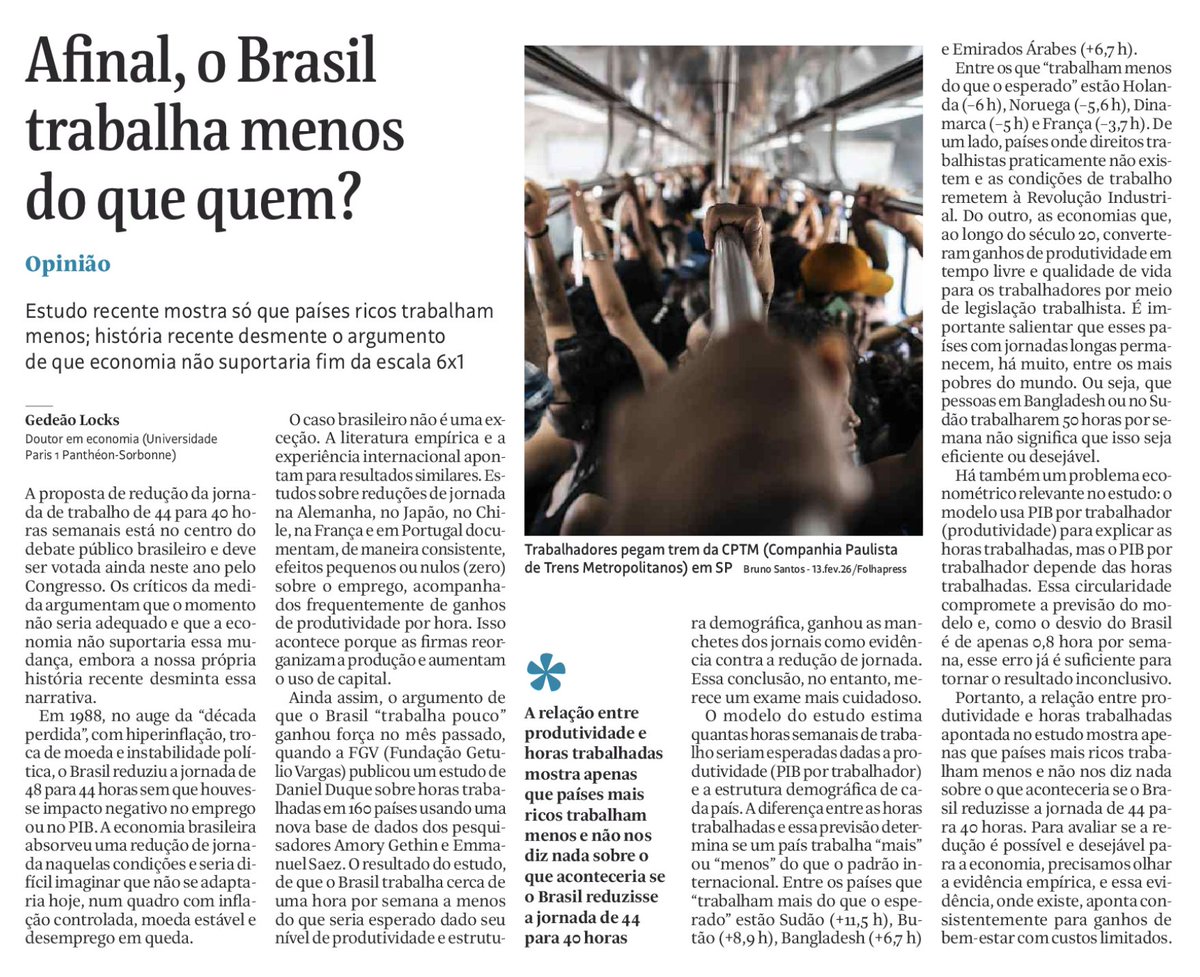
Meu artigo de hoje na Folha discute a manchete de que o Brasil "trabalha pouco". O estudo da FGV tem problemas metodológicos e a média global, por si só, diz pouco. No máximo, sugere que estamos mais próximos da Noruega do que do Sudão -- o que não é exatamente um problema. +
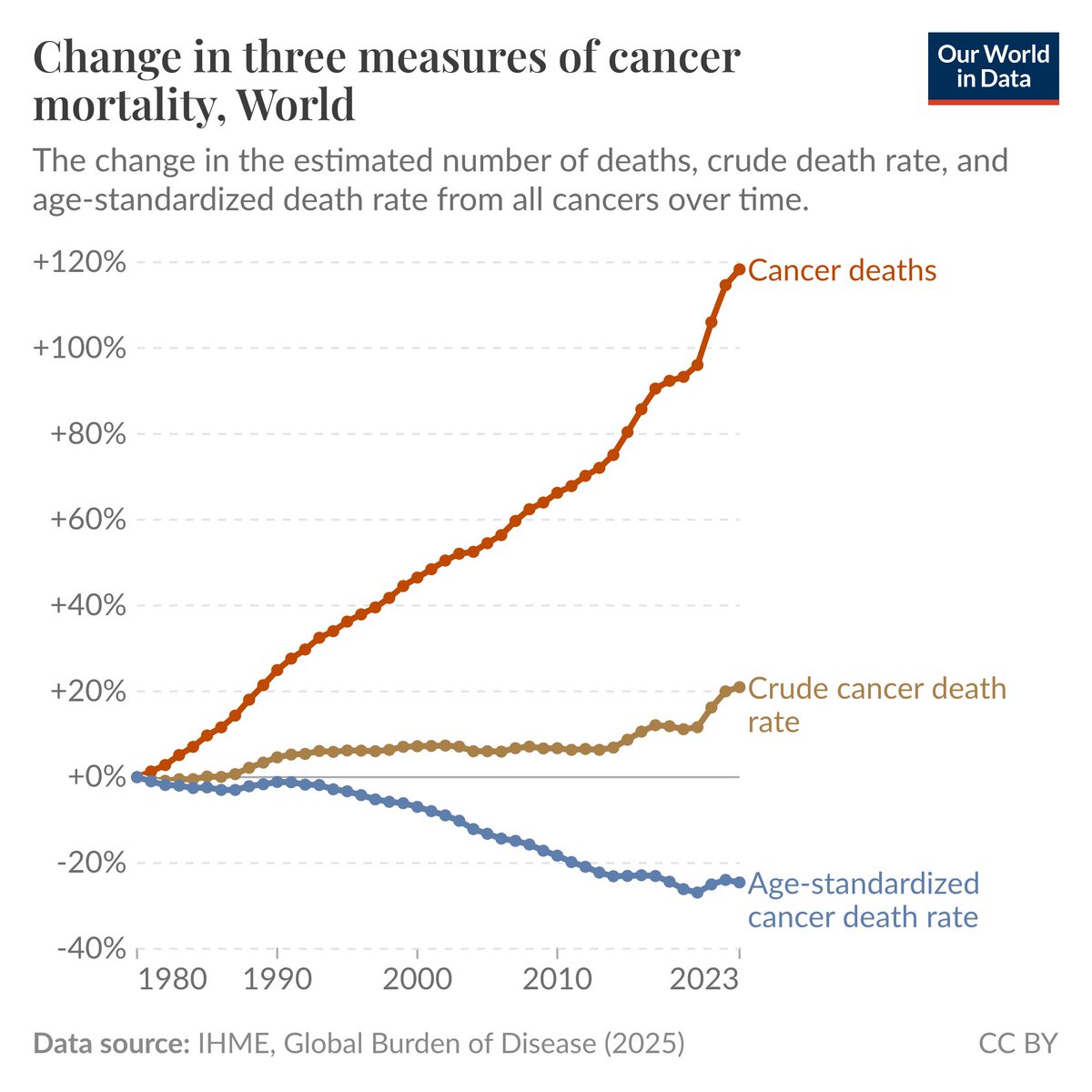
The number of cancer deaths worldwide has more than doubled since the 1980s. Does that mean we're losing the fight against cancer? Not necessarily, because it depends on how you measure it. On this chart, you can see three ways to look at the same data.
The red line shows the total number of cancer deaths. It has increased by about 120%, but this measure doesn't account for the fact that the world's population has also grown enormously over this period.
Another approach is to look at the death rate: the number of cancer deaths divided by the total population. That's the brown line, called the crude cancer death rate. It has increased too, but much less — around 20%.
But there's still a problem: the world's population has been getting older. Cancer is mostly a disease of old age, so even per capita, we'd expect more cancer deaths simply because there are more older people than before.
That's where the method of “age standardization” comes in. It's a way of asking: what would the cancer death rate look like if the age structure of the population hadn't changed?
The blue line shows this age-standardized rate: it's fallen by about 25%. At any given age, people are now less likely to die of cancer than they were in the 1980s.
The same underlying data gives us three different pictures. The absolute number of deaths is up; the crude rate is up slightly; the age-standardized rate is down. None of these are inaccurate, but they answer different questions.
Age standardization is one of the most important statistical methods for making sense of health data. Without it, population aging can hide progress or mask problems.