Very cool opportunity today to be interviewed at the NYSE to discuss how AI is changing Transportation and the role that @INRIX plays. https://t.co/oMF3mLHqG5
Elon Musk avait dit un truc qui m'avait marqué sur l'allocation de ressources. En substance : passé un certain niveau de richesse, l'argent n'est plus de la consommation, c'est de l'allocation de capital.
Cette phrase change tout.
L'économie, dans le fond, c'est juste un problème d'allocation. Tu as des ressources finies et des usages infinis. Qui décide où va quoi ?
Imagine une cour de récré. 100 enfants, des paquets de cartes Pokémon distribués au hasard. Tu laisses faire. Très vite, un ordre émerge. Les bons joueurs accumulent les cartes rares, les collectionneurs trient, les négociateurs trouvent des deals. Personne n'a planifié. Et pourtant chaque carte finit dans les mains de celui qui en tire le plus de valeur. Le système maximise le bonheur total de la cour. C'est ça, la main invisible.
Maintenant fais entrer la maîtresse. Elle trouve ça injuste. Léo a 50 cartes, Tom en a 3. Elle confisque, redistribue, impose l'égalité. Trois effets immédiats. Les bons joueurs arrêtent de jouer, à quoi bon. Les mauvais n'ont plus de raison de progresser, ils auront leur part. Les échanges s'effondrent. La cour est égale, et morte. Elle a maximisé l'égalité, elle a détruit le bonheur.
Le problème de la maîtresse, c'est qu'elle ne peut pas avoir l'information que la cour avait collectivement. C'est le problème du calcul économique de Mises, formulé en 1920. L'URSS a essayé de le résoudre pendant 70 ans avec le Gosplan. Résultat : pénuries, queues, effondrement. Pas parce que les Soviétiques étaient bêtes, parce que le problème est mathématiquement insoluble en mode centralisé.
Quand Musk a 200 milliards, il ne les consomme pas, il les alloue. SpaceX, Starlink, Neuralink, xAI. Chaque dollar est un pari sur le futur. Et lui a un track record. PayPal, Tesla, SpaceX. Il a démontré qu'il sait identifier des problèmes immenses et y allouer des ressources avec un rendement spectaculaire.
L'État aussi a un track record. Hôpitaux qui s'effondrent, éducation qui décline, dette qui explose, services publics qui se dégradent malgré des budgets en hausse constante. Le marché identifie les bons allocateurs, la politique identifie les bons communicants.
Le profit n'est pas une finalité, c'est un signal. Il dit : tu as alloué des ressources rares vers un usage que les gens valorisent suffisamment pour payer. Plus le profit est gros, plus la création de valeur est grande. Quand Starlink est rentable, ça veut dire que des millions de gens dans des zones rurales ont enfin internet. Quand un ministère est en déficit, ça veut dire qu'il consomme plus qu'il ne produit. L'un crée, l'autre détruit, et on appelle ça redistribution.
Dans nos sociétés il y a deux catégories d'acteurs. Les entrepreneurs et les bureaucrates. L'entrepreneur prend un risque personnel pour identifier un problème, mobiliser des ressources, créer une solution. S'il se trompe il perd. S'il a raison, ses clients gagnent, ses employés gagnent, ses fournisseurs gagnent, l'État collecte des impôts. Il est la cellule de base du progrès humain.
Le bureaucrate ne prend aucun risque personnel. Son salaire est garanti. Au mieux il maintient une rente existante. Au pire il la détruit par excès de réglementation, mauvaise allocation forcée, incitations perverses qui découragent ceux qui produisent. Mais dans aucun cas il ne crée.
Regarde les 50 dernières années. iPhone, internet civil, SpaceX, Tesla, Google, Amazon, Stripe, mRNA, ChatGPT. Toutes des inventions privées, portées par des entrepreneurs, financées par du capital risque. Pas un seul ministère n'a inventé quoi que ce soit qui ait changé ta vie au quotidien.
La France est devenue le laboratoire mondial de la dérive bureaucratique. 57% du PIB en dépenses publiques, record absolu. Une administration tentaculaire, une fiscalité qui pénalise la création de richesse. Résultat : décrochage face aux États-Unis, à l'Allemagne, à la Suisse. Fuite des cerveaux. Désindustrialisation. Dette qui explose.
Et le pire c'est que la mauvaise allocation s'auto-renforce. Plus l'État prélève, moins les entrepreneurs créent. Moins ils créent, moins il y a de base fiscale. Plus l'État s'endette et taxe. Boucle de rétroaction négative parfaite. La maîtresse pense qu'elle aide, et chaque année la cour produit moins.
Dans nos sociétés, ce sont les entrepreneurs, toujours, qui font avancer la civilisation. Les bureaucrates au mieux maintiennent une rente, au pire la détruisent. Aucune société n'a jamais progressé en taxant ses créateurs pour subventionner ses gestionnaires.
La question n'est jamais qui a combien. C'est qui alloue le mieux la prochaine unité de ressource pour maximiser le futur de l'humanité. La réponse depuis 200 ans n'a jamais changé. Ce ne sont pas les fonctionnaires.
Running a company:
2020: can you survive a pandemic?
2021: still here? we’re going to give all of your competitors $100m series A rounds.
2022: wow, you made it? okay, all engineers cost $600,000/year now.
2023: nice job! okay, SVB failed and we’re going to take away your bank account.
2024: a survivor I see. but can you pivot from ai to crypto to defense tech back to ai-enabled defense tech in a 12 month period to stay relevant?
2025: unfortunately all of your competitors have raised $2b series B rounds. oh and only 500 engineers are relevant and they cost $100m/yr each.
2026: well, well, well. you’re still in business? let’s deploy the thunderclap of godlike LLMs from the heavens so all of your customers can rebuild your app in 2 hours. can you survive?
A second interview I did last week, this one with John Furrier at the NYSE, talking about how AI is already changing transportation for the better and how INRIX is playing a key role. https://t.co/yhULkv2DJ4
Seattle and Bellevue are about as close to a natural experiment in economics as you could get, akin to North Korea and South Korea.
The reason Seattle is in decay, while Bellevue is thriving is simple: bad policy and Seattle's incompetent socialist leadership.
Just after Washington State voted to approve a 9.9% "millionaire tax" on personal income over $1 million, Jeff Bezos, Howard Schultz, and tons fled. The impacts will be ENORMOUS. I gathered the facts, stories, and data and made this mini documentary: https://t.co/hftcDrw9gM
Jevons paradox is happening in real time. Companies, especially outside of tech, are realizing that they can now afford to take on software projects that they wouldn’t have been able to tackle before because now AI lets them do so.
We’re going to start to use software for all new things in the economy because it’s incrementally cheaper to produce. Marketing teams at big companies will have engineers helping to automate workflows. Engineers in life sciences and healthcare will automate research. Small businesses will hire engineers for the first to build better digital experiences.
And as long as AI agents still require a human who understands what to prompt, how to review when an agent goes off the rails, how it guide back, how to maintain the system that was built, how to fix the ongoing bugs, and more, we will still have humans managing these agents.
This is why all the advice you get of not going into engineering is wrong. The world is going to increasingly be made up of software, and the people that understand it best will be in a strong economic position. This will happen in other roles as well where output goes up and demand increases.
This is a real head scratcher… what could be causing the vacancies? and why would vacancies be causing property values to decrease…
Future head scratcher will be why are property taxes decreasing so much? And why is the Seattle City Budget so upside down relative to revenue? And why is no one else moving in to fill the space?
So many unanswerable questions to ponder. If only there was some logic to all of it!
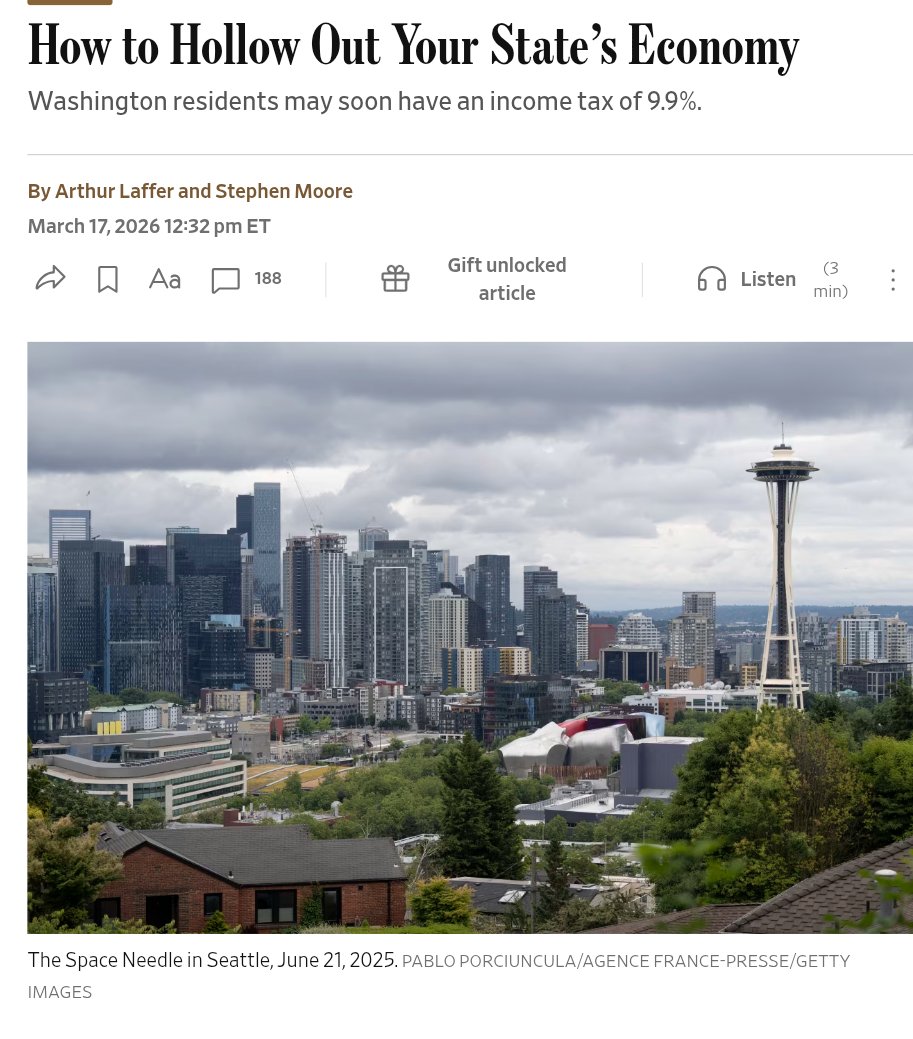
From @WSJopinion: A secret to the Evergreen State’s success has been that it has no income tax. But Democrats in Olympia are perilously close to enacting a “millionaire tax” of 9.9%, write Arthur Laffer and Stephen Moore.
https://t.co/CgiZpdL9rn
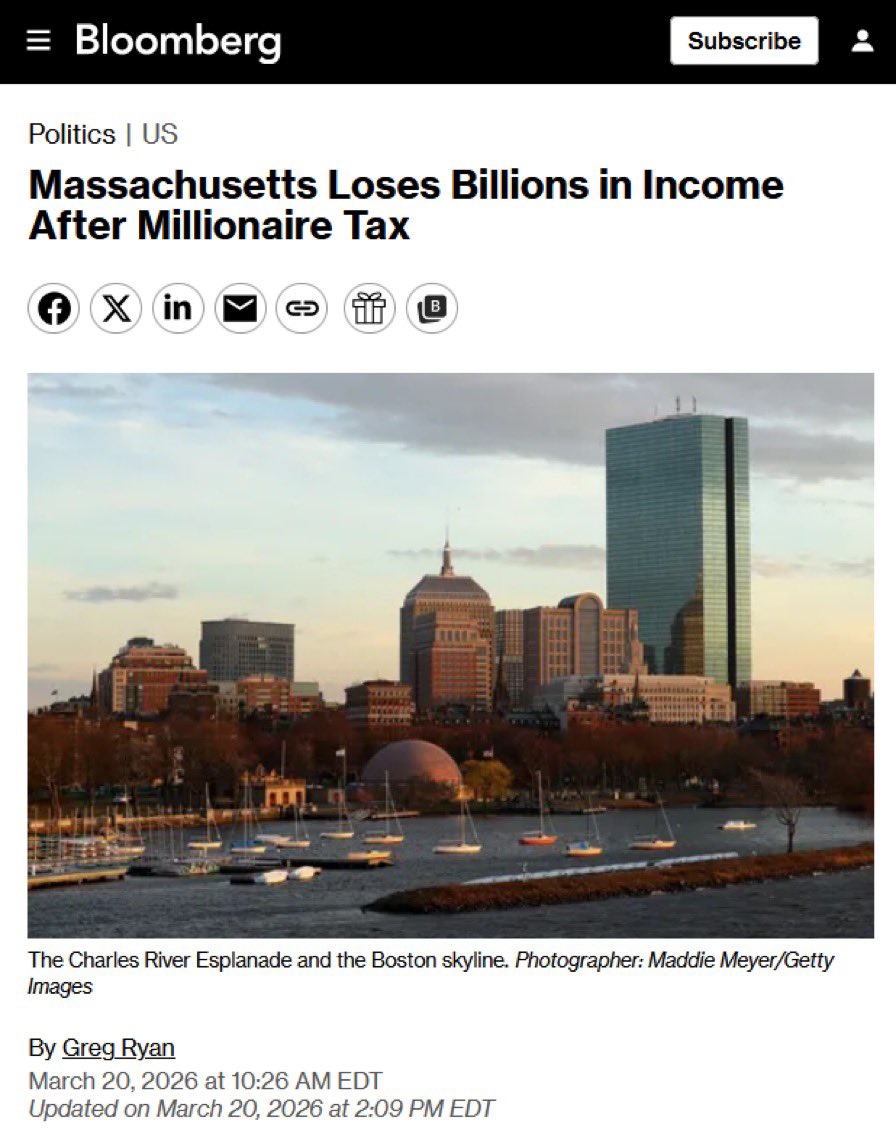
Massachusetts approved a millionaire tax of an extra 4% of income above $1 million in 2022. This is in addition to the 5% state income tax everyone pays. So the wealthy in that state pay 9% on top of their federal income taxes of 37%.
As a result, they are moving to New Hampshire, Florida and other states with no state income taxes
@BobFergusonGov, veto it, force the Legislature back to the drawing board, and demand real tax reform that reduces regressivity by cutting sales and B&O taxes instead of layering new levies on top. Do the right thing now, before Washington’s taxpayers stage a modern-day Boston Harbor in the shadow of Mount Rainier.
https://t.co/Hzf663BzCH
Washington State Democrats lied. Their new income tax on millionaires isn’t just for people making over $1 per year
“It’s not just the millionaires who are gonna face this tax. In fact, couples whose combined income is a million dollars or more will also be taxed. Tax experts call it the marriage penalty.
So if you have two individuals who each make $600,000, neither would pay the state income tax if they filed as individuals, but if they are married and they file jointly, they would owe a tax of about $20,000”
And so it begins… next they’ll start lowering the threshold and it’ll soon apply to everyone
Much of the anger and frustration over the creation of an income tax in Washington state can be explained as the breaking of a century-long social contract that many generations of Washingtonians came to trust and expect.
This social contract was so foundational that it was enshrined in our state's constitution - namely that taxation needs to be uniform and the state cannot target any group for higher rates of taxation.
This is not to say that social contracts cannot be changed, but there is a legal and proper mechanism for doing that: amend the state's constitution.
The Democrats did not choose that path because it is a very high bar to overcome (rightly so) and every time they had attempted this in the past, the people of Washington voted it down.
Instead, the Democrat legislature chose the path of double-dealing and disingenuousness. This occurred in a series of steps:
1. Pack the Supreme Court with judges who would rubber stamp unconstitutional taxes.
2. Pass an unconstitutional capital gains tax but claim that, unlike any other state or at the Federal level, such a tax is an "excise tax" rather than a tax on income, giving the Supreme Court the excuse it needed to rubber stamp this wolf in sheep's clothing.
3. The Supreme Court then upholds this tax, clearly violating the Constitution and opening the door for a full income tax.
4. Create an fully fledged income tax (with all the bureaucracy required to administer it) but cynically label it a "millionaire's tax" even though they rejected every provision to guarantee it would only apply to millionaires.
5. Call the passage of this tax a state emergency, even though it only becomes effective two years from now. What kind of "emergency" allows you to wait 2 years?
Answer: by classifying its passage an emergency, the Democrats purposefully prevented the possibility of a referendum of the people to reject the tax (as Washingtonians had done for a century). This get-what-you-want-no-matter-the-cost strategy is a deeply dishonest means of undermining the democratic process.
6. The Governor claims this tax makes life more "affordable" for Washingtonians but its passage provides almost no meaningful tax relief for the legion of other taxes that have ballooned under the Democrats (gas tax, sales tax, b&o tax etc). They did provide some sales tax relief on shampoo and hygiene products though. 🙄
So much has been lost to the whims of our politically extreme legislature in the last four years, but perhaps nothing so significant and painful as Washington's century-long social contract.
Washington State is about to repeat a costly mistake.
Every state that adopted an income tax has fallen behind economically.
Democrats in Olympia want a 9.9% “millionaire tax.” History says this ends badly.
My latest in @WSJ with @realartlaffer:
https://t.co/skajCE050w
"Washington has been one of the fastest-growing states for decades. It conspicuously avoided the “blue-state disease” of low economic growth and population declines. The Seattle area is home to great companies from Microsoft and Amazon to Starbucks. Washington has been the Florida or Texas of the West Coast.
A secret to the Evergreen State’s success has been that it has no income tax. But Democrats in Olympia are perilously close to enacting a “millionaire tax” of 9.9%. Washington would go from being one of nine states with no income tax to having the fifth-highest rate in the country. The tax has passed both legislative houses and Gov. Bob Ferguson says he’ll sign it. Supporters hope the state supreme court will uphold it, overturning or brushing aside a 1933 precedent under which it is plainly unconstitutional.
The decision to enact an income tax bodes ill for Washington’s economic future. Eleven states have done so since 1960: West Virginia, Indiana, Michigan, Nebraska, Illinois, Maine, Pennsylvania, Rhode Island, Ohio, New Jersey and Connecticut. We found that every one of them significantly underperformed the rest of the nation in every economic measure we looked at, including share of the nationwide population, income, and state and local tax revenue.
The 11 states in combination accounted for about one-third of national output in 1970. Today they account for slightly more than one-fifth. Since Ohio adopted its income tax in 1971, its share of nationwide domestic output has fallen by nearly half. Since Michigan adopted its income tax in 1967, its share of total state and local tax revenue nationwide has fallen by 53%.
Pennsylvania’s share of national output declined 42% since its income tax of 1971; West Virginia has lagged national population growth by 56% since its income tax of 1961; and Rhode Island’s share of state and local tax revenue nationally has plummeted by a third since its income tax of 1971. In terms of the change in its share of the nation’s population, economic output and population, not one of the new income-tax states registers a positive number since the imposition of this tax. And the negative numbers are often highly negative.
In every state that adopted an income tax, supporters promised the added money would be used to improve education. Washington is trying to play this card, saying the tax hike is for education, but the statements from lawmakers make it clear they want a new fund for any of their spending desires.
When the Washington House approved the income tax, Rep. April Berg, chairman of the Finance Committee, triumphantly declared this plan “truly historic” because it will “make life more affordable for Washingtonians.”
Many of them will not be Washingtonians anymore. Illinois added its income tax in 1969, and since then its share of the national population has sunk by 40%. By following suit, Washington will join the ranks of the incredible shrinking states."
-- Wall Street Journal
It's rare that nearly every major media publication's editorial board agrees on something, but they all agree this is an AWFUL idea. #waleg
"It’s telling that politicians, who insist the new law is broadly popular, rejected an amendment that would have let the voters decide on whether to impose a state income tax."
"Yet entrepreneurs and high-performing workers will now think twice about coming to a state that explicitly designs laws to penalize success."
https://t.co/oWqoriWJMd