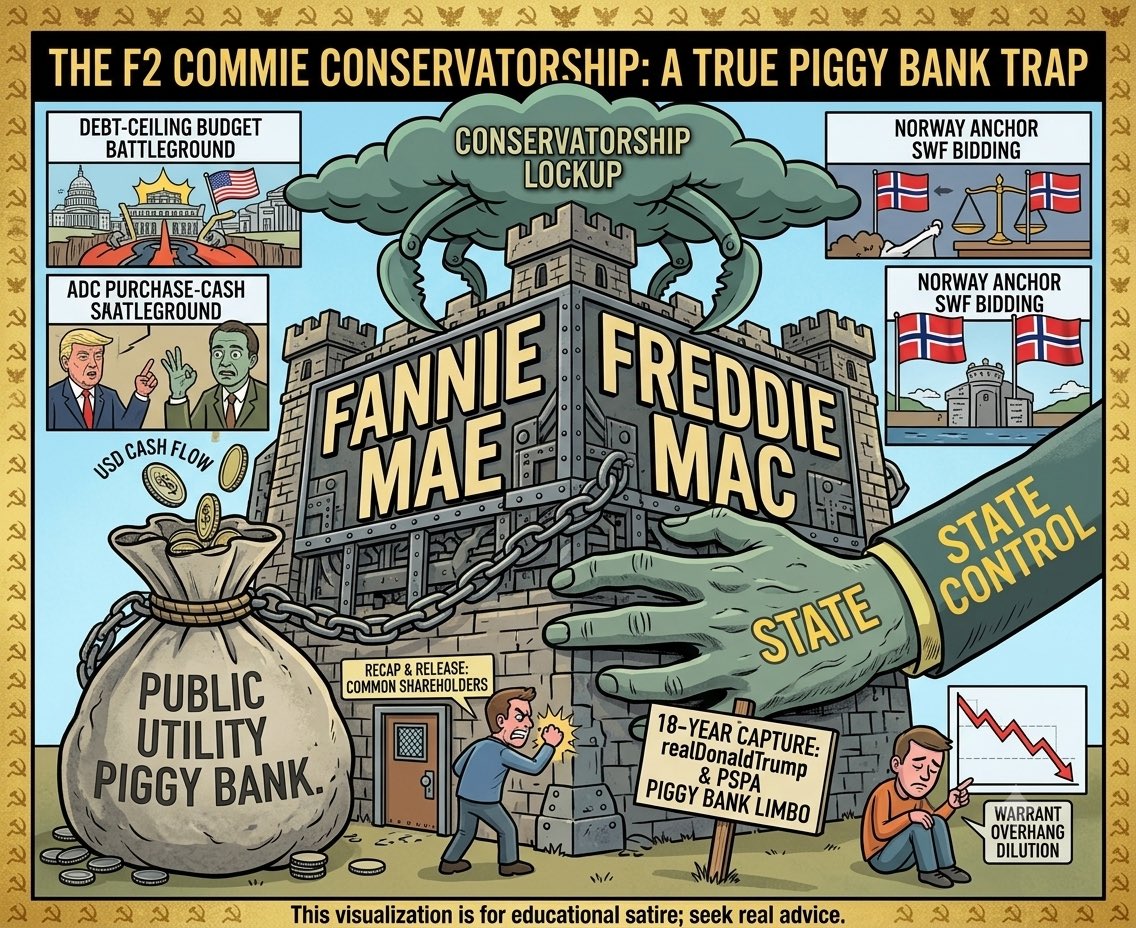
@WhiteHouse Speaking of ‘Anti-Communism’
The F2 Conservatorship is a textbook government command economy, treating Fannie & Freddie as a utility to fund off-budget policy
Already repaid $300B + (and counting) on a $191B loan
Release the twins now !
$FNMA $FMCC
Yes, the election could & should ACCELERATE Freddie & Fannie’s release, which is partly why I bought even more $FMCC.
However, the market only has it backwards IF Scott Bessent agrees & actually moves faster‼️
Every week of delay increases the risks, including Democrats potentially using must-pass legislation to hold release hostage to unrelated demands, extract concessions or impose SOCIALISTIC conditions!
At this point, in order to avoid giving Congress any leverage, Treasury & FHFA really should consider moving now
PS - I don’t want to give the communists any ideas..luckily, they don’t read my posts
$FNMAT $FNMA $FMCKJ
$FNMA $FMCC
If anything, the midterm results accelerate DJT's plans for Fannie Mae & Freddie Mac.
He knows the existential threat to the U.S. economy if the Democrats regain control of this massive, ever-growing piggy bank.
https://t.co/Br4UzTQTH6
In 2008 the government put $187.5 billion into $FNMA and $FMCC.
They have since paid back about $301 billion.
The taxpayer did not lose money on this rescue. The taxpayer made about $113 billion on it.
Today the two companies hold over $200 billion of capital and stand behind about $8 trillion of American mortgages.
Congress just changed hands. Ending these conservatorships is one of the few major decisions in Washington that never needed Congress at all.
What is missing is not authority. It is a decision.
These comments deserve far more attention. The 18 year old conservatorship of $FNMA and $FMCC poses a long term risk to the housing market. @BillAckman highlighted these issues recently. He warned that leaving the GSEs in limbo leaves them vulnerable to inefficiency and political weaponization.
At the risk of going into too much detail here is a synopsis or his talking points and perhaps a few of my own:
Political Weaponization: F2 have a very large war chest and an indefinite conservatorship leaves trillions of dollars in cash generating mortgage capacity under absolute bureaucratic control. A change in administration can instantly weaponize this control to push social and political agendas, shifting the GSEs from neutral market utilities to partisan tools.
Distorting credit allocations: When the federal government controls the flow of capital, mortgage access can be manipulated based on political favoritism rather than merit. It has been pointed out that using Fannie and Freddie to grant mortgages on highly favorable, non-economic terms creates massive structural instability.
The spectre of the GFC: This exact dynamic precipitated the original 2007–2008 financial crisis. Prior to the crash, HUD progressively raised affordable housing quotas for the GSEs, forcing them to absorb toxic, unqualified loans to satisfy political homeownership agendas. Keeping them in conservatorship preserves the exact mechanism that allowed that crisis to happen.
Spreads are historically wide: Currently, the spread between the 30 year mortgage rate and the 10-year U.S. Treasury yield is highly elevated; sitting near 215 to 217 basis points, well above the historical average of ~150 basis points. This massive gap heavily penalizes everyday homebuyers with higher borrowing costs. The fact that spreads are wider than before the GFC dispels the notion that conservatorship suppresses the spreads. An explicit line of credit backstop may be more effective.
Government overreach widens the gap: Policy interventions such as mandates that alter mortgage callability or complicate refinancing rules increase risk premiums for MBS investors. This added policy uncertainty drives up the yields investors demand, directly widening mortgage spreads. Separately, nonpecuniary aspects like eleveated rates/duration risk up this demand and have nothing to do with F2.
Privatization can actually remove uncertainty: Formalizing privatization, acknowledging the GSEs' massive capital buffers, and executing a structured exit would eliminate the "political risk premium" hanging over the MBS market. Restoring the GSEs to the private market under fixed capital guidelines is the most direct path to compressing today’s bloated spreads.
The bailout is repaid: The narrative that Fannie and Freddie are a liability to the taxpayer is completely false. While the government injected $191 billion during the crisis, the GSEs have paid back over $301 billion to the Treasury.
Unlocking 100s of billions in value: Rather than a rushed IPO that risks destabilizing the market, the administration can immediately exercise its warrants for a 79.9% common stock stake (Subject to the SPS/LP repayment stated above) and relist the companies on the New York Stock Exchange. This "walk before you run" strategy would safely remove roughly $8 trillion in liabilities from the federal balance sheet while netting taxpayers a massive "mark-to-market" windfall.