We are now offering free AI strategy calls for eligible business owners. Click the link to book 20-minutes with Coherence Labs co-founder and former Google engineer, Sam Cymbaluk.
https://t.co/AEd2JvStW3
With AI, context is king. That point really can't be overstated.
Pulling up Claude and asking, "I run an XYZ business and want to grow revenue. What are some opportunities I am overlooking?" will likely get you generic answers.
Connecting it to your email first and then asking, "I run an XYZ business and want to grow revenue. Based on my last 90 days of emails, what are some specific opportunities I'm overlooking?" will likely get you highly specific, tactical suggestions that you can act on today.
Are you a business owner working over 50 hours a week? Our custom Automation Blueprint will save you 5 hours a week with AI, or your money back!
https://t.co/1FRXI6Uzw1
AI tips expire. Understanding how models learn doesn't.
Quick test: AI tends to agree with you even when you're wrong. Which of these four stages is most responsible and why?
The Semantic Web asked for ontological agreement before communication and got neither. Our approach with Axiom is the inverse: communicate first, and gradually build shared ontology with those with whom you communicate.
Natural language was not designed to handle the speed at which the world now changes. We cannot coordinate society at speed and at scale if definitions constantly shift under our feet.
Governments know the answer. It goes by many names: formal ontology, knowledge engineering, semantic graphs. It is simply this: logic made explicit.
Our mission at Coherence Labs is to arm everyday people with the clarity of explicit logic!
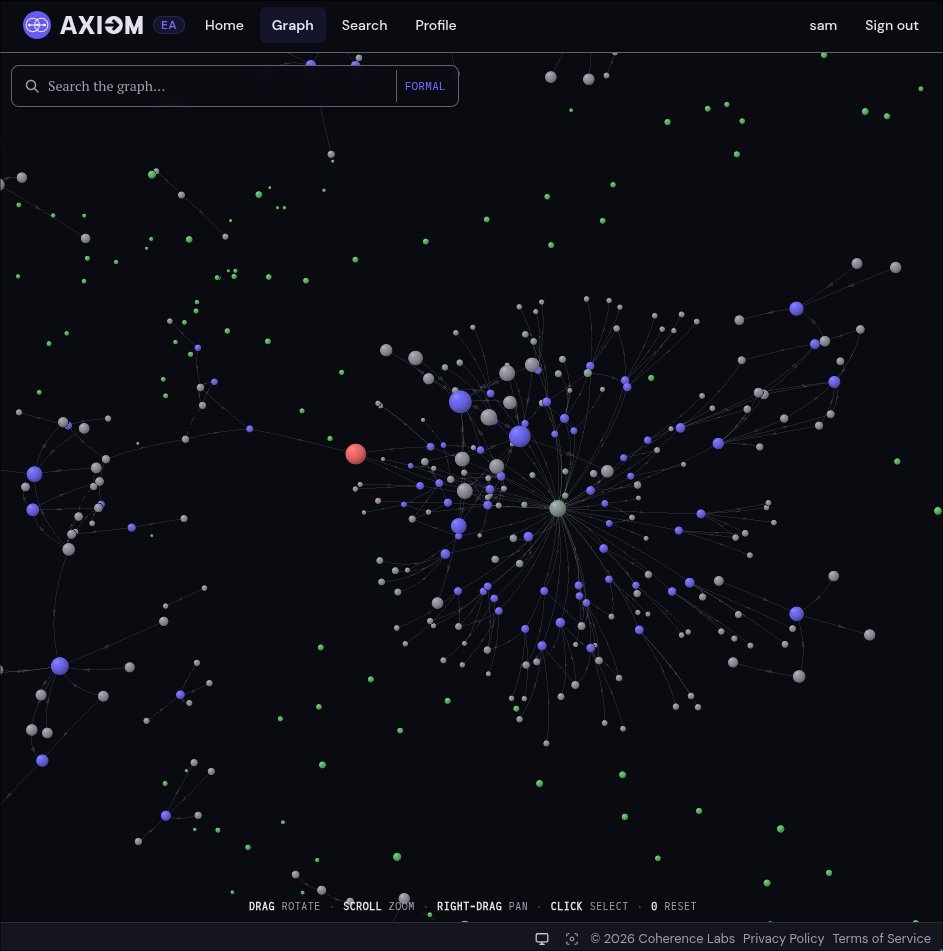
The Axiom global knowledge graph is the first visualization of our formal metaontology environment built on Lean 4:
- Green nodes are propositions proven to be definitionally True (e.g., P: "2 + 2 = 4").
- Gray nodes are contested propositions that users can choose to adopt or reject (e.g., Q: "∀ p : Person, p is-rich → p is-immoral").
- Purple nodes are proven theorems connecting propositions together (e.g., "(∀ p : Person, p is-immoral) → Q").
- The red node is False. Anything proven contradictory is connected to it.
The success of LLMs doesn't make determinism obsolete—it makes it far more valuable. With 1000 times more stochastic reasoning available to us, the new bottleneck to innovation is the decomposition of problems into deterministic atoms from which we can confidently reason.
@yumahey Looks really cool! People think LLMs have proven that determinism doesn't matter, but that's far from the truth. Effectively breaking things down into the deterministic pieces we can confidently reason from is going to become the bottleneck for innovation.
Induction, deduction, and abduction are considered the three fundamental ways to logically reason, yet almost no one understands them.
They are usually depicted as three distinct modes, but this is misleading. Induction and abduction are better understood in terms of deduction. So let's start there.
Deduction is a logically valid argument:
P1: Socrates is a human
P2: All humans are mammals
C: Socrates is a mammal
A deductive argument is truth-preserving. That means that if the premises are true, the conclusion must be true. A math theorem is a deductive argument. We also know by the Curry–Howard correspondence that deductive arguments and computer programs are actually the same thing.
Induction can be thought of as extrapolating from data and is really a special case of deduction where some premises are left implicit:
P1: Tweety is a bird
C: Tweety can likely fly
As stated, this isn't truth-preserving. Just because Tweety is a bird doesn't mean she is likely to fly. A penguin named Tweety is not likely to fly. We can convert the argument to a deductive argument by making the additional premises explicit:
P1: Tweety is a random bird
P2: Random birds can likely fly
C: Tweety can likely fly
This is valid because knowing a bird is a penguin would no longer make it a random bird.
Lastly, abduction. This is the one that computers (even AI) are still not good at. Abduction is where we pick new premises or axioms to reason deductively from. Abduction is where a lot of scientific breakthroughs happen. We got general relativity because Einstein asked, “What if we don’t assume time and space are the same everywhere?”
Lean is the closest thing we have to a universal language for math. Our platform, Axiom, asks the question: What if people could communicate all their ideas in math?
Logic isn't a set of rules — it's the concept of having consistently applied rules. In Axiom, you decide your own rules, we just make sure you apply those rules consistently. Get started for free: https://t.co/7XT540NiiO