Actually bought my big bag at $0.70 in 2021, saw the ath but nah I said it would go higher, only to see dumpo in few days and hodling ever since. Now I can smile again😆
Every cycle has that one moment where fear hits harder than logic. I’ve seen this movie before, and I know how it ends.
The more I analyze the crash from two days ago, the more I realize how much it mirrors March 2020 - not necessarily in fundamentals, but in psychology.
Obviously, even if it might look similar on the chart, it was fundamentally very different.
Back then, the whole world was going crazy: it was a full-on panic dump, pure capitulation driven by fear. Then came a massive wave of monetary expansion combined with zero interest rates, which triggered one of the craziest pumps crypto had ever seen.
Most altcoins, including $ETH, dumped around 70% within just a few days during that crash, only to go on the most explosive run and mind-blowing altseason in the 12–18 months that followed.
$ETH did a 50x from the bottom, while major alts like $BNB and $ADA delivered well over 100x returns.
When the crash happened in 2020, it absolutely wasn’t obvious that this was what would come next. Honestly, I was scared as hell and wasn’t sure whether crypto, or even my role in it, would survive strongly enough for me to make a living.
It was only my conviction in this space, my willpower, and maybe a bit of FOMO, that constant “what if”, that made me keep going.
Just surviving turned out to be one of the best decisions I ever made.
Sure, this time is different in many ways - macro, structure, market maturity - all of it. So just comparing charts from four years ago to today isn’t as simple as some make it look.
Still, the more I think about it, the more I come to a few conclusions:
1) This industry is here to stay, nowadays more so than ever before.
2) While I was strongly convinced over the past months that we’re in a classic four-year cycle, I now see a real chance that this bull market won’t peak by the end of this year, but could extend deep into 2026.
3) Personally, I’m still a strong believer in an altseason yet to come. If there was ever a time to call capitulation and a bottom for alts, it was two days ago.
That brings me to the final question everyone should ask themselves:
You either believe that fundamentally strong alts are dead OR you believe this is the new internet, and that somewhere in this flood of projects lie the next Facebook, Instagram, or Robinhood. The next generation of billion-dollar companies.
Given that I believe in the latter, I strongly believe we’ll see similar runs for fundamentally strong alts as we did post-COVID.
I strongly believe that in the next 12–18 months, some sleeping giants will run more than 100x.
I strongly believe that those who don’t lose faith, those who don’t give up, will experience life-changing gains in the next 12–18 months.
And I strongly believe it’s far from being over for crypto.
#Altcoins $BTC
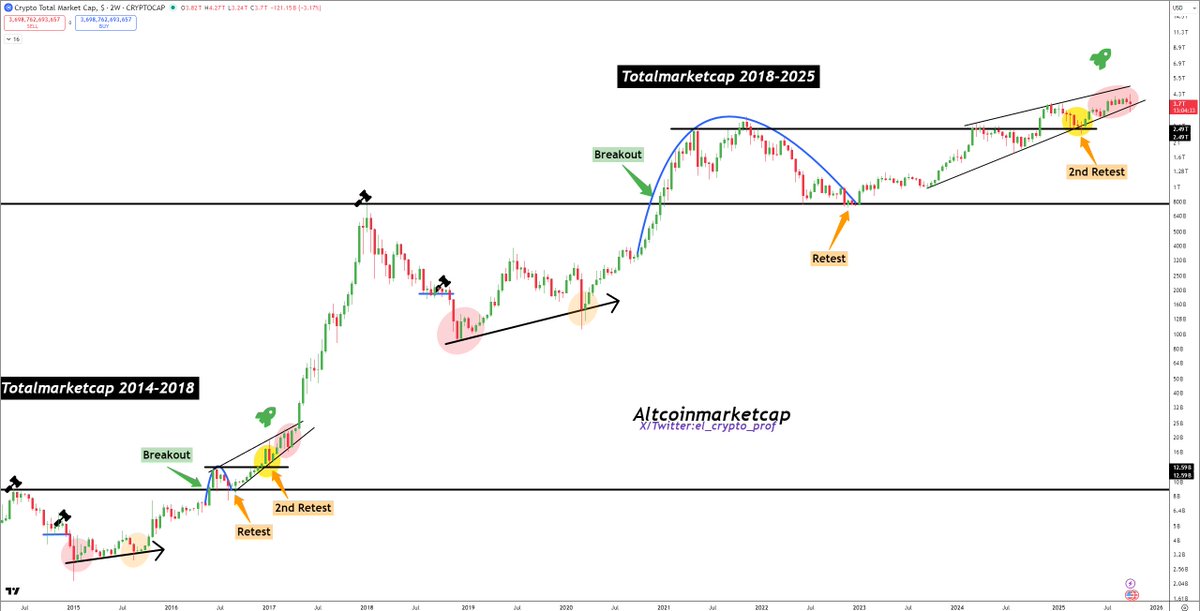
The Totalmarketcap pattern still looks like it did in 2017. Nothing has changed.
Back then, we also saw a crash of +20%. Shortly afterwards, the best months for crypto followed. Incidentally, this was also the case after the COVID crash.
I wouldn't give up here.
Let's provide a @morphnetwork Retail Index that collates receipts, privacy-first, and publishes weekly no doxxing, just data people can use.
Roll up anonymized lines from the Open Receipt Schema: amount, category hash, region, currency, timestamp. Strip PII, salt merchant IDs, and normalize to base currency on an independent mid. Net out chain noise (Execution + L1 "blob" fees) and promos so the index reflects shelf price, not fee weather or coupons. Emit per-category medians and a clean week-over-week delta in bps; store the method + sample size on-chain so anyone can verify.
Why it matters: wallets echo a personal cost-of-living trend; merchants see demand shifts without buying a report; builders can trigger fair-price benefits when the index spikes (automatic givebacks on groceries, transit, meds). Opt-in toggle in Pay, open endpoints for dashboards, and a tiny "blob weather" side chart so people see why totals changed even when prices didn't.
Simple, legible, human: receipts → signal, not surveillance. That's where onchain consumer finance starts to tell the real world.
In global finance, one gap remains and that is bridging traditional banks to blockchain.
Trillions sit locked in slow TradFi systems, while DeFi grows without institutional liquidity or compliance. @RaylsLabs solves this with a blockchain built for banks.
Its VEN (Value Exchange Network) lets institutions deploy permissioned EVM subnets in minutes, using zero-knowledge proofs for privacy and connecting seamlessly to public chains, bringing $100T in bank assets and 6B customers onchain.
Rayls offers portable, scalable banking infrastructure. A full UniFi ecosystem combining privacy, interoperability, and decentralization.
Financial data is encrypted with ZK tech on a high-performance L1, giving banks full governance and compliance control.
Backed by @paraficapital, @hiFramework, @valorcapgroup, and @AlexiaVentures, Rayls already influences CBDC privacy design.
It addresses scalable onchain banking, AML/KYC/GDPR alignment, and high throughput tokenized assets like RWAs, stablecoins, and cross border payments.
At its core, Rayls unites TradFi and DeFi, powering a secure, user-centric financial internet where banks innovate, liquidity flows freely, and blockchain finance reaches mass adoption
Pivot to @RaylsLabs where banking finally goes onchain and thank me later
observed how funds handle crypto intelligence.
Most rely on multiple dashboards for sentiment, price, and chain data.
Every tool adds time, not clarity.
@Cointel_io eliminates that.
→ Aggregates all market data sources in real time
→ Filters noise using impact-based scoring
→ Surfaces only insights that affect portfolios
During my test, fund analysts spent 30% less time cross-verifying data.
Accuracy went up, repetition went down.
@Cointel_io gives structure where speed alone is not enough.
#Altcoins
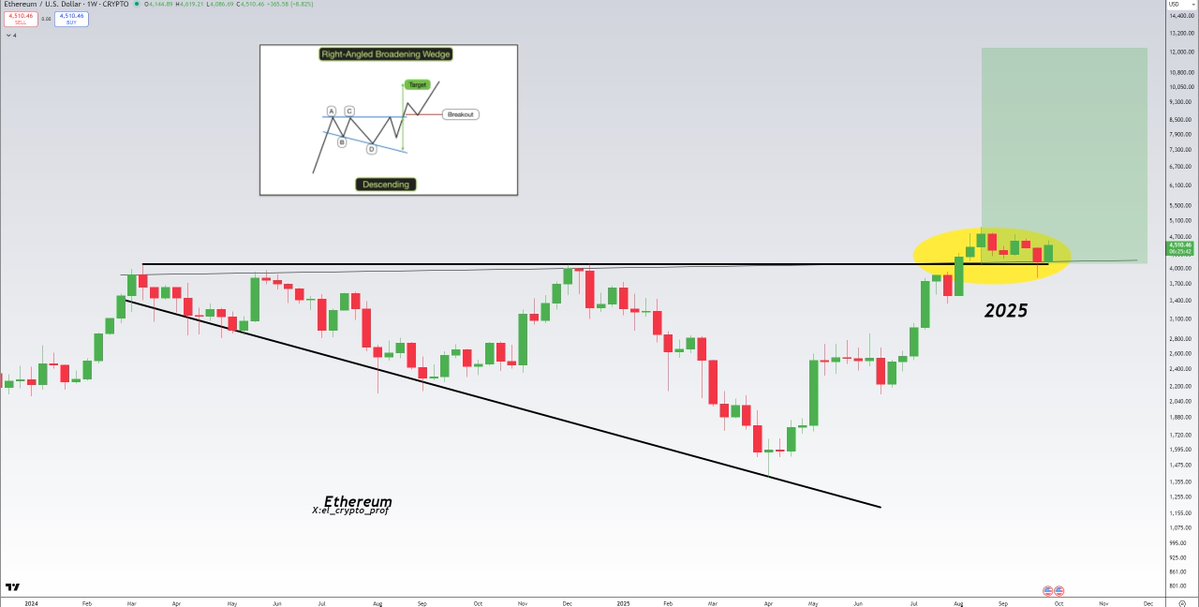
One of the most important, if not the most important chart for $ETH.
Ethereum is going through this pattern like it's straight out of a textbook.
Target: around $12,000.
Can you imagine how Altcoins will skyrocket then?
You're all not bullish enough.
BREAKING: 🇺🇸 Morgan Stanley says it will “support” its 16,000 Financial Advisors managing $2 TRILLION if they wish to allocate to Bitcoin and crypto. 🤩
🫡 @HHorsley
🔴 CRYPTO IS CRASHING! 🔴
• Your altcoin is down 40%.
• Crypto X in full meltdown mode.
• “it’s over” tweets incoming.
Meanwhile, the guy who held through 10 crashes before is just making coffee, waiting for the inevitable rebound.
The market isn’t broken, your emotions are.
Trustless incentives with receipts, not vibes. @brevis_zk
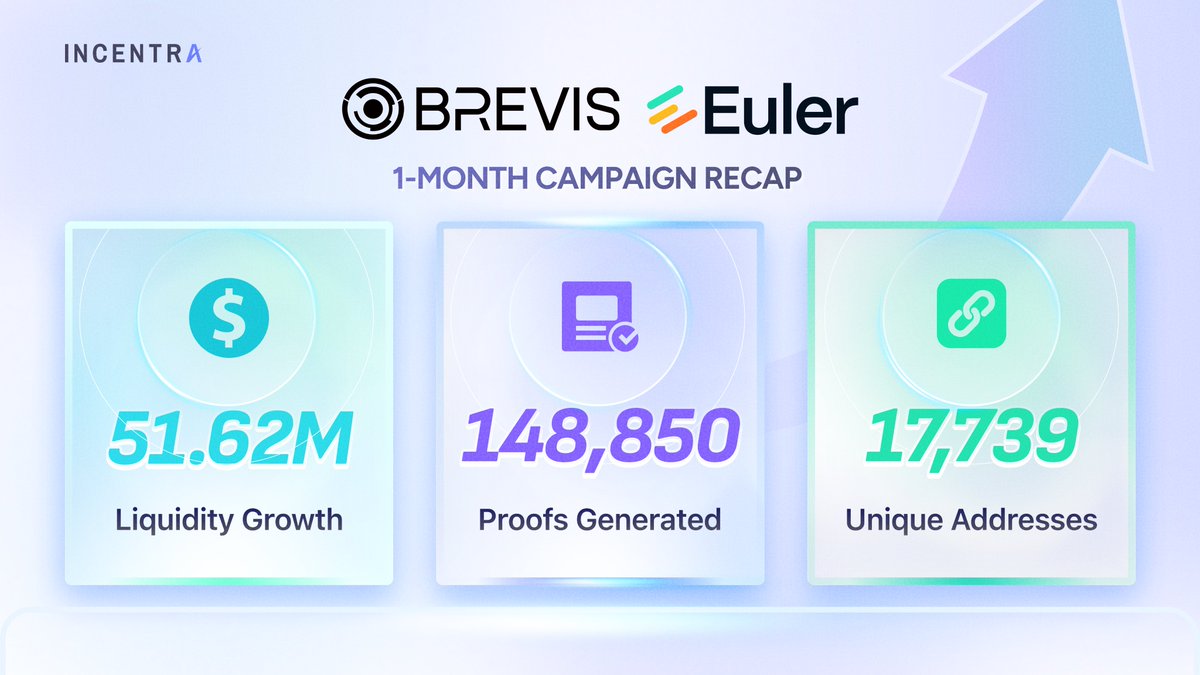
❯ One month in with @eulerfinance on Arbitrum: $51M TVL added, 17K unique addresses, 148K ZK proofs all programmatic, no back-office scripts.
❯ Payouts aren’t “promised,” they’re proved: rewards roll on a fixed cadence, sealed into a proof and verified on-chain at claim.
❯ Under the hood, Incentra’s flow is boring-in-a-good-way: epoch data → off-chain compute → succinct proof → on-chain verify. That’s the whole trust model.
→ https://t.co/pPlPzeT2Gb
Here’s why this matters: most campaigns subsidize idle TVL and farm loops. Euler’s run paid for time-weighted supply in active vaults, with math anyone can audit (and no one can game without moving markets). Early data says it actually pulls real liquidity instead of mercenaries.
Mini read:
❯ Signal: daily, ZK-verified rewards since late June; claim UX is a single verify + transfer.
❯ Risk: weights always decide outcomes watch if deposits bunch where rewards outpace borrow demand.
Quick compare: typical airdrops = spreadsheets + doxxed addys; Incentra = transparent math + private proofs, repeatable across venues.
User step: open the Incentra link in Brevis’s Euler post → connect on Arbitrum → supply to eligible vaults → claim via the dashboard as epochs close (the contract verifies the proof at claim).
Call: I’m tracking TVL stickiness and borrow spread compression into month two. If your rewards look off, ping me with your vault + epoch I’ll sanity-check the path to higher yield. #DeFi #ZK
JUST IN: 🇧🇷 Brazil’s Nubank hires former Coinbase product director Michael Rihani as its new Director of Crypto.
Rihani previously worked on integrating Bitcoin payments at Tesla.
Nubank serves over 123 MILLION customers. 🟧
➥ @SeiNetwork Unique Addresses hit a new ATH
➠ 15.9M monthly active users, surpassing Base, opBNB, Kaia, and Polygon
➠ 65M total wallets, with 265K new users added in a single day
➠ 1M daily onchain wallets, processing nearly 4B transactions
➠ DEX activity up 700% since last year
Now add ETFs into the mix, Yeahhh they’re cooking
Markets Move Faster on Sei. ($/acc)
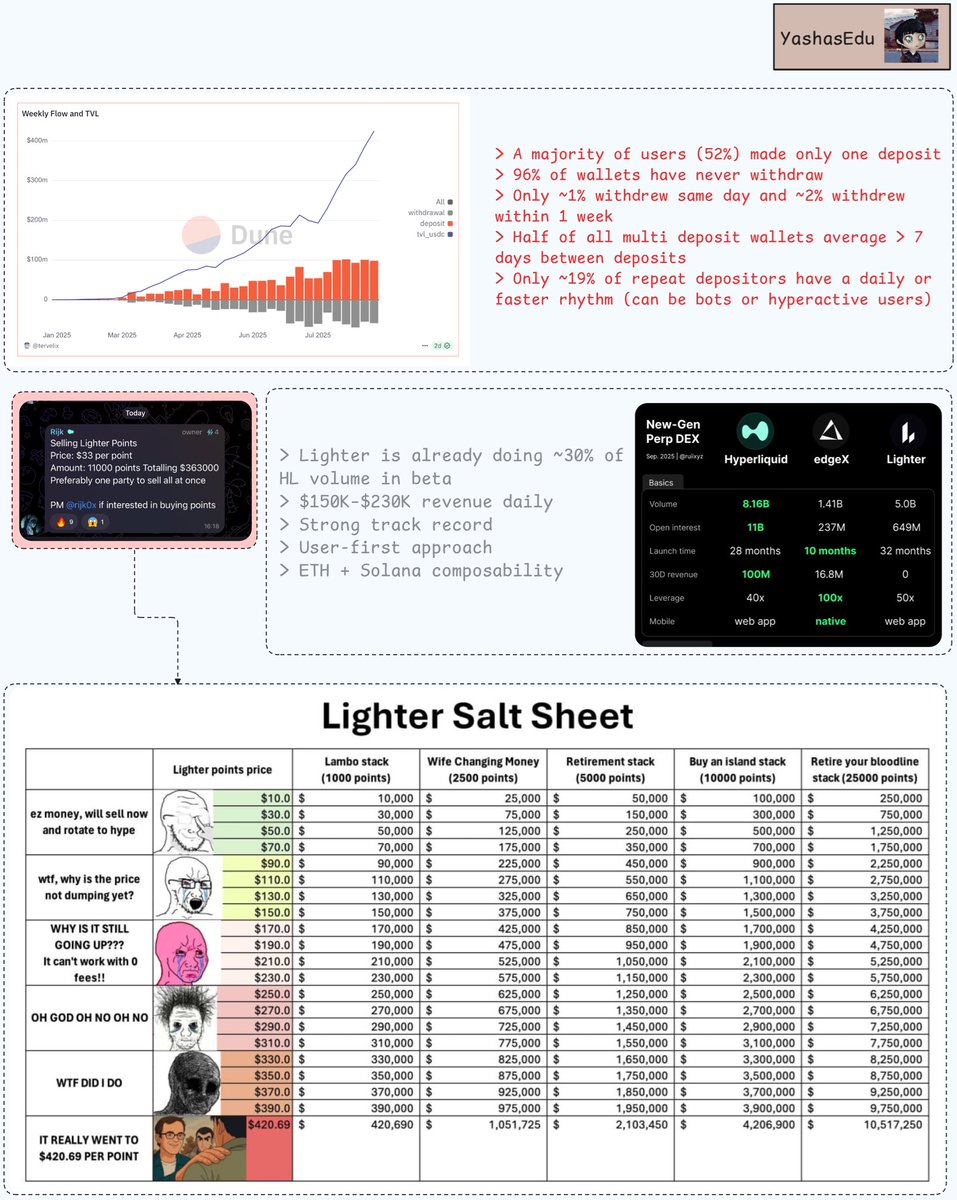
Some people are selling @Lighter_xyz points at $33? The math doesn't work imo.
That pricing shows Lighter's worth $730M to $1.3B. Meanwhile, Avantis trades live at $1.1B+ FDV with half the users, $18.6M TVL v/s Lighter's $438M & $25M open interest against Lighter's $650M. The comparison makes no sense.
Lighter is fundamentally different…
> Zero fees on limit orders
> Proprietary zk CLOB delivering 5ms soft finality
> LLP positions usable as margin (earn yield while using positions as margin) allowing capital composability that doesn't exist elsewhere
> Has mechanisms designed to stop wash trading
> From January's private beta launch to 56,000+ active users today
> Lighter reached $400M in TVL in 237 days (Hyperliquid reached it in 400 days)
> Daily volumes hitting $1-2B
> TVL growth that secured the #2 perp DEX position while still in beta
> @vnovakovski’ FinTech background, a16z & Lightspeed backing, former CEX and HFT experience across the engineering team
Hyperliquid proved onchain perps work at scale. $2.5T cumulative volume, $110M monthly revenue. But users spread capital across venues for arbitrage, different risk profiles & loyalty rewards. Lighter's approaching this market with better tech + economics.
The revenue question gets raised often. Zero fees seem unsustainable until you consider the playbook.
1/ attract users with free access
2/ build network effects
3/ monetize through premium features + institutional services
Robinhood proved this works in TradFi.
Remember institutional interest is growing. MMS are testing the platform, prop trading firms evaluating integration, arbitrage desks building connections. The professional trading community recognizes technical quality when they see it.
But the valuation disconnect persists. TGE targeting $2-4B FDV means points could hit $40-150 range, assuming standard tokenomics. Even conservative estimates put fair value above current OTC pricing.
Hyperliquid points traded $15-25 OTC during farming, peaked above $40, then the protocol achieved much higher valuations post launch. Early sellers missed significant upside when the market repriced based on actual performance.
The pattern repeats across successful protocols. Launch at accessible valuations, early farmers sell cheap, new users enter, market reprices based on metrics and adoption. Those who hold through TGE typically benefit from this cycle.
Lighter occupies a unique position. Better tech than most competitors, stronger metrics than anything except Hyperliquid, zero fee advantage that creates switching incentives. The path to becoming the clear #2 perp DEX appears open.
The decision framework imo is straightforward. NFA.
> Selling at $33 assumes growth stops
> competition wins
> revenue never materializes
> the market stays small
Holding assumes the opposite trajectory based on current evidence. The bear case requires explaining why all the positive indicators mentioned above will reverse.
> The perpDEX market is expanding, not contracting ($18.82B currently)
> TradFi adoption of crypto derivatives continues
> Onchain infra improves
> User experience gaps close
> Capital efficiency innovations attract new participants
@lighter_xyz positions itself at the center of these trends with tech & execution that addresses real market needs. Cu rrent OTC pricing seems disconnected from underlying fundamentals & comparable project valuations.
Whether points hit projected $40-150 range depends on final tokenomics, TGE execution & market conditions. But the gap btw current pricing & reasonable fair value estimates suggests material upside for those willing to hold through TGE. NFA.