The more comprehensively you cover a topic ecosystem, the greater your chances of being surfaced or referenced in AI generated answers.
https://t.co/Zgc6XTIOEJ
Let me know your feedback!
Our AI Keyword Grouping Tool lets you:
Drop in up to 5,000 keywords and:
• Group keywords by search intent
• Identify parent topics and subtopics
• Process results live
• Export clean groups to CSV
• Keep your keyword data private — it’s not stored
Try it for free today ⤵️
Clusters
this is essentially how query fan out terms can be “grouped” together and the number of unique queries within each cluster. 🍇
Citations
which domains and URLs are cited by AI LLMs as source material for a valid response. 📝
The more comprehensively you cover a topic ecosystem, the greater your chances of being surfaced or referenced in AI generated answers.
https://t.co/Zgc6XTIOEJ
Let me know your feedback!
Introducing Claude Fable 5: a Mythos-class model that we’ve made safe for general use.
Its capabilities exceed those of any model we’ve ever made generally available.
@glenngabe I think Google lumped everything into common crawl including Googlebot. Ergo, if you want to block information agents you have to block Googlebot too.
Source: https://t.co/lfGgl1bIRb
The more comprehensively you cover a topic ecosystem, the greater your chances of being surfaced or referenced in AI generated answers.
https://t.co/Zgc6XTIOEJ
Let me know your feedback!
Query fan out is a big concept in search right now.
So I built a tool to make fan out data available in one click.
What is query fan out? Simply put: when you ask an AI a question, it often doesn’t rely on a single query.
If AI systems are exploring adjacent topics, subtopics, and supporting concepts, understanding those pathways can help you identify topical content opportunities you might otherwise miss.
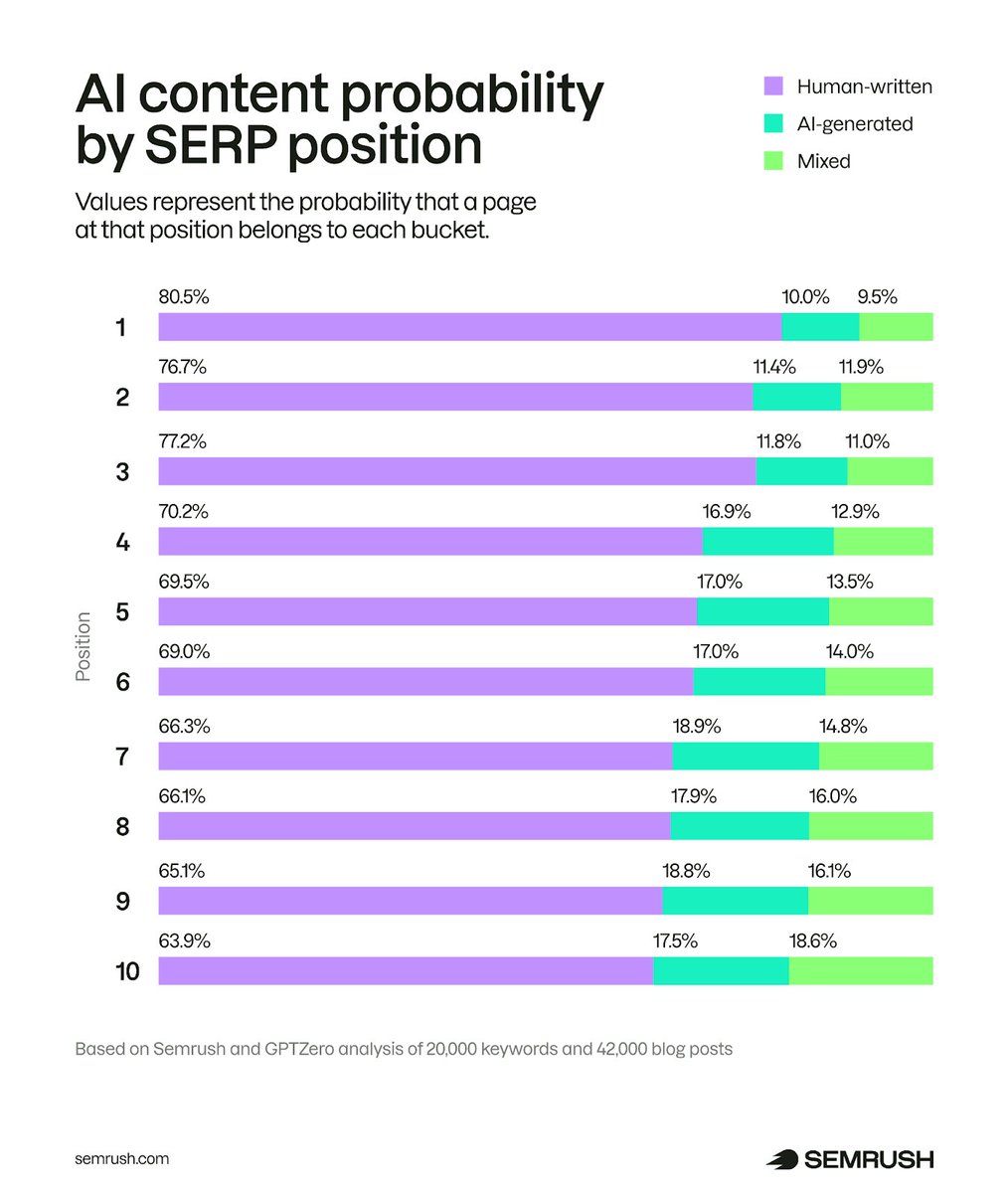
After analyzing 42,000 blog posts with an AI detector, content classified as fully human-written outperformed AI-generated or mixed content across the top 10 positions.
The gap is most striking at position 1:
80.5% probability of being human-written vs just 10% AI-generated.
This may appear to conflict with survey data showing that 72% of SEOs believe AI content ranks as well as human-written content. However, the data points to a more nuanced reality.
The key difference emerges at the very top of the rankings.
From position 5 onward, the performance gap between human-written and AI-generated content narrows significantly.
In other words, AI content performs competitively when the benchmark is ranking on page one.
However, in the highest-ranking positions, human-written content clearly leads.
Full study: https://t.co/JQkiiBPlo0.