@EaseMyTrip@DGCAIndia@jagograhakjago "‘Airline Policies’ apply based on the facts YOU submit. You submitted lies.False Report:Your agent wrote to the airline that my ‘Visa was REJECTED’.Misrepresentation: He implied I refused to pay fees,when I was always ready to pay standard penalties.
After 48 hours of mental torture, @EaseMyTrip left me no choice.
They held my ₹1 Lakh+ booking hostage. They lied to the airline. And when I asked for help, their Leadership told me: "We made no mistake."
Here is the timeline of harassment. 🧵👇
They lied to the airline about my Visa status.
They delayed 48 hours, causing price to surge from ~17 ~71k to ~86k.
Now they demand I pay for your negligence.
This is Unfair Trade Practice.
@DGCAIndia@jagograhakjago I didn't pay ₹34,000 because I accepted your lie.I paid it because I was terrified.Every hour your team delayed, the price spiked.The flight was filling up. I was staring at the screen, realized I was about to lose my seat and my entire academic semester.#MentalHealthAwareness
@DGCAIndia@jagograhakjago CONTEXT: I had NO CHOICE.Further delay by agency would have.Surged prices even higher (already jumped due to your 48hr delay).Risked the flight being sold out completely.Led to total cancellation of my travel & academic loss.I paid ~34k to salvage my trip @Consumer_GoI @DGCAIndia
@QACaretm I also emailed [email protected] earlier. .
REALITY: My Visa is VALID.
Please protect my booking from auto-cancellation due to this agency error.
@QACaretm "Thanks for the swift response. DM sent with proof.
🚨 CRITICAL CONTEXT: The agency (@EaseMyTrip) falsely emailed your trade desk stating my "Visa was REJECTED."vPNR: EBVDOM
This false info caused your system to deny the waiver initially. Review DM
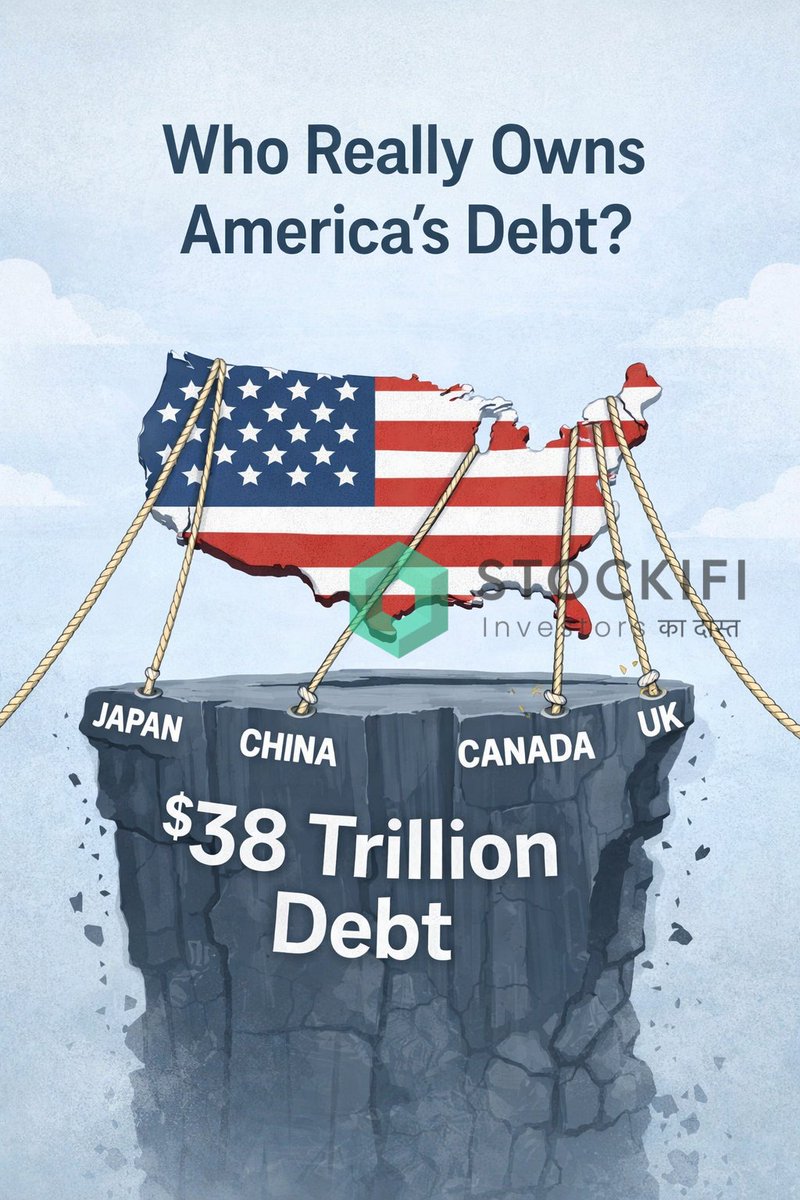
Who Actually Owns America’s $38 Trillion Debt?
In 2026, America’s debt crossed $38 trillion
It’s growing by $92,912 every single second
That’s more than the GDP of the US, China, and Germany combined in the early 2000s.
But here’s the real question…
Who actually OWNS this debt?
You’d think America owes it all to itself.
But 24% — over $9.1 trillion — is held by foreign countries.
That includes:
China ($765B)
Japan ($1.13T)
UK ($779B)
And shockingly… Canada ($426B)
That’s over $10,200 for every Canadian citizen.
But why would other countries fund America's overspending?
Because it’s a global currency dependency trap.
Here’s how it works:
Foreign nations buy US Treasuries
↓
America gets cheap capital
↓
It spends on imports (cars, clothes, electronics)
↓
Foreign nations get dollars
↓
They send those dollars back by buying more US debt
It’s a loop.
And the moment it breaks, the fallout could be historic.
Let’s zoom in on the top foreign creditors:
● Japan – The Foundation
Largest foreign holder of US debt. This keeps their currency low, exports strong, and interest rates suppressed.
● UK – The Rising Partner
Post-Brexit, UK financial institutions became aggressive buyers to hedge against domestic volatility.
● China – The Strategic Seller
Has been slowly offloading its US holdings. Down from over $1.2T in 2012 to $765B today.
● Canada – The Trusted Neighbor
Fifth-largest holder. Quietly funding America while trading most of its oil, wheat, and autos in USD.
America needs foreign creditors.
Why?
Because if global nations stop buying its debt…
→ Interest rates spike
→ US budget collapses
→ Global markets panic
→ Your salary, savings, and stocks start bleeding
Welcome to what economists call The Great Exit.
Imagine this scenario:
Canada and Japan stop buying US Treasuries.
Here’s what happens next:
Funding Gap: No new buyers = liquidity crunch
Interest Spike: To attract new buyers, US must offer higher rates
Currency Collapse: Dollar falls, imports cost more
Global Recession: America cuts spending, dragging everyone down
And in the middle of it?
India, Brazil, South Africa, all paying the price.
But wait… Why do countries STILL buy US debt?
Because of what economists call the 3 Global Dependencies:
Lower Interest Rates
Buying US bonds keeps the USD cheap. That helps exporters like Japan & Canada.
Currency Stability
US bonds = safe haven. Even during war, recession, or political chaos, people trust the dollar.
Trade Recycling
You sell to the US → get dollars → reinvest those dollars back into US Treasuries.
It’s a beautiful trap. Until someone decides to exit.
Here’s the dangerous part:
If this foundation cracks…
Even a small pullback in foreign buying can cause massive disruptions:
● Borrowing costs rise
● Credit markets freeze
● US may default on short-term obligations
● The entire global interest rate ecosystem collapses
Because every economy — from Toronto to Tokyo — is priced in relation to US rates.
India isn’t directly exposed.
But we’re tied through:
● IT exports
● Pharma contracts
● Global investor flows
● Commodity pricing
If the US enters a debt crisis, Indian equities, bonds, and the rupee will feel the heat overnight.
Remember:
2008 was a US housing crisis
But India lost over ₹23 lakh crores in months
This could be 3x bigger.
The scariest stat?
In 2026, America’s interest payments crossed $1.17 trillion annually.
That’s more than the entire Indian Union Budget.
Which means:
America is now borrowing just to pay interest.
That’s not growth. That’s a financial pyramid scheme.
And when the base stops funding the top, the whole thing collapses.
What happens next?
Watch for 3 signals:
Countries reducing US debt holdings (especially China, Saudi Arabia)
US raising interest rates beyond market expectations
Sudden demand for gold, oil, or alternative currencies
Because if even 5% of foreign creditors stop buying…
The US doesn’t just wobble.
It shakes the entire global system.
America’s debt has passed $38 trillion
Interest payments now exceed the Indian Union Budget
24% is owned by foreign nations who can crash the party anytime
This is the quietest threat to global financial stability