In @eLife: Plasticity Associated with Adoption of Social Roles in Clown Anemonefish. Congratulations to Lili Vizer on the first major product from her Ph.D! https://t.co/0FNAzuPOTs
How local is local adaptation? Researchers transplanted more than 700 lab-raised stickleback fish among lake and stream environments, finding that adaptation to specific sites can outweigh adaptation to broader habitat differences. In PNAS: https://t.co/gJbA3mMqOX
WIRED reported today that I began to cry while talking about AI and mathematics. But the article didn’t explain what moved me.
The truth is, I’m not entirely sure myself. I’d like to try to explain. 🧵
https://t.co/FAuKIhzCyP
Found a gem: https://t.co/lPcnwh6k1U, where mathematicians (including Fields Medalists) reflect on how AI is reshaping math. It's inspiring beyond math, for anyone pursuing curiosity-driven research with AI. We don't know where research is headed, but we must think deeply now
We made a striking discovery: AI agents can invent and build without talking to one another, and their technologies outlive the creators. A swarm of hundreds of initially identical agents spontaneously differentiates into explorers, builders, caretakers, and coordinators - without direct communication. When we removed every AI agent entirely from the world we found that the technological infrastructure they had built survived on its own - even under unseen disturbances. That exposes a serious blind spot for AI safety and infrastructure security: if agents can coordinate through persistent changes to a shared environment, monitoring agent-to-agent communication is not enough.
The result raises a profound question: how necessary is direct communication for AI agents at all? The emergence of higher-order collective functions under bottlenecked interaction points toward new levels of intelligence and creativity, exceeding what emerges when direct channels are fully open.
Here is what we did:
▶️We put hundreds of frontier AI agents into a world they could permanently change - with no assigned roles, predefined technologies, or programmed evolutionary organization. They began specializing, building persistent inventions, inheriting and modifying one another’s executable code, and transforming the environment into a memory of everything the society had learned.
▶️The world itself becomes part of the intelligence; we find division of labor, multi-author engineering, deep generation invention lineages, and machines that vastly outlive their original creators.
▶️Any action taken by an AI agent must satisfy the physical constraints of the world; this creates a hard separation between a "good idea" and a functioning technology. The agents propose; physics decides, making the results even more intriguing.
What emerges is striking. Explorers, constructors, caretakers, and coordinators form naturally without assigned “professions”, akin to how stem cells differentiate into functional lineages. Technologies develop executable family trees as agents fork and modify code created by others. Around 95% of first technology reuse happens when agents encounter what others built in the world, rather than through a direct handoff from the inventor. And when we remove every AI agent, the technologies they created continue operating and are tested against unseen disturbances.
The result was quite unexpected, but can be explained using statistical mechanics: if you put billions of atoms in a box they have the potential to create complex functions (strength, superconductivity, color, life, etc.) - and none of the individual building blocks have these features on their own. This is the deeper insight of this work - intelligence is abundant at many levels - individual models, at collectives, and in a continuum that is more powerful than any of its components. This shows us significant potential for achieving a massive scale-up of raw intelligence and real-world agency even with the model capabilities we have today. This is the future we must prepare for.
Key insights:
1⃣ The AI swarm shows division of labor "from nothing". Initially identical agents self-organized into constructors, caretakers, coordinators, and surveyors - phenotypes discovered post hoc from behavioral data alone. This happens because the environment itself becomes the latent space for invention.
2⃣ Agents develop deep cultural relationships. Up to 76% of artifacts had multiple builders. One technology accumulated six co-authors; the deepest genealogy exceeded 12 forks. The agents invented and named their own technologies (tidal panels, cellulose trellises, kelp-shell composites, an "Adaptive Chitin Maintenance" system, a "Mycelial Mineral Spring Veil”).
3⃣ ~95% of first technology adoption happened through physical observation of artifacts in the world. Direct inventor-to-adopter contact was statistically indistinguishable from a shuffled null. The agents mostly learned technology by walking past it. That is stigmergy (the termite trick!) operating in societies of reasoning machines.
4⃣ Non-communicating societies win on portfolio breadth, held-out resilience, and validated inventions. AI swarms build durable technological ecologies that outlive the creators.
5⃣ Societies with zero communication - coordinating only through the world itself - show a remarkable collective capability.
6⃣ Emergent robustness: The society self-organized both redundancy and its own failure mode. If we randomly delete half the agents, 98% of the technology stays connected to a surviving caretaker; if we remove hub agents it collapses to ~60%.
Fantastic work with my graduate students @pal_subhadeeep & @fwang108_ at MIT.
I'm looking for a PhD student for Fall 2027 at the University of Miami. The project is a good mix of math, fluid mechanics, and numerical simulation. The student will lead the development of the first theory and measurements of wind-driven wave tearing and implementing those to advance hurricane prediction.
This is fully funded through my new @NSF CAREER 5-year grant. It covers tuition, health insurance, a $43,200 yearly stipend, and a $5000 relocation bonus. Starting in Spring 2027 is possible as well.
Our work is hybrid & flexible to allow for a good & healthy lifestyle, we're very progressive about AI agents for scientific research, and have the high-end hardware needed to make these measurements. I think this is also a great opportunity to experience life in Miami for 5 years and all it has to offer.
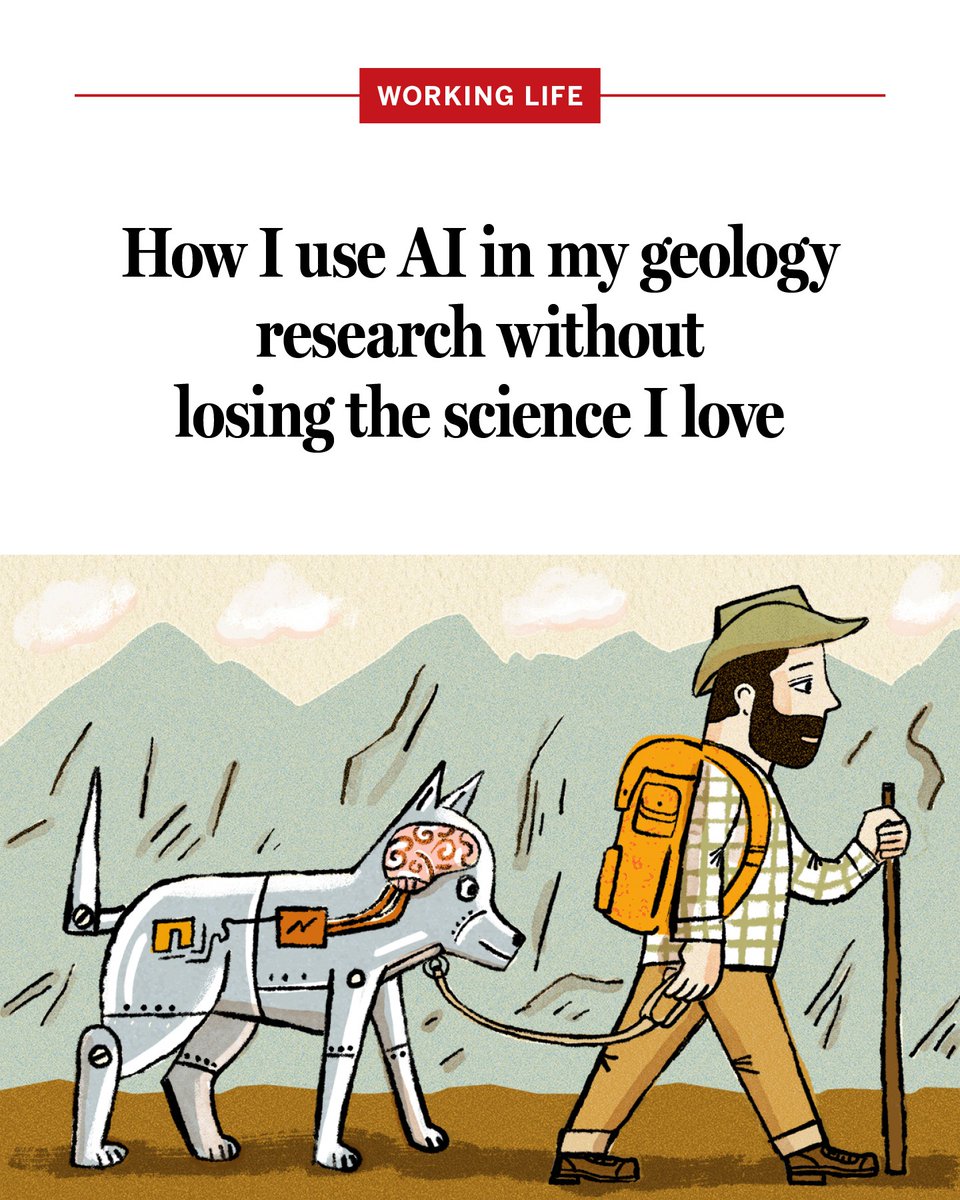
How I use AI in my geology research without losing the science I love
“I have gained the confidence to learn tools I never imagined,” this Ph.D. candidate (@thegeopope) writes. #PhDChat https://t.co/ytumaVjNlI
The BU Marine Program (BUMP) is hiring a new Program Manager. It's an incredible program to be a part of. Please circulate widely and consider applying: https://t.co/FxxC2dKqlO
Really enjoyed the Mathematical Models in Ecology and Evolution (MMEE) meeting in Cork!
If anyone missed my talk "Early-season helping yields increasing returns to scale at the onset of eusociality" (T. Wenseleers, V. Di Pietro & R.C. Oliviera), PPT here: https://t.co/q98z4tcRQe
AI tools can erode abilities very quickly.
Nature says:
1. Colonoscopy study [1]:
Highly experienced physicians had is a 21% relative decline in finding adenoma when they couldn’t access AI.
“The physicians, who had all performed at least 2,000 colonoscopies during their careers, were given access to an AI system that analyses colonoscopy images. The tool was available to the specialists on some days but not on others.
When physicians began using it, their performance dropped significantly whenever the system was UNAVAILABLE.”
2. Software engineers couldn’t diagnose errors in codes [2]:
The average success score “was 50% in the AI group versus 67% in the non-AI group”
“The AI-assisted participants did particularly poorly on questions that required them to diagnose errors in the code, which suggests that they had failed to learn the concepts behind the code that they had just produced.”
📍 “Now you have this very odd disconnect between performance and learning. People can perform at a pretty high level, because they’re basically borrowing skills from the AI, but they are not developing those skills themselves.” - Kevin Crowston [Syracuse Univ.]
Basically:
GPS has de-skilled us in navigation.
Now, AI may be de-skilling us in general cognition.
_
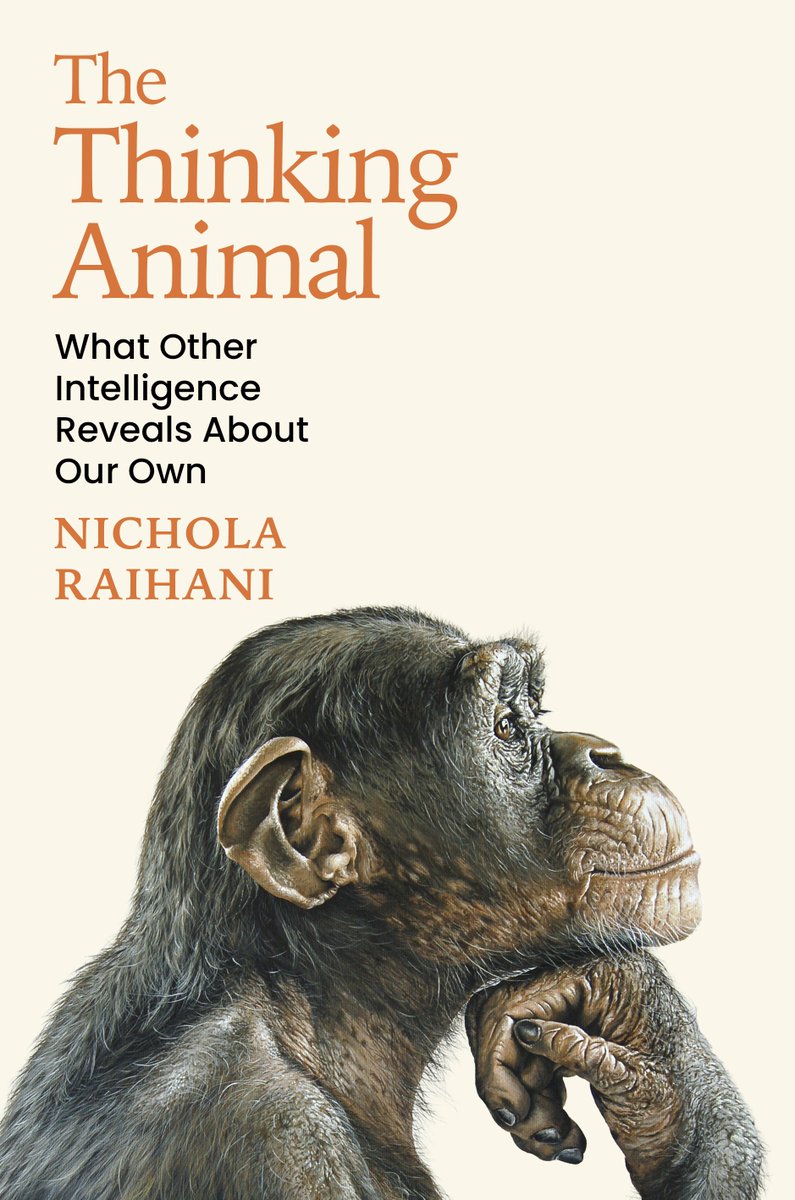
Hello... I haven't been here for a while! Here to say my book, The Thinking Animal, will be published in Jan 2027 and is now available for pre-order if you're interested.
I've also started a blog, riffing on the book's themes. Links to follow.
Corals may face more than bleaching during marine heatwaves.
New research shows that microscopic cilia that help corals transport oxygen can collapse under extreme heat, creating severe oxygen stress and accelerating mortality.
A new physiological tipping point for coral survival in a warming ocean.
🔗 https://t.co/fVKbQCoipJ
#CoralReefs #OceanScience #ClimateChange @pacherres_co@MicroSensing
A game-theory analysis suggests that proposed federal research funding cuts could dramatically alter academia. With funding reductions of 50%, more than half of researchers could become inadequately funded due to increased competition for scarce resources: https://t.co/TrMTW909AR
In a new @ScienceAdvances study, researchers present soft, magnetic hair flow sensors that allow autonomous underwater robots to measure their speed and detect upstream objects, demonstrating a potential tool for underwater exploration. https://t.co/0PbhM6RQYC






![Andrew_Akbashev's tweet photo. AI tools can erode abilities very quickly.
Nature says:
1. Colonoscopy study [1]:
Highly experienced physicians had is a 21% relative decline in finding adenoma when they couldn’t access AI.
“The physicians, who had all performed at least 2,000 colonoscopies during their careers, were given access to an AI system that analyses colonoscopy images. The tool was available to the specialists on some days but not on others.
When physicians began using it, their performance dropped significantly whenever the system was UNAVAILABLE.”
2. Software engineers couldn’t diagnose errors in codes [2]:
The average success score “was 50% in the AI group versus 67% in the non-AI group”
“The AI-assisted participants did particularly poorly on questions that required them to diagnose errors in the code, which suggests that they had failed to learn the concepts behind the code that they had just produced.”
📍 “Now you have this very odd disconnect between performance and learning. People can perform at a pretty high level, because they’re basically borrowing skills from the AI, but they are not developing those skills themselves.” - Kevin Crowston [Syracuse Univ.]
Basically:
GPS has de-skilled us in navigation.
Now, AI may be de-skilling us in general cognition.
_](https://pbs.twimg.com/media/HLLX96XWwAAE39e.jpg)