Nockchain’s core bet is simple: Proof-of-Work doesnt have to be wasted.
Instead of burning cycles on meaningless hashes, miners run Nock computations. The work itself becomes verifiable. The long-term goal is a trustless compute market settled on-chain, where people can buy and sell compute for AI inference, ZK proofs, and other workloads.
But that idea breaks down fast if the nodes securing the network need rack-server-level hardware just to stay online. Until recently, that was a real constraint.
Before the PMA, running a node meant using 34 to 68 GB of RAM. Every restart could take minutes because the full noun graph had to be replayed from scratch. That was not laziness or poor engineering. It comes from the structure of the Nock runtime itself. Keeping a large, mutable, pointer-heavy data structure alive across restarts is a hard problem.
What they shipped: RAM down to ~1.8 GB, boot time in seconds, and event processing sped up over 100x on the small stuff.
The important move was taking durable state out of the Nock stack and putting it into a file-backed mmap arena. Nouns are stored as offsets instead of raw pointers. That means the state can survive a restart without depending on where the operating system maps memory.
This matters far beyond node UX. The next pieces on the roadmap depend on it: the AI compute market in June, full ZKVM in Q3, then a ZK verification opcode after that. None of that scales if node operators are priced out by hardware requirements.
PMA does more than improve performance. It removes the technical bottleneck that the rest of Nockchain’s roadmap depends on.
$NOCK
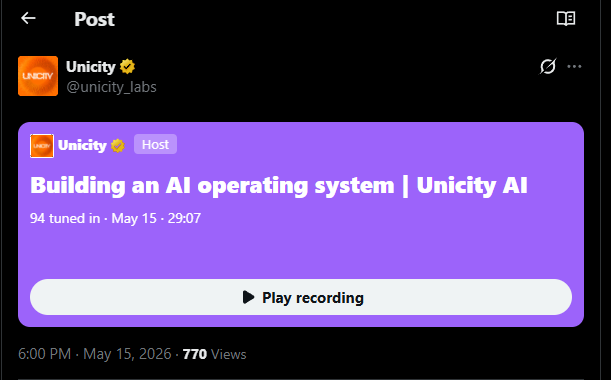
@unicity_labs guys seriously when will you leave that web3 n*******s approach and collab or make partnership with people who are not for airdrop but for technology 100k+ followers 27K discord members and only 94 people listened idk who is your advisor but man that he is boomer
Roadmap on the site is updated now to reference the ASERT upgrade, properly sequence upcoming scaling upgrades, and reference our plans around quantum-secure signatures.
Atho Explorer is getting posted soon.
The explorer will let the community view testnet blocks, transactions, addresses, mempool activity, and network data in real time.
This is another step toward making Atho more transparent, testable, and ready for mainnet.
Testnet is moving forward.
Feedback is welcome.
https://t.co/ajKUy62eAa
Most blockchains are a shared spreadsheet.
Unicity replaces it with a cryptographic object you hold. No one else sees it.
Why do we need this for an agentic internet? 🤔
Unicity Labs is building a next-generation system where AI agents can transact and interact directly without intermediaries. At its core is the Unicity Protocol, enabling near-instant, low-cost transactions without shared ledgers or delays. AgentSphere lets agents discover each other, negotiate, and settle peer-to-peer with zero platform fees. Sphere Quests is an incentivized testnet campaign where users complete real tasks, earn XP, and gain future token rewards. Anyone can join for free, starting with a quick onboarding at https://t.co/lgZsKlRcJH.
Unicity Labs is building a next-generation system where AI agents can transact and interact directly without intermediaries. At its core is the Unicity Protocol, enabling near-instant, low-cost transactions without shared ledgers or delays. AgentSphere lets agents discover each other, negotiate, and settle peer-to-peer with zero platform fees. Sphere Quests is an incentivized testnet campaign where users complete real tasks, earn XP, and gain future token rewards. Anyone can join for free, starting with a quick onboarding at https://t.co/lgZsKlRcJH.