🚨 THIS IS NOT A DRILL 🚨
Glamsterdam goes live on Hoodi on Monday!
This is the second and final testnet fork before mainnet, following Sepolia on October 6. Once Hoodi forks smoothly, the next step is setting a mainnet date.
When: Monday October 26, 17:42 UTC
Join the YouTube livestream to watch the fork go live, and bring your questions to the chat.
https://t.co/ENBek1lgM4
Shipped in 26.39 – 26.42 👇
1)
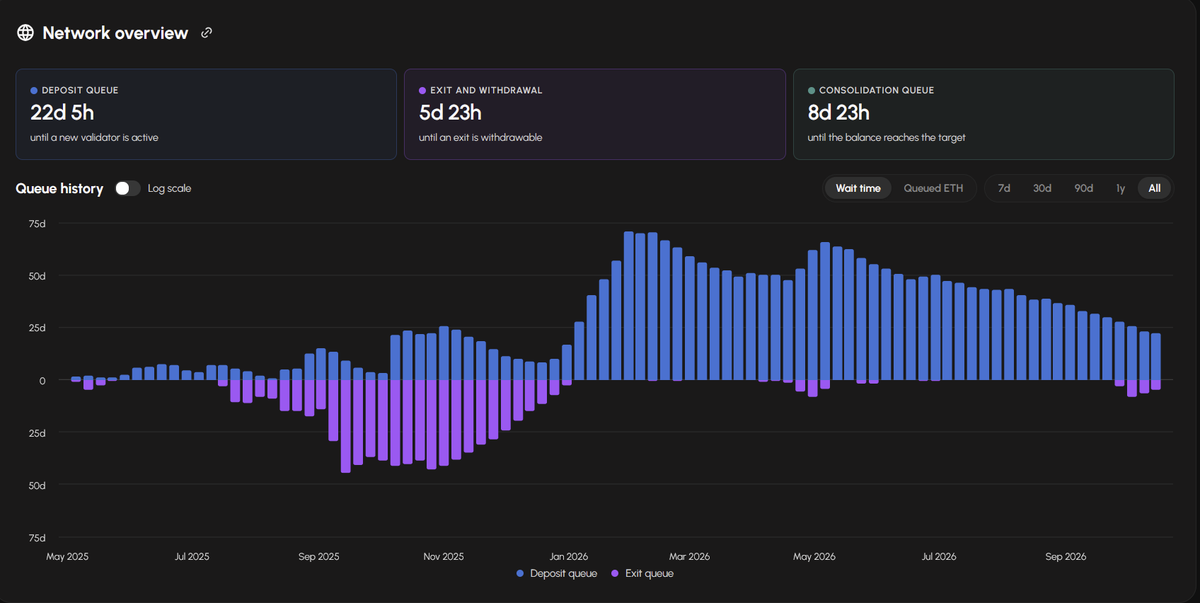
Validator queues are now easier to understand.
Many users mixed up the exit queue, the withdrawal delay and the point when funds actually arrive in their wallet.
https://t.co/tTsaZNOaJZ
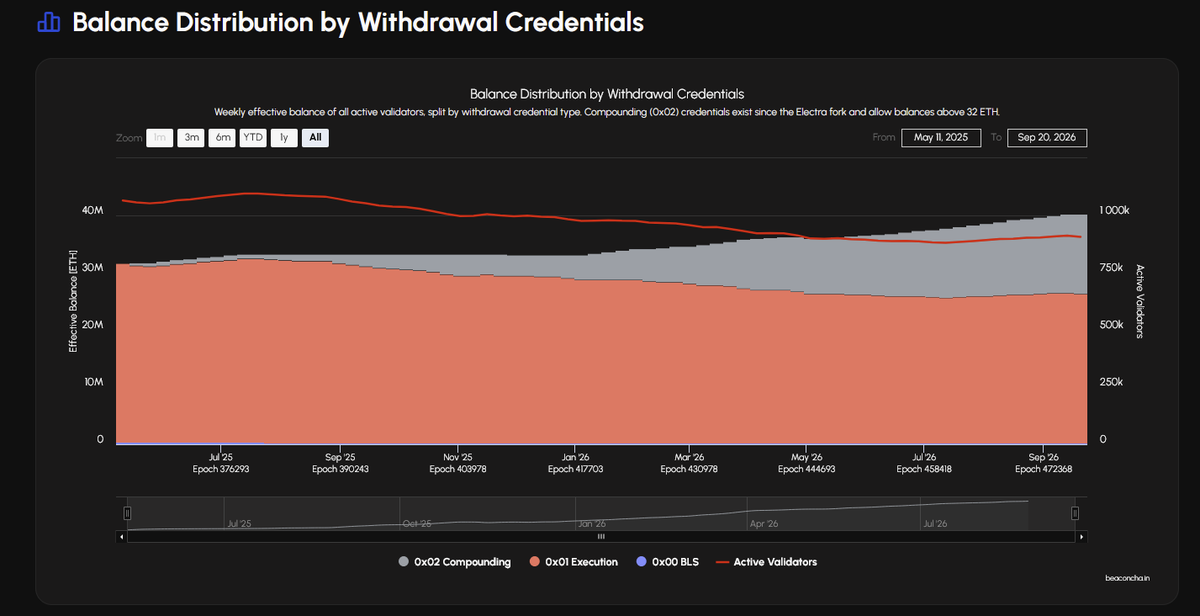
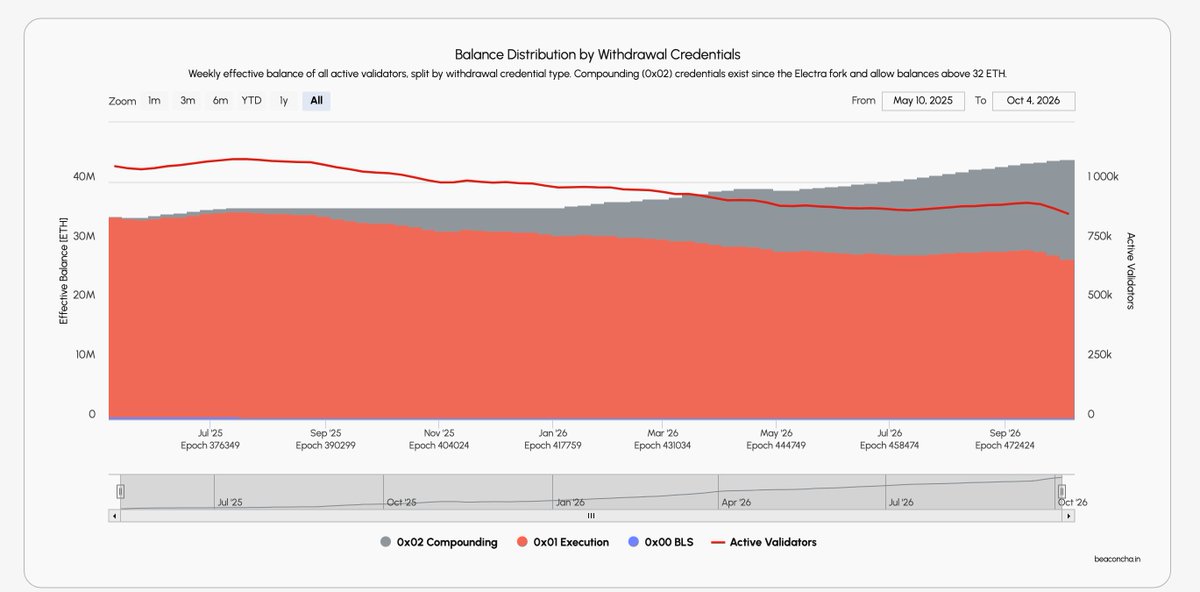
Here is an even better view of who's stepping in, who's stepping out, and who's consolidating in the validator set.
This is not the mass exodus that some accounts are wrongly portraying. Great to see all these consolidations!
Source: @beaconcha_in https://t.co/eP5a739QZv
Ethereum Validator Queue
We've received several messages about validator queue exit times not matching the validatorqueue site.
Validatorqueue site counts consolidations as exits, so Lido's consolidations wave inflates its exit wait.
Live numbers: https://t.co/5oLy42GQQp
No.
The validatorqueue site is counting consolidations as exits.
Lido (@LidoFinance) just triggered a wave of consolidation requests, and those are showing up as exits.
You can find the accurate numbers here: https://t.co/lv8qkDnhdV
Today I call upon the blockchain industry to calmly begin planning for "bunker mode". My personal recommendation is to set in motion a controlled mass migration of assets to fresh addresses, i.e. addresses whose pubkeys remain hidden behind a hash.
Holders, starting with large and sophisticated ones, should consider moving the bulk of their funds to addresses that have never signed a transaction. And when they do sign one, they should also move remaining funds to a new address (possibly generated from the same seed phrase).
Don't rush. While I believe there is cause for action a rushed migration would do more harm than good. Don't panic either. Moving assets to protected addresses is a simple, preventative step which does not require new cryptography or new wallets.
IMO it is now reasonable to brace for the possibility that ECDSA breaks before qday, in the worst case in months not years. By "break" I mean fast private key recovery (e.g. in one week) on available hardware (e.g. a large GPU cluster).
Recent days have been humbling for human mathematical intuition. Long-held, unquestioned hypotheses have fallen. This includes the n log(n) bound for integer multiplication and the 3SUM conjecture. In hindsight, May's unexpected disproof of the Erdős unit distance conjecture was our warning shot.
Yesterday's OpenAI drop made it clear that mathematical superintelligence is upon us. They say there are weeks where decades happen. We are about to live through weeks where centuries of mathematical progress happen. Could our magic 64-byte ECDSA signatures be too good to be true? Was it just security through obscurity all this time?
Elliptic curves feel especially vulnerable to superintelligence. Curves carry rich structure, with room for fancy tricks like Schoof, Frobenius, pairings. (By contrast, hashes are designed to minimise algebraic structure.)
Separately, as Ewin Tang can attest, an efficient quantum algorithm sometimes foreshadows an efficient classical one. We should be open to the possibility of a classical counterpart to Shor that breaks elliptic curves and RSA at once.
Also noteworthy is the striking under-representation of cryptographic breakthroughs among the 722 mathematical results OpenAI published. I've witnessed first-hand the US government censoring academic quantum cryptanalysis results. Backroom interventionism is my base case.
I urge large, sophisticated actors to lead by example. Project11's "risq list" (bitcoin-risq-list.projecteleven[.]com) is a great tracker of exposed BTC pubkeys. Binance, Bitbank, Robinhood, Bitfinex, and Tether have an opportunity to harden their cold storage. Next month I'll address institutions in London in a live Q&A (forum.ethereuminstitutional[.]org/london-2026).
Again, please do not rush. Wallets holding under 50 BTC enjoy partial cover from "Satoshi's shield", i.e. his 20K exposed addresses that hold 50 BTC each. Load-bearing signers like oracles and L2 security councils should consider rotating ECDSA pubkeys with every signed message and/or multi-signing with a hash-based schemes like SPHINCS.
Exiting bunker mode safely will require post-AI cryptography. My inclination is to go all-in on hash-based cryptography and avoid structured mathematical assumptions entirely, whether from curves, lattices, or isogenies. A single battle-tested hash (e.g. from the SHA or BLAKE families) yields plausible post-AI security.
The Ethereum roadmap on strawmap[.]org fully embraces hash-based cryptography with end-to-end formal verification as a response to the quantum threat. Those timelines must now be revisited and accelerated in light of mathematical superintelligence. I'll be pushing for maximum defensive acceleration.
📋Withdrawing EIP-8363 from consideration for Hegotá.
EIP-8363 rapidly became one of the most commented-on EIPs in the history of the Ethereum-Magicians forum, with 200+ comments in a few weeks. As we progressed through the Hegotà CFI (Consideration For Inclusion) process, several parties in the industry as well as core protocol and client contributors voiced that a fork scoping exercise was not the right venue to settle an issuance policy change.
We agree and we'd rather acknowledge this now than carry on towards Hegotà in this context. The topic is too important and raised too many concerns that it deserves its own process. We commit to giving issuance its own process and we thank the entities such as @LidoFinance who offered to help steer such an initiative.
We stand by the motivation of this EIP, in particular: “a very high staking ratio is undesirable for two distinct reasons (...), preserving Ethereum’s security, neutrality and resistance to capture, and protecting ETH’s role as money.” Not everybody immediately relates to both reasons and for others recognizing just one of these reasons is enough to justify a change. Nevertheless, we will all benefit from improving our understanding of the issue and what is at stake. The questions we have faced since we published EIP-8363 can be boiled down to 5 categories:
➡️Security: What does a lower ratio actually secure versus a higher ratio?
➡️Industry impact: What else is built on the yield and what will be the impact ?
➡️Curve specs and alternate tools: Is this curve even the right instrument?
➡️Composition: Who is left staking (the effect on the composition of the validator set) ?
➡️Decentralization: How will solo stakers be impacted by the reduction?
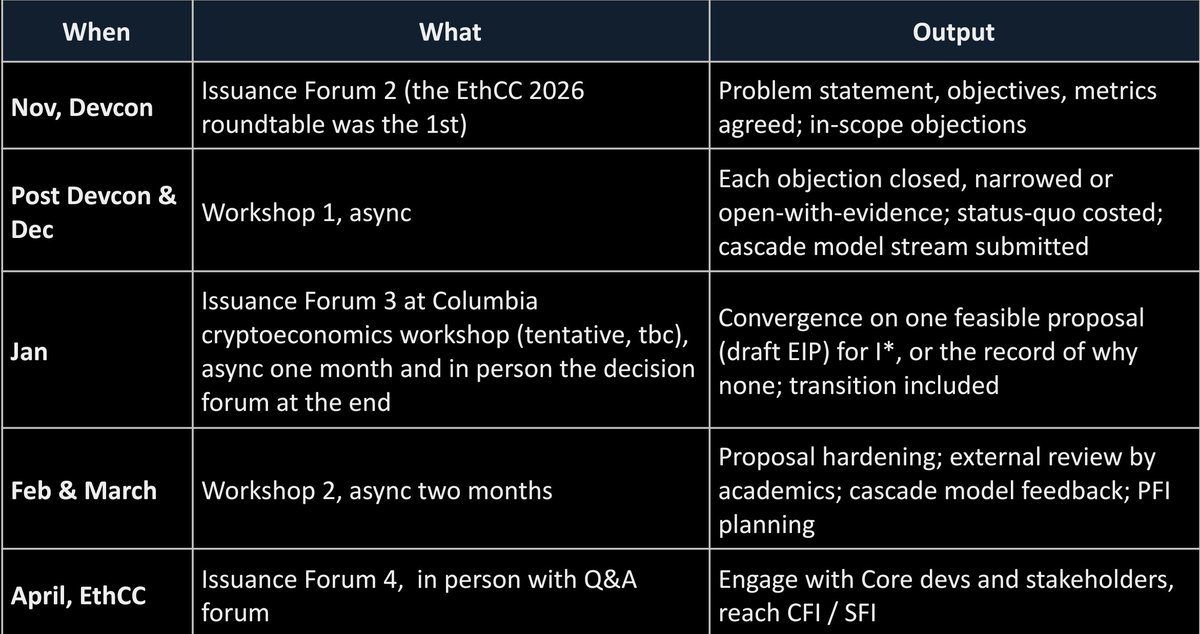
We already argued a lot, conceded some and adjusted a few points in the very long Ethereum-Magicians thread mentioned supra. For a broader consensus to emerge and a better issuance policy for Ethereum to be designed and adopted, we need a dedicated process. We call for all willing hands to help and contribute to this, please do reach out. Here’s our start at what a multi-node process would look like (table attached).
Onward and forward, let’s improve Ethereum.
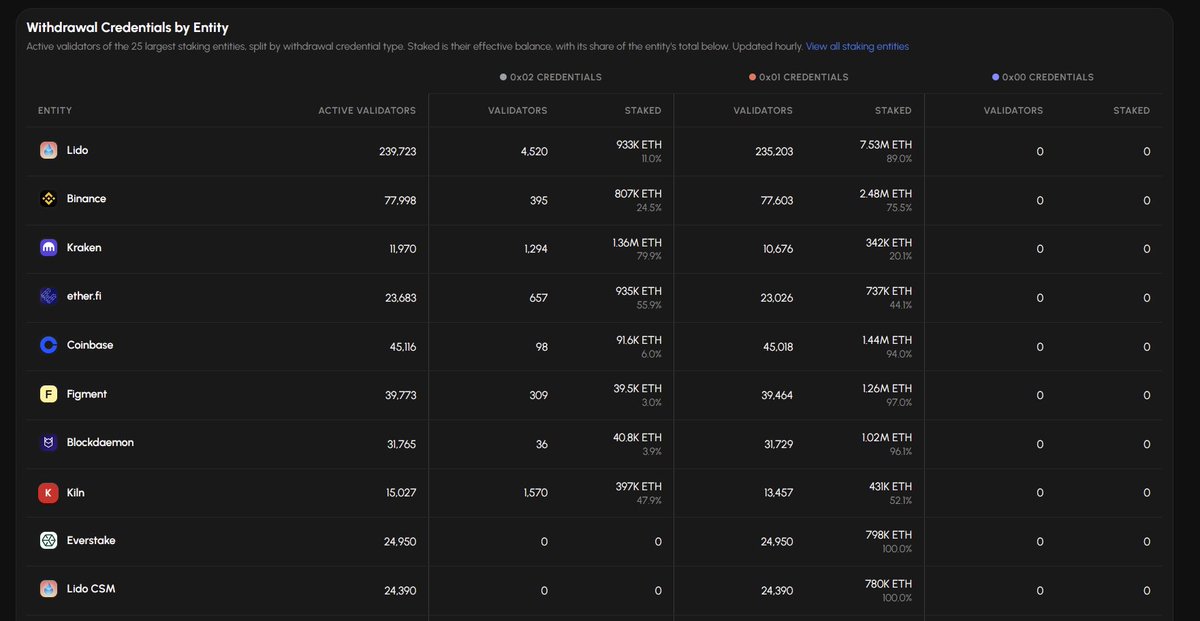
We've added a leaderboard to track consolidation progress and credential breakdowns for each staking provider:
https://t.co/VWJzYC19Jm
What else would you like to see on https://t.co/Mq7v0RHCpP? 👀
One step closer to 4-8x faster Ethereum finality!
It took some time and lots of tokens, but we now have a formally verified proposal for a decoupled consensus protocol in I* (a future Ethereum upgrade)! Not yet a full spec (up next), but it includes all the key consensus-relevant details to become one.
Since Ethereum aspires to be live without most of the stake online, the protocol involves many more components than a normal BFT protocol, and its correctness involves much more than standard safety and liveness. Those nuanced properties are now verified!
What's more, I came away convinced that all protocol design will involve AI-assisted Formal Verification in the future, both for correctness and iteration speed.
The work wasn't limited to just:
Design the protocol -> Formally verify it
Instead, the loop became more like:
Design -> Formal Model -> Find exactly what breaks and why -> Redesign it.
For a fairly complicated protocol like this one, I think having the Lean model be part of the design loop played a big role in accelerating the process.
A future with agents paired with formal models is a superpower for Ethereum development, because they can then use those models to find exactly where an argument breaks down, formalize counterexamples, test proposed fixes, iterate on the protocol.
Many details that would slip under the radar when asking agents (and indeed, humans) can now be specified exactly and checked by the Lean kernel. This then forces agents to be more precise and lets them make verifiable progress on their own. It's been incredible to see this play out, seeing agents find gaps and propose protocol changes to fix them.
In other words, autoresearch can speed up protocol design, formal verification is here to stay, and Ethereum Finality will get faster.
The consolidations page picks up two charts:
- Staked ETH per withdrawal credential type
- Average and median balance of compounding validators
https://t.co/VWJzYC0BTO