We research macro-scale patterns in butterfly ecology using combined laboratory, field, and data intensive approaches. Based out of @GUBiology @Georgetown.
Do you want to help #butterfly#conservation but don't know where to start? Then https://t.co/bEFsdvtro4 is for you!
Join our eButterfly webinar, on how to use it, and all its new features this Thursday, July 21st, at 4 PM (EST).
Preregister here: https://t.co/Fk7ijaV1TV
A single-winged butterfly nebula… 🦋
The NSF-supported Gemini South telescope in Chile captured this image of the Chamaeleon Infrared Nebula – a gaseous region of the Milky Way where stars & planets are born. https://t.co/nCcFNq4Ejz
📷: @GeminiObs / @NOIRLabAstro /NSF/AURA
Happy #PrideMonth! Georgetown celebrates LGBTQIA+ identities and communities – best understood in the context of each person’s identities and communities – and draws upon our Jesuit values to continue to advance equity and inclusion. https://t.co/Rk5hKzzhlB
The iNaturalist community has posted over 100 million verifiable observations!
Check out our blog post, it has some cool graphics and breakdowns. Thank you to everyone who adds observations and identifications to iNat!
https://t.co/A47TGYpXiK #communityscience#citizensicence
New butterfly evolutionary study is out as preprint! 2244 spp sequenced for 391 genes. Butterflies likely originated in what is now Americas, ~100 million years ago. Research led @FloridaMuseum#McGuireCenter. Global study w/87 scientists from 28 countries https://t.co/mNqRNHfJQF
Grace Jeschke (@J888Grace) is a Ph.D. student in our lab looking at how thermal stress (like climate change!) may modulate immunological responses of caterpillars. #FaceOfScience
Vaughn says, "I love thinking about collections as clues - how can we use them to reconstruct historical ecologies?" Outside of science, Vaughn recently collaborated with his partner on an artistic cyanotype climate study: https://t.co/mDnSHabM9e #ClimateArt#ClimateChangeArt
Vaughn's fascination with insects started by working in the collections at @AcadNatSci@DrexelUniv and they became interested in high-latitude ecosystems while living in Finland during a @FulbrightFIN award where they worked with @libre_research on data bias.
Elise says, "I love exploring how other creatures experience the world in such different ways, and how platforms like @inaturalist let us scale up from people reporting their every day encounters to understanding patterns and processes."
Beauty in unexpected places! 😍 Our McGuire Center staff are working on organizing and digitizing parts of this large collection of more than 19,000 Lepidoptera genitalia slides. More about this collection from Deborah Matthews, Jim Hayden and team:
https://t.co/26wySpAAz9
Just received word that Vaughn's 2nd dissertation chapter on the use of occupancy models with natural history museum data was accepted for publication in Methods in Ecology & Evolution! Congrats Vaughn!
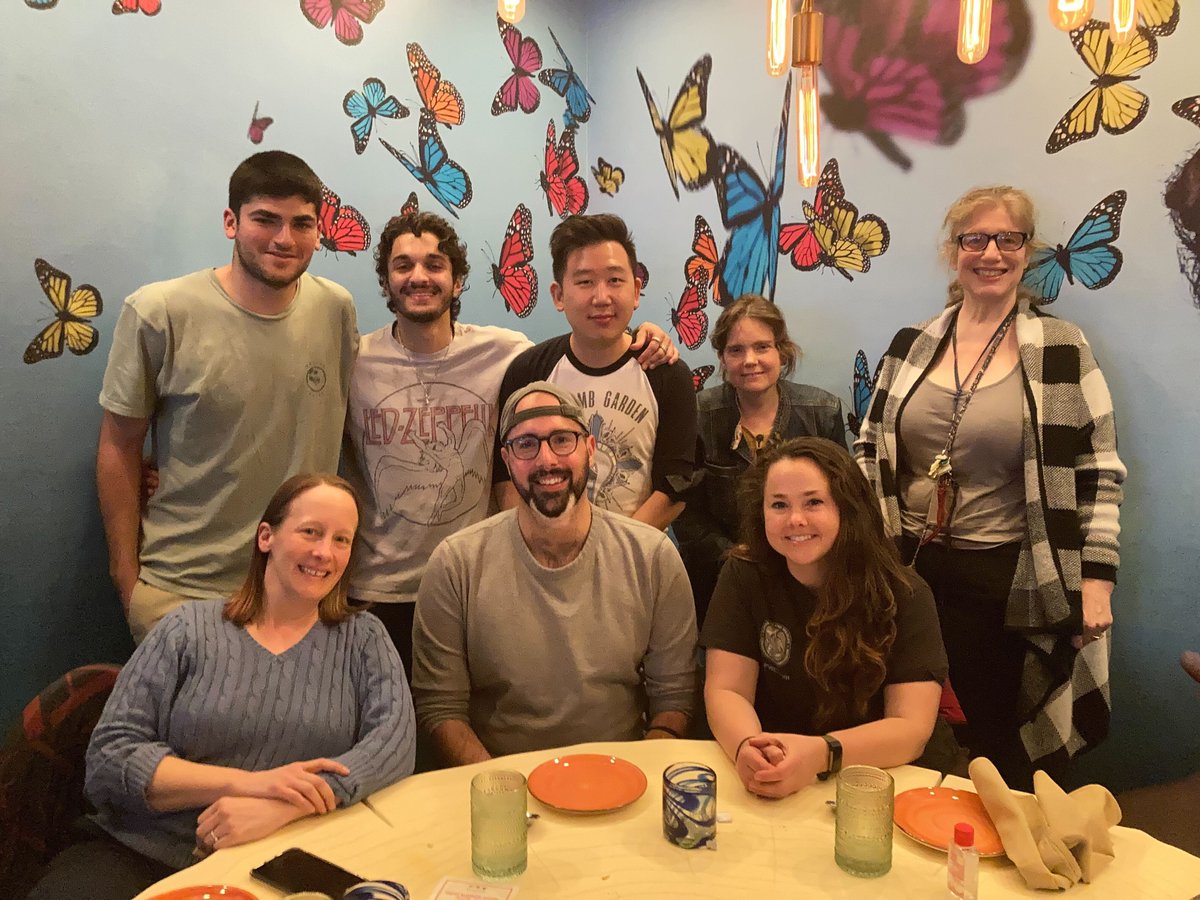
Last night the Ries Lab crew got together to celebrate Cliff and Arshan getting into medical school (note the appropriately themed restaurant). We're so proud of these guys!
Did you blink and miss it?
Thanks for the annual update, @Team_eBird—and congrats to all 1,799 institutions, teams, projects and partners who make more than #2Billion records of #OpenData on biodiversity available through the #GBIF network! 🎉🥳🍾
https://t.co/FpbygWT96U