My third (and last) post in my series on obfuscation (iO): local mixing
https://t.co/xO2ZYcxTWU
Local mixing is a very different philosophy from the other two, no prior background in lattices required, and very different tradeoffs (eg. in terms of computational overhead, it's viable today; the entire question is verifying the security of what's ultimately a novel family of cryptography). I highly encourage following their work, they plan to publish much more soon.
@DefiIgnas Teams really shut down because they anticipated longer bear?
I thought it's just because they didn't have the resources to continue operations.
But thinking about it, many teams shutting down experienced bear markets back in the days.
Weird.
The part of this chart I keep coming back to is everything that happens post peak.
I’ve been away from consistent writing on X for a while this year because I chose to give more of my attention to other things, work included.
I’ve spent my time reading, building workflows, tightening my research process, finding gaps in what I thought I understood, and turning major repetitive parts of my work into systems where they actually make sense.
I’ve also become more deliberate about what I refuse to outsource. Tools can save me hours, and automation can keep a workflow going, but some of the difficult work is exactly where personal judgement calls.
I can't help but negotiate with ideas, wrestle with decisions, get things wrong, correct them, and understand why.
The market is surely quiet, and even more so, we are entering the FOMO period as well (late Q3 and early Q4). Right now is the time to try things, test things, and perfect your system.
When everything is moving, euphoria gives you constant feedback and almost anything feels like progress.
However, times like this force you to decide whether you actually enjoy learning, building, and getting better when nobody is rewarding you for it just yet.
The market is never dead. The euphoria will come again. I only want the next opportunities to find me more capable than the last.
The part of this chart I keep coming back to is everything that happens post peak.
I’ve been away from consistent writing on X for a while this year because I chose to give more of my attention to other things, work included.
I’ve spent my time reading, building workflows, tightening my research process, finding gaps in what I thought I understood, and turning major repetitive parts of my work into systems where they actually make sense.
I’ve also become more deliberate about what I refuse to outsource. Tools can save me hours, and automation can keep a workflow going, but some of the difficult work is exactly where personal judgement calls.
I can't help but negotiate with ideas, wrestle with decisions, get things wrong, correct them, and understand why.
The market is surely quiet, and even more so, we are entering the FOMO period as well (late Q3 and early Q4). Right now is the time to try things, test things, and perfect your system.
When everything is moving, euphoria gives you constant feedback and almost anything feels like progress.
However, times like this force you to decide whether you actually enjoy learning, building, and getting better when nobody is rewarding you for it just yet.
The market is never dead. The euphoria will come again. I only want the next opportunities to find me more capable than the last.
Coding agents are making implementation cheaper, and I think we should begin to question how companies use the labour they save.
I use these tools enough in my own work to understand why the business productivity claims can feel extreme.
Even though implementation became much faster, the gap between producing code and producing finished software is clearly obvious once you get to the review stage, architecture, integration, and maintenance.
I read the AI productivity and labour research by the International Center for Law and Economics, where they evaluated 100,000+ developers.
→ Commit activity already increased by roughly 180%,
→ The number of projects increased by about 50%, and
→ Shipped releases increased by about 30%.
This explains that the increase in software production does not necessarily translate to economic benefit because the expected gain continued to shrink as products moved closer to something a user could actually consume.
And apparently, cheaper development can reduce the labour required for work companies already planned to do, while also making previously uneconomic projects worth building.
Employment depends on how much new demand appears as the cost of production falls.
So far, software supply appears to be expanding faster than usage of the new products being created. Meaning what is left is Distribution.
Therefore, even if code becomes more abundant than it already is, judgment must be equally earned.
A Singapore crypto scam using fake LinkedIn job offers and malware stole $11.8M after a victim downloaded malicious software during a fake technical assessment.
Someone attempted this on me a year ago. So sad!
https://t.co/8i6shDSqRj
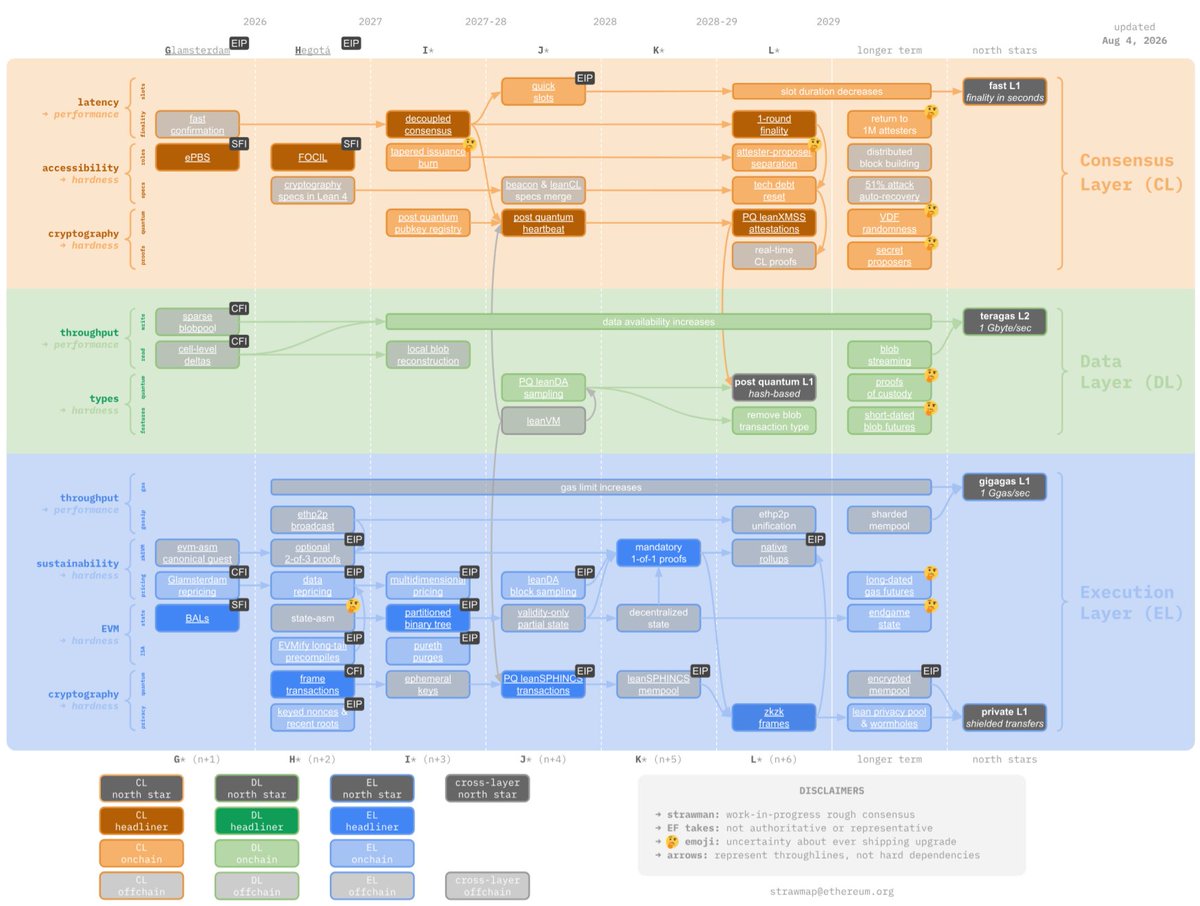
I updated my 2023 roadmap diagram to overlay where the items that were there sit in the current Strawmap ( https://t.co/I35mrXutP2 ).
In general, a lot of overlap, but:
* Some things got reshuffled in order (eg. quantum safety up-prioritized)
* Some things deprioritized (eg. VDFs; many EVM improvements)
* Some things replaced with superior constructions (eg. Verkle -> unified BT -> PBT; state expiry -> new state types)
What's most striking, however, is that some completely new things are in the strawmap that are NOT in this diagram, because they were not in the 2023 roadmap at all. These reflect changing priorities.
Notably:
* First-class attention to strong privacy. This covers: keyed nonces and recent roots, aspects of FOCIL, lean privacy pool & wormholes
* Aggressive scaling in the context of post-quantum. This covers: leanSPHINCS signatures and aggregation, zkzk frames (see https://t.co/ibrOpMxMfO )
* Lean-ification of the spec, to assist in formal verification (full FV of everything is only possible because of modern AI)
* Blob and gas futures (this idea just didn't exist back in 2023)
* Native rollups (SNARKs were nowhere near mature enough to even consider this back in 2023)
* A more open design space for the "future of the EVM". zkzk frames already implies that the protocol will expose to users some ISA that's not the EVM - current leading candidates are leanISA and RISC-V. These ISAs are more simple, modern and efficient than the EVM. Once they're there, why not expose them to developers everywhere? (And then, why not turn the EVM into being an IR on top of that ISA, instead of an enshrined feature massively complicating the base protocol?) Though much of the deeper exploration here is too early even for the strawmap.
* New state types are not just a replacement for expiry, they're a fundamentally different paradigm to how Ethereum does scaling
A common theme in scaling, found in both state types and zkzk frames (both new ideas), is that instead of trying to maximally scale ALL ethereum activity, we try to create specialized mechanisms that have more restrictive properties that make them more scaling-friendly, while supporting the heaviest loads incurred by users and applications today (eg. token transfers, swaps) and tomorrow (eg. privacy protocols).
The other common theme is treating STARKs and AI-accelerated FV as first-class objects, that we are okay betting the technical future of Ethereum on. There are recursive STARKs in many layers of the protocol, one particular primitive (the "aggregate to union verified dependencies" primitive) is expected to be used in *three* places in the protocol: EL, CL and DL. This can only be safe with formal verification, which is itself only feasible with modern AI tools.
In general, many steps forward in maturity. And a huge amount of hard work by many dozens of Ethereum researchers and developers on all of these features.
Ethereum will be quantum-safe. Ethereum will put users' privacy first. Ethereum will be secure. Ethereum will be censorship-resistant. Ethereum will be highly performant and scalable while satisfying the above. And Ethereum will be Lean.
The part of this chart I keep coming back to is everything that happens post peak.
I’ve been away from consistent writing on X for a while this year because I chose to give more of my attention to other things, work included.
I’ve spent my time reading, building workflows, tightening my research process, finding gaps in what I thought I understood, and turning major repetitive parts of my work into systems where they actually make sense.
I’ve also become more deliberate about what I refuse to outsource. Tools can save me hours, and automation can keep a workflow going, but some of the difficult work is exactly where personal judgement calls.
I can't help but negotiate with ideas, wrestle with decisions, get things wrong, correct them, and understand why.
The market is surely quiet, and even more so, we are entering the FOMO period as well (late Q3 and early Q4). Right now is the time to try things, test things, and perfect your system.
When everything is moving, euphoria gives you constant feedback and almost anything feels like progress.
However, times like this force you to decide whether you actually enjoy learning, building, and getting better when nobody is rewarding you for it just yet.
The market is never dead. The euphoria will come again. I only want the next opportunities to find me more capable than the last.