hell yes to this acceptance speech from Qween Jean, who just became the first openly trans person to ever win a Tony
"We are here for the legacy of queer people. Trans people, we have to take up space. We have to shift the paradigm...the world right now is deeply, deeply combating so many ailments, and we know as a society that when we come together we can make real, permanent change."
Qween won Best Costume Design for a Musical for Cats: The Jellicle Ball
@tonyposnanski They should just get the same artists that did the anti-woke TPUSA halftime show: Kid Rock, Brexton Boonley, Benson Brinley, Jaxston Brenson, Binson Boonler, Baxton Bentley, Dixson Jentley, Dexter Baxter, and Bixton Bentson!
I genuinely don’t think people understand how insane this is.
In just 50 years, we’ve wiped out around 70% of animal populations on Earth.
Not hundreds of years ago.
Not ancient history.
In one lifetime.
Entire species disappearing.
Forests going silent.
Oceans being emptied.
And somehow the world treats it like just another statistic instead of a full-blown emergency.
That should scare all of us a lot more than it does.
TWO people have been arrested in Texas, for posting on social media about their contaminated water. One of these people, held OVERNIGHT.
The water is BROWN and the city has made no effort to replace the infrastructure. Instead, they’re arresting their residents for discussing it
Erin Brockovich has launched a website and has begun tracking all data centers in America and logging resident complaints
In just 1 week it’s already logged 1,690 resident complaints
For this who don’t remember
Erin Brockovich was the paralegal responsible for winning out a case against PG&E, Hinckley in California, because their wastewater runoff was seeping into rural areas and creating a lot of health issues for, for the surrounding neighborhoods
That case brought in a $333 million settlement that went to the families affected by the situation because a lot of them either had staggering medical bills due to their tap water was no longer safe
So why is this important, well residents all over America are reporting their tap water and river water is being heavily polluted by data centers
Her map of data centers is new, she just launched it
The website features an interactive US map showing operational, under-construction, and proposed AI data centers, overlaid with community-reported complaints
Residents can submit reports with details, photos, and locations. Within days of launch, it received a surge of submissions over 1,600 in the first week, and reports of 1,800+ from 47 states shortly after
Common Resident Complaints Being Logged
- Water usage
- Raising utility bills for residents
- Noise pollution: Constant 24/7 humming from fans, generators, and cooling systems disrupting sleep, daily life, and wildlife.
- E-waste from frequent hardware upgrades, pollution including PFAS concerns
🚨 BREAKING: Feeding Our Future mastermind Aimee Bock has been sentenced to 41.5 YEARS in prison for orchestrating a massive COVID-era fraud scheme that stole roughly $250 million from taxpayers through fake child meal claims.
Federal prosecutors described it as one of the largest pandemic fraud schemes in U.S. history.
And suddenly a lot of people online who spent years screaming about “foreign gangs” are discovering the central figure was a white nonprofit executive from Minnesota.
Fraud is fraud.
Stealing money meant to feed children during a national crisis deserves severe punishment no matter who commits it.
$250 million.
During a pandemic.
Using hungry kids as the cover story.
That sentence sends a message.
What kind of government brings back cyanide bombs onto public land after years of documented deaths and outrage?
The devices are called M-44s. They’re baited with scented lures designed to attract coyotes and other animals. But they don’t know the difference between wildlife, pets, or children.
One tug releases sodium cyanide into the victim’s face. Moisture turns it into deadly hydrogen cyanide gas. The result is often convulsions, paralysis, and a horrifying death.
These are the same devices that killed a 14-year-old Idaho boy’s dog in front of him in 2017 and sent him to the hospital.
The Biden administration banned them from Bureau of Land Management lands in 2023. But in 2026, Trump’s agencies quietly reversed course, reopening roughly 245 million acres of public land to their use. Then House Republicans pushed language to fully restore the program through the USDA.
Wildlife Services’ own records show thousands of animals killed with M-44s in a single year, including accidental deaths of protected species and non-target animals. Family dogs, wolves, grizzlies, even condors have been caught in these traps.
This isn’t conservation. It’s poison hidden across public lands for the benefit of livestock interests.
Americans should not have to worry about cyanide devices near hiking trails, campsites, or places where children and pets roam.
They brought them back quietly because they knew the public would be horrified.
NEW: Multiple ICE warehouses were sold by people in Trump's circle who were sitting on the properties and losing money.
We dug into it, and found that some properties were bought by the feds for 10x their list price.
It's a new level of corruption — and you're paying for it.
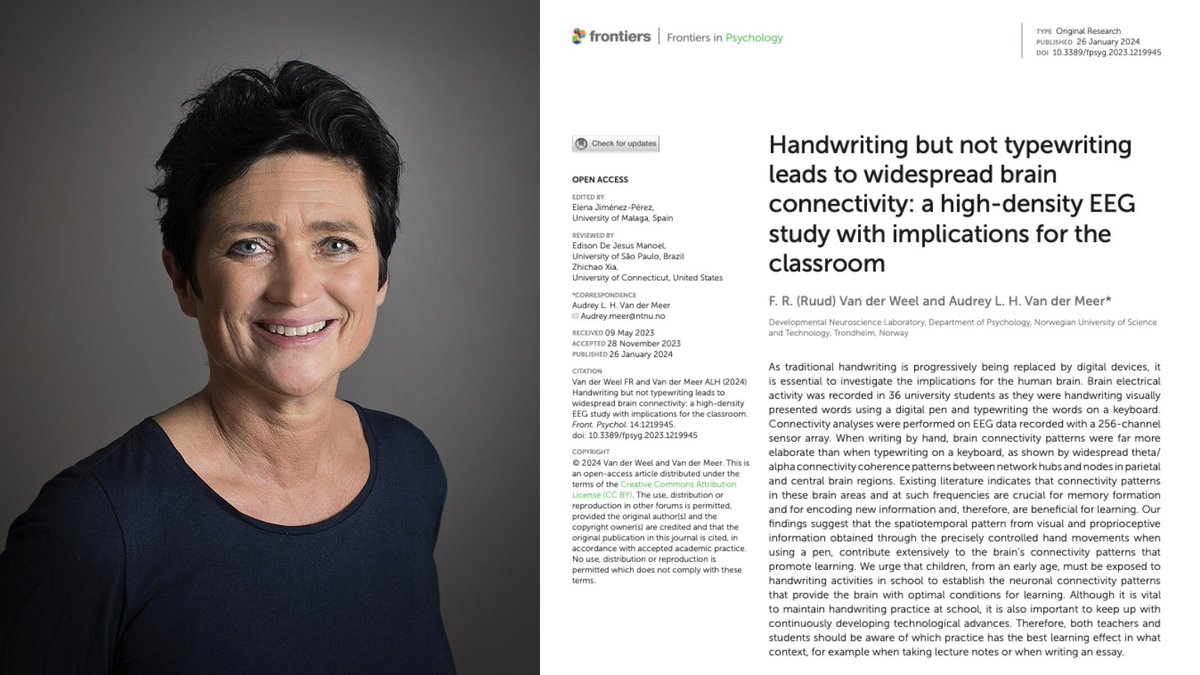
A Norwegian neuroscientist spent 20 years proving that the act of writing by hand changes the human brain in ways typing physically cannot, and almost nobody outside her field has read the paper.
Her name is Audrey van der Meer.
She runs a brain research lab in Trondheim, and the paper that closed the argument was published in 2024 in a journal called Frontiers in Psychology. The finding is brutal enough that it should have changed every classroom on Earth.
The experiment was simple. She recruited 36 university students and put each one in a cap with 256 sensors pressed against their scalp to record brain activity. Words flashed on a screen one at a time.
Sometimes the students wrote the word by hand on a touchscreen using a digital pen, and sometimes they typed the same word on a keyboard. Every neural response was recorded for the full five seconds the word stayed on screen.
Then her team looked at the part of the data most researchers had ignored for years, which is how different parts of the brain were communicating with each other during the task.
When the students wrote by hand, the brain lit up everywhere at once.
The regions responsible for memory, sensory integration, and the encoding of new information were all firing together in a coordinated pattern that spread across the entire cortex. The whole network was awake and connected.
When the same students typed the same word, that pattern collapsed almost completely.
Most of the brain went quiet, and the connections between regions that had been alive seconds earlier were nowhere to be found on the EEG.
Same word, same brain, same person, and two completely different neurological events.
The reason turned out to be something nobody had really paid attention to before her work. Writing by hand is not one motion but a sequence of thousands of tiny micro-movements coordinated with your eyes in real time, where each letter is a different shape that requires the brain to solve a slightly different spatial problem.
Your fingers, wrist, vision, and the parts of your brain that track position in space are all working together to produce one letter, then the next, then the next.
Typing throws all of that away. Every key on a keyboard requires the exact same finger motion regardless of which letter you are pressing, which means the brain has almost nothing to integrate and almost no problem to solve.
Van der Meer said it plainly in her interviews.
Pressing the same key with the same finger over and over does not stimulate the brain in any meaningful way, and she pointed out something that should scare every parent who handed their kid an iPad.
Children who learn to read and write on tablets often cannot tell letters like b and d apart, because they have never physically felt with their bodies what it takes to actually produce those letters on a page.
A decade before her, two researchers at Princeton ran the same fight using a completely different method and ended up at the same answer. Pam Mueller and Daniel Oppenheimer tested 327 students across three experiments, where half took notes on laptops with the internet disabled and half took notes by hand, before testing everyone on what they actually understood from the lectures they had watched.
The handwriting group won by a wide margin on every question that required real understanding rather than surface recall.
The reason was hiding in the transcripts of what the two groups had actually written down.
The laptop students typed almost word for word, capturing more total content but processing almost none of it as they went, while the handwriting students physically could not write fast enough to transcribe a lecture in real time, which forced them to listen carefully, decide what actually mattered, and put it in their own words on the page.
That single act of choosing what to keep was the learning itself, and the keyboard had quietly skipped the choosing and skipped the learning along with it.
Two studies. Two countries. Same answer.
Handwriting makes the brain work. Typing lets it coast.
Every note you have ever typed instead of written went into your brain through a thinner pipe. Every meeting, every book highlight, every idea you captured on your phone instead of on paper was processed at half depth.
You did not forget those things because your memory is bad. You forgot them because typing never woke the part of the brain that would have made them stick.
The fix is the thing your grandmother already knew.
Pick up a pen. Write the thing down. The slower road is the faster one.