📢The @CAREER_erc is organizing a workshop on “Skills and Careers in Changing Labour Markets” in Amsterdam on 26-27 May 2025!
👉With keynotes from @siwei_cheng and Heike Solga
Interested? Chech our call for papers and apply!
https://t.co/lpPE71B6fY
📢Working on the crosssections of education, work, and labour markets? We welcome contributions to discuss new theoretical insights and methodological developments during the @CAREER_erc workshop on 26-27 May in Amsterdam!
⏳Deadline call for papers December 20, 2024
So very delighted to see our paper (with the amazing @tfliao) published @ESR_news!
We find that the prevalence, frequency and duration of unemployment can explain part of the rise in the Dutch wage disparities!
Mismatches between educational qualifications and occupations lead to health issues.
Why? Because of psychosocial rather than material problems.
Read this newly published paper @SSReditorial to find out more 👇
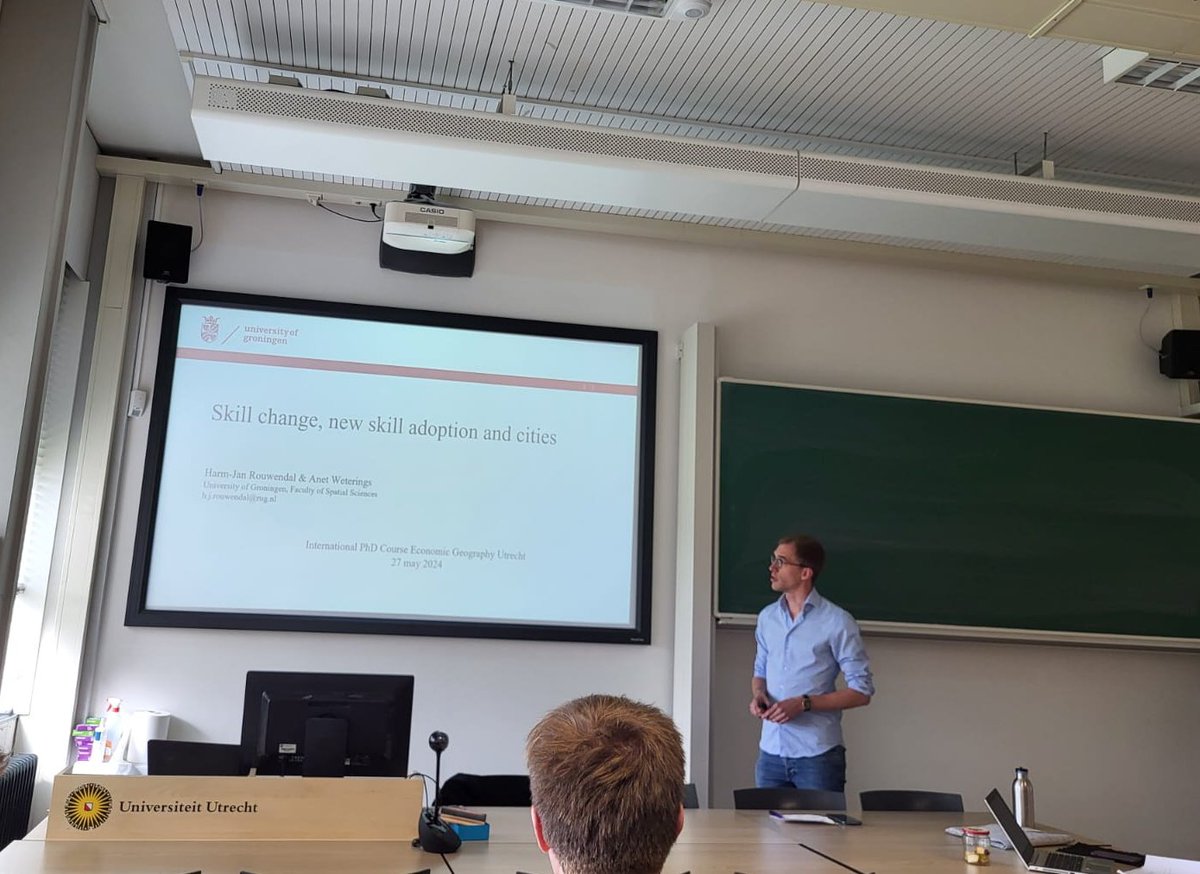
Happy to present our work on skill change and new skill adoption in cities at the International PhD Course on Economic Geography in Utrecht @SGPL_UU
Thanks for the feedback Christian and @CCastaldi!
A pre-print for another paper from the @CAREER_erc project team, by @LabussiereMarie and @thijs_bol!
It analyzes the relationship between occupations and skills in the British labor market:
👇
Some colleagues (and sometimes myself) have wondered what I have been doing behind my computer for the last two years. Enough suspense!
@thijs_bol and I are happy to share the pre-print of our (affectionally called) "bundles of skills paper".
https://t.co/5C4jWo53xK ⬇️1/5
When can immigrant educational selectivity explain second-generation attainment?
@ReneeLuthra and I outline some conditions and analyze a case where they are not met (the UK).
Check out our new paper on Social Science Research:
https://t.co/qmulNSkbcQ
With the European Year of Skills ending, #skills2capabilities invites you to an online event to engage with Horizon Europe projects on skills for social and economic transformations:
https://t.co/bNqxDWOsoW
Social inequalities are sensible to macroeconomic conditions! Read #OpenAccess our brand-new findings on how the Great Recession affected social mobility chances of the new generations: increasing their university drop-out! By @LorisVergolini and myself ⬇ https://t.co/gzfQzG8Alw
Our team at @UNED_Inequality is hosting the @ECSR_Soc network workshop:
'Exploring the Role of Geography in Educational Inequality Research'
📅 9-10 April, 2024
📍 UNED, Madrid
Interested? Reach out to the organisers @IlariaLievore & @mvaldes1989
Check out the program ⬇️
Interested in social networks and in education or labor markets? Apply to our workshop in Lausanne on 29th / 30th October 2024. Keynote is held by @arvidssonmartin. Deadline for sending in abstracts is the 30th of March. Organized in cooperation with @SGovpet and @Centre_LIVES
New analysis of the 🇳🇱 2017-'19 reform increasing youth minimum wage showed no negative employment effects and wage increases for young workers, together with positive spillover effects, especially for low-wage workers. 👇
Is there such a thing as unskilled labor?
And do fast-food workers develop skills as McDonald's ads suggest?
@LabussiereMarie gives her 2 cents in this new blog post on the @CAREER_erc project!
https://t.co/kLnI3w6iBU
Call for abstracts: Workshop on networks in education and the labor market in the beautiful Lausanne.
Apply by 30th March
Details here: https://t.co/J0M6jmYdtT
Next Monday, in Venice, I will present our work on estimating the returns to education and early-career experience for young French people, with R. Gary-Bobo and D. Argan.@CrestUmr@Ensai35
Very interesting talk on gender pay and employment gaps - showing slow progress being made. In a recent @ETUI_org paper we look in detail at men and women working different jobs, link with inequality, and how this itself affects pay differences https://t.co/Je3CsQNfE9
🚨 I am excited to share my JMP!
"Scale-Biased Technical Change and Inequality"
I propose a new theory on why some technologies increase inequality, while others reduce it. I provide causal evidence from the adoption of steam engines and electric motors to support the theory.
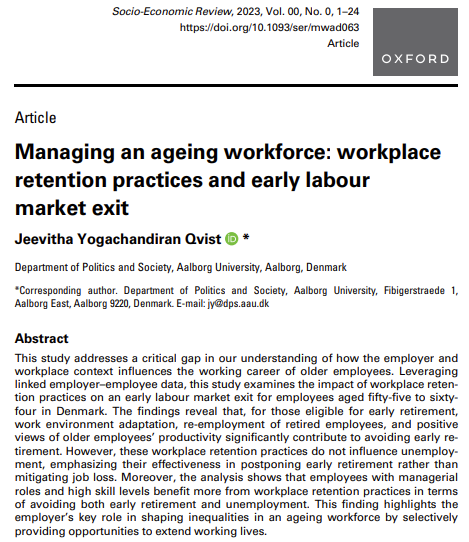
How do the employer and workplace influence the working career of older employees? In this brand new Socio-Economic Review @SASE_Meeting paper I look at the impact of workplace retention practices on older employees' early labour market exit in DK (1/5)
https://t.co/kUQ8HBNu0c