Same order, same instant, frame-synced
Coinbase vs. JTX
JTX fills fastest with lower fees
Every market in the world, settling at the speed of light. The future of markets is fast, self-custodial DeFi on @solana
Tokens with sustained demand, and diminishing annual supply inflation, stand to do well over time, and explains why some “dinocoins” have awoken this cycle.
The economics for tokens has quietly changed. After years of poor value accrual and cyclical demand, compunded by the fear of prosecution, protocols are actually paying token holders now via multiple mechanisms.
$1.95B went to holders over the last 12 months, 5x the end of 2022. Holders' share of revenue has gone from 20% to 37%.
And it's broadening out. 9 tokens paid holders >$1M a year in 2022. Now it's 32.
This weeks @RealVision Alpha Crypto Pulse drops with the latest stats highlighting crypto's improving investibilty for institutional investors.
Market seems to be waking up to the insane throughput of Fibre, one of the few architectures able to satisfy the mind-numbing scale of an agentic wave of demand.
A prospective customer with extreme throughput requirements asked how much capacity Fibre can really deliver. So we ran an end-to-end benchmark across 120 validators.
It sustained 3.07 Tb/s of throughput, enough data for nearly 2 billion transactions per second. Every transaction Visa processed in 2025 would fit in just over two minutes.
Full breakdown: https://t.co/VgLyQBnzNi
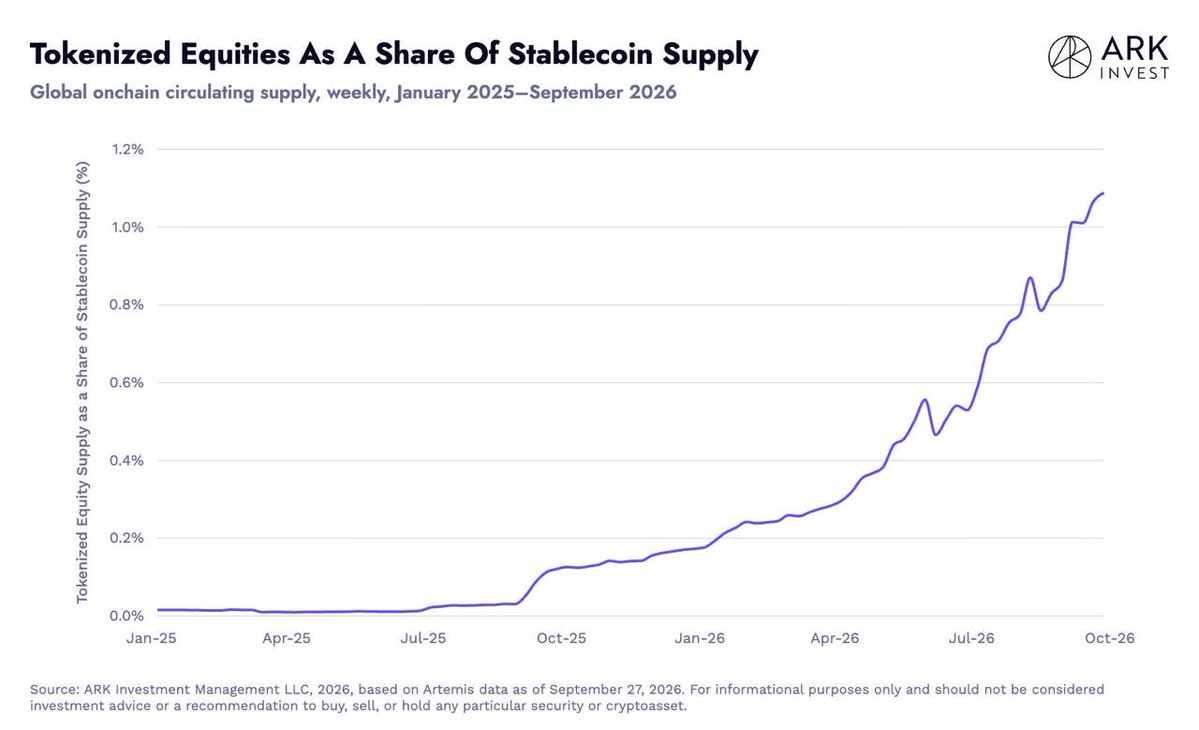
If you haven't noticed, @Backpack has been crushing. It's a CEX that runs like a blockchain, allowing for real time proof of reserves, as well as a nativity and fluidity between the TradFi and onchain worlds that's unmatched. Advantage appears small now, but will compound. Stats:
"To put it simply: a @Backpack tokenized stock is the only tokenized stock in the market right now that is directly redeemable 1:1 into a real share held at a brokerage account in seconds and at no fee.
Most alternatives, including xStocks, Ondo and Robinhood's tokens, are structured as debt or derivative instruments that track a stock's price and give the holder a contractual claim against the issuer rather than the share.
The distinction sounds technical but its consequences are real: because our token converts directly 1:1 into stock and back, market makers can arbitrage and merge liquidity between traditional venues and Solana with no basis risk, and they do: when the onchain price drifts from the NBBO, someone buys the cheaper side, converts, and sells the dearer side. That is what keeps our prices pinned to the underlying, keeps volume flowing through the token even in quiet markets, and is the mechanical reason our spreads are significantly tighter than competitors in the Blockworks data.
A debt token cannot support that trade in the same way, because there is nothing to convert into, is contingent upon the NAV of the underlying pool, and subject to timing delays and fees."
The Internet Needs Crypto to Survive AI: https://t.co/fmxCTfx146
One of the most exciting, and underrated, developments in crypto atm revolves around this @Bankless conversation with @eastdakota of @Cloudflare.
~20% of all websites are routed through Cloudflare, and in this conversation Matthew tells us that the business model of the Web is under attack. To put it simply, agentic traffic is exploding, and agents don't click on ads, but ads underpin much of the "free" stuff we get online. The infrastructure is creaking under agent load.
Matthew's assertion is that microtransactions, at a scale not previously seen, will be needed to pay for access to content, as the advertising model of the Web falls apart with agents. Crypto people have talked about microtransactions forever, but it was for people, which never worked, whereas we're now contemplating it for agents.
He says Cloudflare handles ~500M requests per second, and that 1-10% of those requests may be suitable for this microtransaction model. A blockchain environment is the only payment network that could theoretically handle this scale, and it would need to hit 5-50M TPS.
5-50M TPS in prod dwarfs anything yet attempted in crypto, and is far beyond anything TradFi can handle. There are very few blockchain environments that could conceivably provide this throughput.
Just as important as the scale, is the model and trust assumptions. While Cloudflare may roll this out as a solution for its customers first, what's implicit here is the potential for an entirely new business model for the Web.
If Cloudflare walks this path, I hope that what they build has permissionless validation, allowing for anyone to audit the network.
Cloudflare has been a torch bearer for the open Internet, and so it only follows that if they're to pioneer a new business model for the Web, that the architecture be an open network. Doing so will engender the most trust, goodwill, and adoption in the long run.
Web 3.0 is dead, long live Web 3.0.