On the morning of September 11, 2001, Roselle, a calm, golden‑furred guide dog, rode the elevator up to the 78th floor of the North Tower with her owner, Michael Hingson. To everyone else, it was just another Tuesday. To Roselle, it was a job: stay close, stay steady, keep her human safe.
When the first plane hit, the entire building lurched like a ship struck by a wave. Lights flickered. Ceilings cracked. Papers rained down like snow. People screamed. But Roselle didn’t. She simply pressed her body against Michael’s leg, a silent message: I’m here. Follow me.
Smoke began to fill the hallway. The air tasted like burning metal. Sirens wailed from every direction. Yet Roselle walked forward with the same steady pace she used every day, guiding Michael to the stairwell.
Behind them, dozens of terrified people followed her tail like a beacon. Step by step, floor by floor, she led them downward through the choking darkness. The stairwell shook. The heat intensified. But Roselle never sped up, never panicked, never once broke her rhythm. She knew that if she stayed calm, her human would too.
Somewhere around the 30th floor, a woman froze, sobbing, unable to move. Roselle stopped. She nudged the woman gently, leaning her warm body against her leg until her breathing slowed. Only when the woman whispered, “Okay… okay,” did Roselle continue the descent.
It took nearly an hour to reach the lobby. Firefighters shouted for everyone to run. The tower groaned above them. Roselle guided Michael through the chaos, out into the blinding sunlight, and down the street, refusing to stop until she sensed they were finally safe.
Minutes later, the North Tower collapsed.
Roselle didn’t know she had just saved her owner’s life. She didn’t know she had led more than a dozen people to safety. She didn’t know she had become a symbol of courage around the world.
She only knew one thing: her human was alive, and she had done her job.
Most people know Roselle guided her blind owner down 78 floors of the North Tower, but very few know what happened after they escaped. As the tower collapsed behind them, a massive cloud of ash and debris roared through the streets like a tidal wave. Michael couldn’t see it coming, but Roselle could. Instead of panicking, she leaned her entire body into him and pulled forward with absolute determination, guiding him through a darkness so thick he couldn’t breathe or hear. Even as the ground shook and people screamed around them, Roselle never once broke her pace. Her training didn’t tell her what to do, her loyalty did.
#archaeohistories
🇺🇸 The Boatlift That Was Bigger Than Dunkirk
At 10:45 a.m. on September 11, 2001, a Coast Guard lieutenant named Mike Day keyed a radio in New York Harbor and said the only sentence that mattered.
“All available boats. This is the United States Coast Guard. Anyone wanting to help with the evacuation of Lower Manhattan, report to Governors Island.”
The boats were already coming.
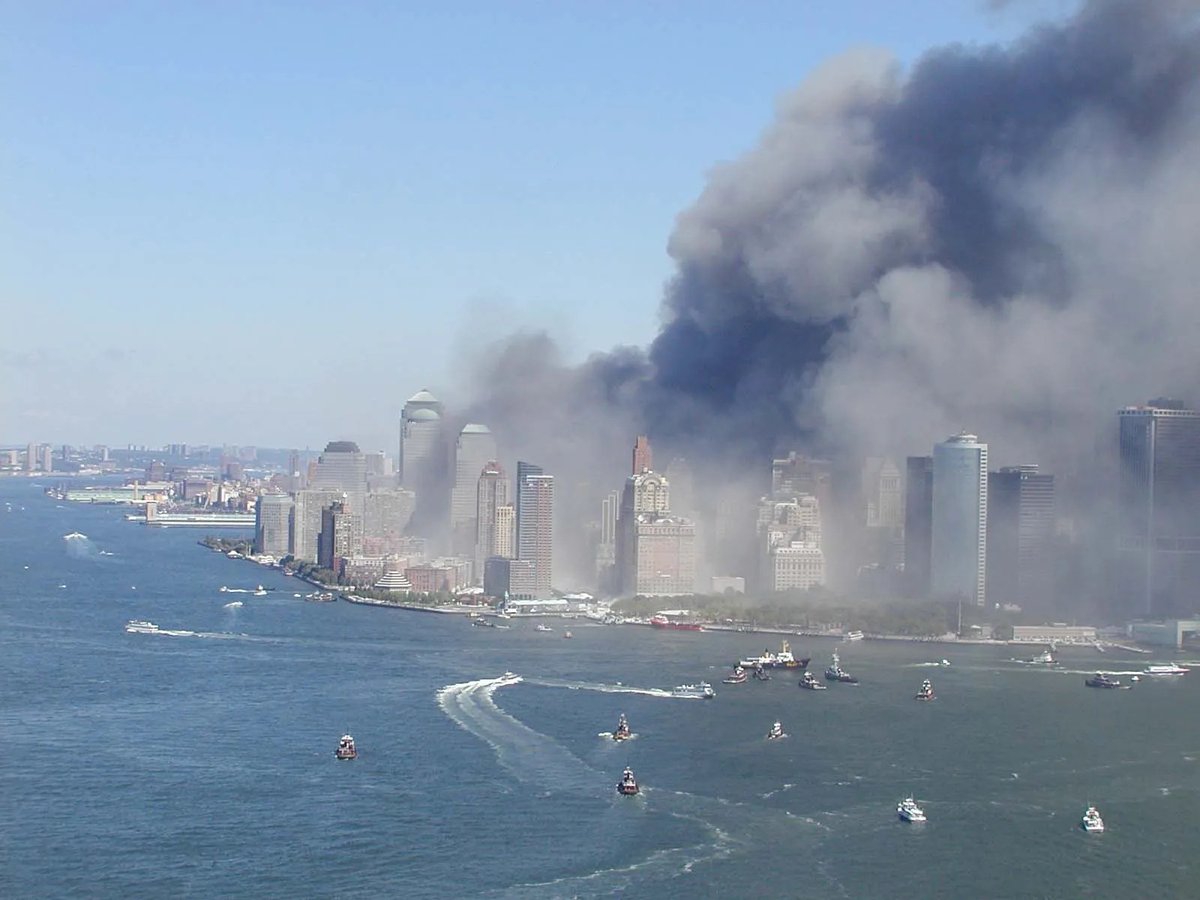
The bridges were closed. The tunnels were closed. The subways were dead. South of the towers, hundreds of thousands of people had nowhere left to walk. Some jumped into the Hudson. Some stood on seawalls that were never meant to be docks and waited for anything that floated.
Dunkirk took nine days to pull 338,226 Allied soldiers off a beach in 1940.
On 9/11, roughly 800 mariners on about 150 vessels moved as many as 500,000 civilians off Manhattan in about nine hours. Ferries. Tugs. Dinner boats. Pilot boats. Yachts. A retired fireboat. Rubber dinghies that held two people. The largest water evacuation in history.
NY Waterway did not wait for the official call. After the second plane hit, the whole fleet moved. Captain Rick Thornton nosed his ferry against a seawall that was not a slip and started taking people off. Some of them he pulled out of the river. His company alone carried about 158,000 people to Jersey City, Hoboken, Weehawken, Brooklyn, and Queens.
On a normal Tuesday they carried 34,000.
The Staten Island Ferry moved more than 50,000 people and came back the other way with water, bandages, and men who still had work to do in the dust.
The old fireboat John J. Harvey, already retired, tied up near the Museum of Jewish Heritage, took civilians off the seawall, then pumped water when the hydrants downtown died.
Lt. Day later admitted what the day required. “I broke more rules that day than probably I’ve enforced in my whole Coast Guard career.”
In raw numbers it was bigger than Dunkirk. No boat went down. By nightfall the southern tip of Manhattan had been emptied by people who were not on anyone’s list of heroes when the morning started.
They were tug captains. Ferry deckhands. Pilots. A lieutenant with a microphone. Ordinary boats answering one sentence.
All available boats.
Trump shot at a rally in PA. Looks like he was hit in the ear. He’s definitely alive. He looked strong as Secret Service took him off stage. Pumped his fist as he was leaving. Shooting him is both morally and politically disastrous. Incredibly dumb and despicable. Glad he’s ok.
Now is the time for every American who loves our country to step back from the division, renounce all violence, and unite in prayer for President Trump and his family.
@JennaEllisEsq@andrewklavan His show is the highlight of my weekends and I feel like each week I gain some new perspective on culture, the arts or politics. I’ll Klavanstan with you too.
@LibertyLockPod We have a deeply unserious leadership class who only care about their own enrichment. Sadly the vast electorate is equallly unserious about using their votes to establish any accountability largely due to brainwashing by an evil corporate media. We live in dangerous times.