@AlexBenay I always treat a blank page as the wrong way to create discussion. I have learned to start with something, as criticism still creates engagement and discussion. Some people have trouble thinking out of the box and like structure. Either way it is a starting point.
Gartner Newsroom: Gartner Says Autonomous Business and AI Layoffs May Create Budget Room, but Do Not Deliver Returns #GartnerNewsroom https://t.co/MJkbHrHAFK
A Mayo Clinic-developed artificial intelligence (AI) model can help specialists detect pancreatic cancer on routine abdominal CT scans up to three years before clinical diagnosis. It identifies subtle signs of disease before tumors are visible, when curative treatment may still be possible. The findings, published in Gut, mark a milestone in Mayo Clinic's multiyear research effort to enable earlier detection of one of the deadliest cancers.
Learn more: https://t.co/EJySSkaW3P
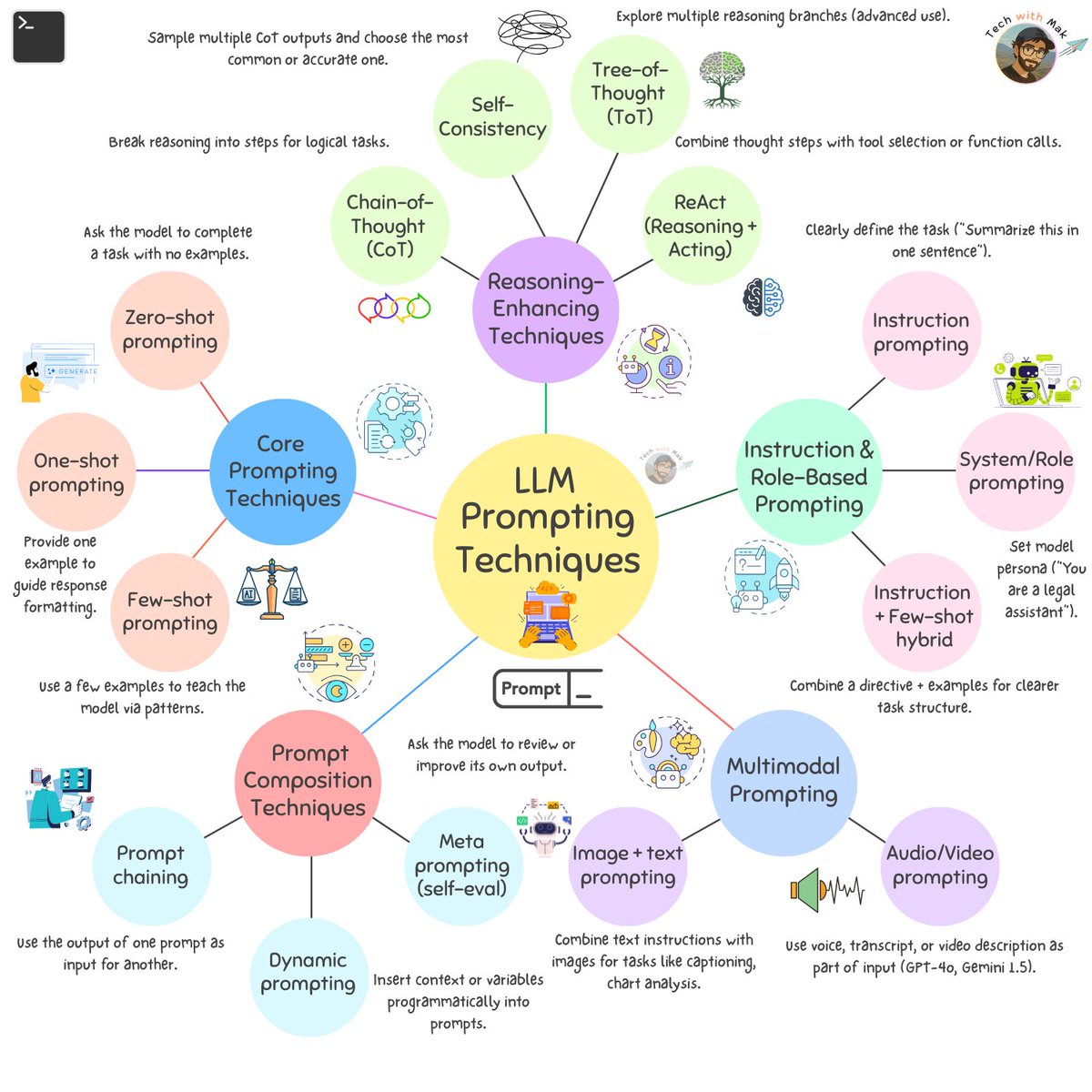
Prompting isn’t just asking the AI a question. It’s a deliberate, engineered input design process, and a critical skill when working with Large Language Models (LLMs).
Let's breakdown the prompting techniques.
✅ 1. Core Prompting Techniques
▪ Zero-shot - No examples provided. Just the task.
▪ One-shot - One example shown before the task.
▪ Few-shot - A handful of examples used to teach patterns.
🧠 2. Reasoning-Enhancing Techniques
▪ Chain-of-Thought (CoT) - Encourage step-by-step reasoning.
▪ Self-Consistency - Sample multiple CoTs; choose the best.
▪ Tree-of-Thought (ToT) - Explore multiple reasoning paths (advanced).
▪ ReAct - Combine reasoning steps with action/tool use (e.g., API calls).
🧾 3. Instruction and Role-Based Prompting
▪ Instruction prompting - Clear directives (“Summarize this…”).
▪ System / Role prompting - Define persona or behavior (“You are a legal assistant”).
▪ Hybrid (Instruction + Examples) - Combine clarity with few-shot grounding.
⚙️ 4. Prompt Composition Techniques
▪ Prompt chaining - Use one prompt’s output in the next.
▪ Dynamic prompting - Inject real-time variables or context.
▪ Meta prompting - Ask the model to improve or verify its own response.
🖼️ 5. Multimodal Prompting
▪ Image + text - Provide both visual and textual context.
▪ Audio/Video + text - Use transcripts or sensory input (model-dependent, e.g., GPT-4o, Gemini 1.5).
🧑⚕️ 6. Domain-Specific Prompting
▪ Code prompting - Constrained, tool-specific inputs (e.g., Python, SQL).
▪ Medical / Legal prompting - High-precision language with strict format and accuracy needs.
🧪 7. Prompt Evaluation & Debugging
(Not prompting techniques, but crucial tools.)
▪ Prompt ablation - Remove elements to test contribution.
▪ Injection testing - Evaluate prompt robustness in apps or agents.
❌ What’s Not a Prompting Technique
▪ RAG: A retrieval + generation architecture. Prompts are used inside it.
▪ Agents / Tool-use systems - Orchestration frameworks (e.g., LangGraph, AutoGPT). Prompting is one component, not the technique itself.
🔧 Prompting is no longer “just prompt engineering.” It’s system design.
If you're working with LLMs, know these cold.
Follow @techNmak for your daily dose of learning.
CIOs must adapt as AI transforms the workplace and leadership roles: https://t.co/ZOHg4mtvx3
Learn practical ways to leverage AI for continuous improvement and strategic planning in your organization.
#GartnerIT#CIO#AI
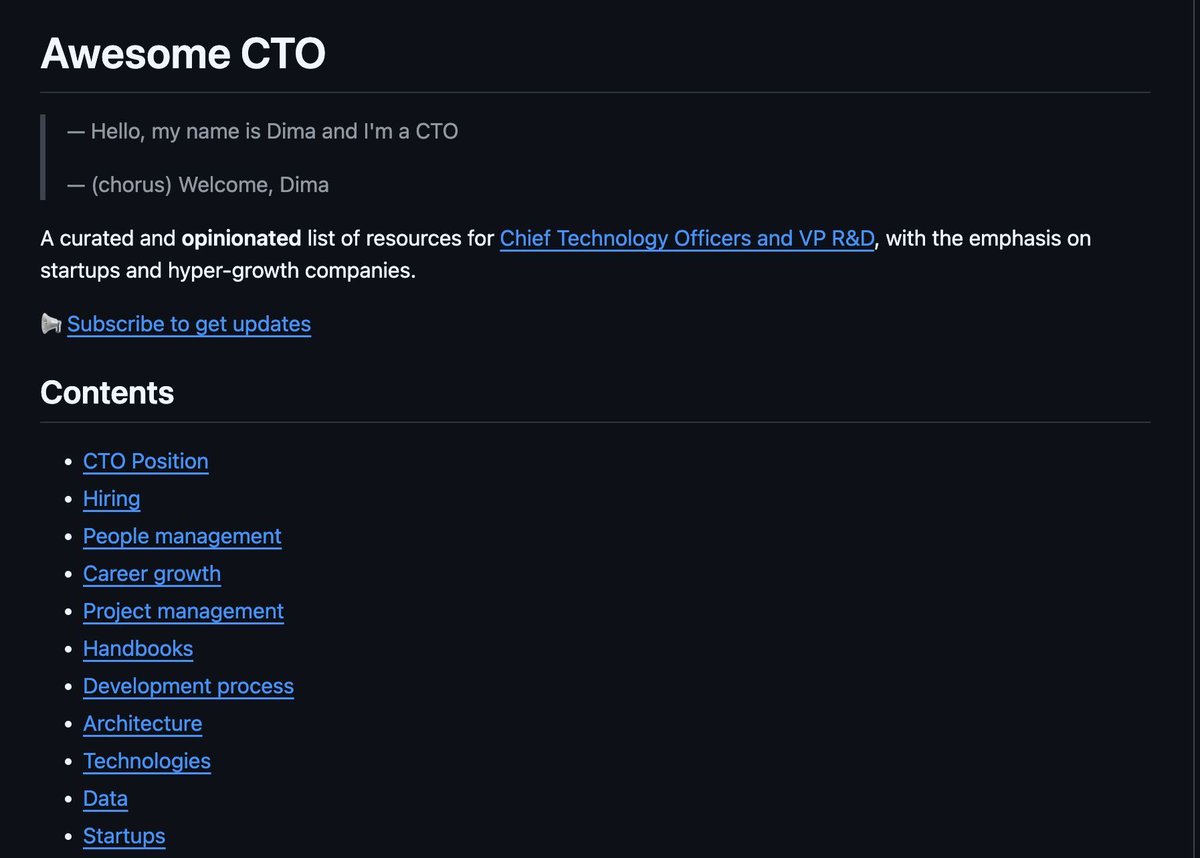
Awesome CTO
A great github repo full of resources for software engineers and aspiring CTOs:
- Software Development Processes
- Hiring for technical roles
- Software Architecture
- Product and Project Management
- Career growth
Check it here:
https://t.co/2l1aCAqv2c
Agentic AI isn’t just a buzzword — it’s a shift.
From reasoning and planning to autonomy and collaboration, these are the key concepts shaping how AI systems think, act, and work together.
Here’s your cheat sheet:
- Agentic AI
- LLMs
- Autonomous Agents
- Multi-Agent Systems
- MCP (Model Context Protocol)
- RAG (Retrieval-Augmented Generation)
- A2A (Agent-to-Agent Protocol)
- Tool Use Agents
- Action Orchestration
- Memory-Augmented Agents
- Reasoning & Planning Agents
- Autonomous Decision Making
- Human-in-the-Loop
- Agent Framework
- Guardrails
- Tool Calling
We’re entering the era where AI doesn’t just respond it reasons, collaborates, and acts.
If you work in AI, product, or data, it’s time to get fluent in this new language.
𝐇𝐨𝐰 𝐭𝐨 𝐛𝐮𝐢𝐥𝐝 𝐀𝐈 𝐀𝐠𝐞𝐧𝐭:
1️⃣ System Prompt Define your agent’s personality, capabilities, and boundaries. This is its brain’s instruction manual.
2️⃣ LLM (Large Language Model) Choose the engine: GPT-4, Claude, Mistral, or an open-source model — pick based on reasoning needs, latency, and cost.
3️⃣ Tools Equip your agent with tools: API access, code interpreters, database queries, web search, etc. More tools = more utility.
4️⃣ Orchestration Use frameworks (like LangChain, AutoGen, CrewAI) to manage reasoning, task decomposition, and multi-agent collaboration.
5️⃣ Memory Implement both short-term (context window) and long-term memory (Vector DBs like Pinecone, Weaviate, Chroma).
6️⃣ UI (User Interface) Design an intuitive chat UI or workflow interface that enables smooth interaction with your agent.
7️⃣ AI Evals Test your agent's performance with real-world tasks. Use tools like TruLens, Rebuff, or custom evals to measure effectiveness, reliability, and safety.
#AIAgents #LLM #GPT4 #LangChain #AutoGen #SemanticKernel #AIProduct #PromptEngineering #ArtificialIntelligence #TechStack
Save it for later✅
Follow @_Ai_Yash_ for more updates.
#ai #artificalintelligent #Trending