@cwjroberts Both M-Pesa and PayPal are proprietary closed ledger systems that you pay into and then can transfer in near real time within.
That is the structure of both. That is not the structure of RTR.
Canadians will now start being able to send and receive money in seconds. Any hour, any day, all year round.
As announced in Budget 2026, Canada's Real-Time Rail starts rolling out today. Over the next year, financial institutions and payment providers across the country will come on board, reaching more than 9 in 10 Canadians.
Faster, safer payments for families and businesses, on national infrastructure owned and operated here at home. That strengthens our economic sovereignty.
@cwjroberts Are you talking about M-Pesa in Kenya? That's not an equivalent system... it's basically PayPal via text. We had PayPal and e-transfers (which is a more capable system) even earlier.
The only equivalent to RTR I know of in Africa was launched recently in Tanzania.
@JessieTweeting That's still very vague, and hypothetical.
DND was refusing to release aggregated information about the number of soldiers still in critical condition.
That information has now been released via another source.
When will you be able to point me towards the harm that's caused?
Ashleigh deserves a lot of credit for continuing to press for this information.
And DND deserves significant criticism for refusing to release it.
I wish I was confident that this information will be available on an on-going basis, as it should be, but I suspect it won't be.
NEW: For a week, we pressed DND for updated information on soldiers injured in the deadly CFB Wainwright fire, including how many remained in critical condition.
DND wouldn't disclose that number.
So someone else did.
https://t.co/PYKX7BkmIK
@JessieTweeting I've talked about OPSEC in relation to this. I don't see the case for it.
If you'd like to make a specific argument, feel free. But mentioning the concept in general terms, like this, isn't going to have much of an impact on my views.
There's an enormous scale difference between what Stellantis was doing there and what Roshel does.
Presumably Roshel has some plans to grow... but it's hard to believe they'll be using that facility's full capacity any time soon.
@RandoRobby42@rodmcrae It gives them a method to do money transfers electronically that actually works how you think electronic money transfers should.
They weren't literally mailing cash around before (mostly). That's just a convenient mental framework.
@rodmcrae This system basically teleports the money instead. It's just there, including for larger transactions.
It also attaches a bunch of useful information directly to the transfer that makes bookkeeping a lot easier.
The whole thing is just better.
@rodmcrae The risks involved mean the bank is not always willing to do this.
There are limits on the amount of money you can transfer without waiting. And unusual circumstances do the same.
Ever needed to wait a week for a refund or a correction to payroll? This is why.
@Njopling1 Yes. Though mainly because vehicles occupy space for longer.
Acquiring the Stellantis plan increases their physical footprint to something close to 10x what it was, though.
@random2152 Yes. We'd need enough helicopters to do it, of course, but anything that allowed us to generally have more than one helicopter on a deployment would make smaller helicopters more appealing.
Those options also have costs, of course.
New article from me.
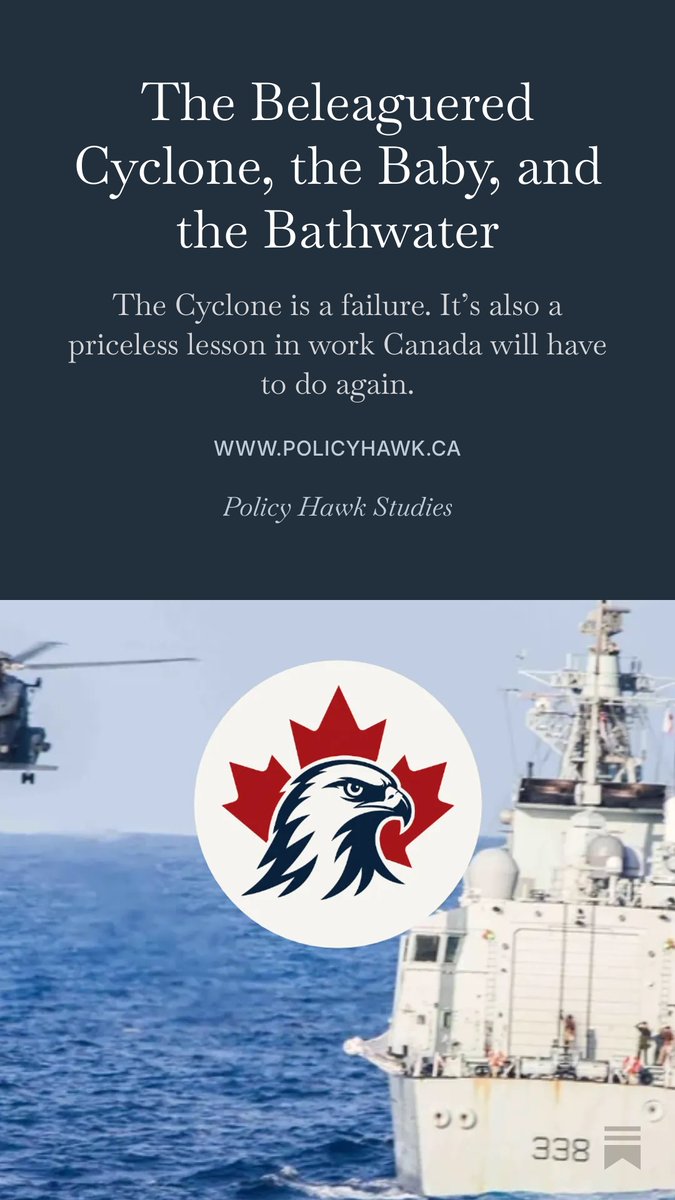
The Cyclone is a failure. It’s also a priceless lesson in work Canada will have to do again.
Civilian designs are sometimes the best starting point for things the CAF needs. If all we get from the Cyclone is “never do that again,” how does that help us? 1/2
New article from me.
The Cyclone is a failure. It’s also a priceless lesson in work Canada will have to do again.
Civilian designs are sometimes the best starting point for things the CAF needs. If all we get from the Cyclone is “never do that again,” how does that help us? 1/2
"Another aspect to consider is that Canada can simply no longer afford to purchase the bulk of its equipment from other nations....[w]hen Canada’s defence budget was around 1% of GDP and only 13% of that miserly budget was devoted to major equipment purchases, it did not matter if nearly all of that money was spent in other countries. However, with Canada committed to spending 3.5% of its GDP on defence by 2035, with reasonable estimates putting major equipment expenditures as high as 30% of that total, the arithmetic changes. At those levels, major equipment purchases would account for 1.05% of GDP, roughly eight times the 2014 share of 0.13%. The economic headwinds created if most of that spending were to leave the country every year, with nothing of direct economic value returning, are simply unsustainable. Canada must largely rely on its own industries for major equipment purchases to achieve and sustain its military spending commitments."
This is a good article. But I think the more important question is not simply what aircraft should replace the Cyclone. It is which functions must remain aboard a crewed aircraft, which can be distributed across uncrewed systems, and which requirements disappear altogether when the force is designed differently? That is particularly consequential as Canada shifts from an expeditionary force optimized for coalition operations abroad toward one that must also provide persistent defence of its own vast territory.