Council on Energy, Environment and Water. Among Asia's top not-for-profit independent policy research institutions, impacting sustainable development at scale.
🚨 57% of Indian districts, home to over 76% of the population, are currently at high to very high risk from extreme heat.
Our district-level heat risk assessment covers 734 districts and 35 indicators spanning hazard, exposure, and vulnerability. Going beyond just daytime temperatures, it includes night-time heat and relative humidity, offering a clearer picture of how climate change has altered the frequency, intensity, and duration of heat hazard from 1982 to 2022. It finds that the top ten most heat-risk-prone states and UTs are Delhi, Andhra Pradesh, Goa, Kerala, Maharashtra, Gujarat, Rajasthan, Karnataka, Tamil Nadu, and Uttar Pradesh.
India’s growing #heat crisis isn’t just about hotter summers—it’s about how early heat arrives, where it concentrates, and who is most exposed. Our study recommends 5 ways to build resilience:
👉 Go beyond just daytime temperatures when planning for heat risk reduction
👉 Tap into State Disaster Mitigation Funds
👉 States with over 50% high-risk districts should declare #heatwaves as state-specific disasters
👉 Promote heat insurance to protect livelihoods of outdoor workers & vulnerable communities
👉 Create a national Heat Action Plan repository to track progress and share learnings across states
🔗 Read 'How Extreme Heat is Impacting India' at https://t.co/3wKCN8PacM
Rain gave Delhi its first "good" air day in nearly three years this July. Three days later, the AQI was back at 261.
Clean air cannot be left to the weather. It needs money, and India Inc. has it: thousands of crores a year in environmental CSR. Clean air just needs a share of it.
Our #NewBlog makes the case that this is the CSR opportunity Indian companies can leverage. Air pollution costs India an estimated INR 7 lakh crore a year, yet less than one per cent of corporate sustainability investment is linked to any direct air quality benefit. Most CSR money stays close to where companies are based, not where the air is worst.
✍️Prarthana Borah and Arpan Patra set out the four shifts that would change that.
Read more at: https://t.co/O7lYbKhuw5
@prarthana_delhi
Clean energy for productive use solutions, solar dryers, small horticulture processors, solar refrigerators, have the potential to enhance 37 million livelihoods and unlock a USD 50 billion market opportunity. They are already improving farm productivity, reducing post-harvest losses and enabling rural micro-enterprises.
Yet commercial scaling remains a challenge, and the barriers are no longer technological. The next step is building the ecosystem that enables commercial adoption: one that creates market demand, unlocks financing, strengthens manufacturing and rural distribution, sets quality standards, supports enabling policy, and delivers dependable after-sales service.
To strengthen this ecosystem, Powering Livelihoods, a joint initiative of CEEW and Villgro, in collaboration with the Clean Energy Access Network (CLEAN), is launching Powering Progress: Global Dialogue Series on the Future of Clean Energy for Productive Use and Economic Opportunity.
This global dialogue series will bring together policymakers, enterprises, financiers, researchers, development organisations, and ecosystem leaders to exchange knowledge, share practical experiences, and co-create solutions for commercially scaling clean energy for productive use (PUE) technologies.
Join us for Session 1 - From Innovation to Scale: Building Commercial Markets for Clean Energy for Productive Use Solutions
📅 12 August 2026
🕰️3:00 PM – 4:00 PM IST
Register here: https://t.co/J8tYooJs7i
This inaugural session will bring together voices from across the clean energy ecosystem to discuss building commercially sustainable, scalable markets for productive-use clean energy solutions.
@thecleannetwork, @Villgro, @ajainme
We are delighted to announce that CEEW has signed a Memorandum of Understanding with the Solar Energy Corporation of India Limited. Through this partnership, we aim to shape a clean, reliable and affordable electricity sector in India.
CEEW and SECI will work together to generate evidence, develop policy solutions, and support the design of next-generation market mechanisms that enable a clean, reliable, and affordable power system:
👉 Build evidence to inform new energy and flexibility procurement mechanisms and co-develop offtake contracts
👉 Scale up Contracts for Difference and market-linked instruments to de-risk clean capacity, deepen exchange participation, improve price discovery, and strengthen India’s power market architecture. ; and
👉 National and international knowledge exchange with key stakeholders across government, industry, finance, academia, and power market experts
This partnership aims to support India's journey towards a future-ready electricity system that is affordable, reliable, and increasingly powered by clean energy
With Solar Energy Corporation of India Limited (@SECI_Ltd) , Shri Akash Tripathi (IAS), Dr Arunabha Ghosh (@GhoshArunabha), Sivakumar Vepakomma, Disha Agarwal (@disha_agarwal12), Prashant Soni, Pratik Prasun, Prateek Aggarwal (@prateekddun), Rashi Singh, Vishal Tripathi, Arushi Relan, Akanksha Tyagi, Nicole Almeida
As North India sees renewed heavy to very heavy rain after a dry spell, it's a reminder of a pattern our research has been flagging for a while: some parts of India don't have a "normal" monsoon any more—they swing between drought-like and flood-like years instead.
Our tehsil-level assessment of India's changing monsoon patterns found that nearly 24% of India's tehsils have witnessed a high number of both deficient and excessive rainfall years over the past four decades (1982–2022). Districts such as Bengaluru, the Nilgiris, Jaipur, Kachchh and Indore are experiencing this same pattern, alongside tehsils concentrated in Marathwada, Rajasthan and Gujarat.
Delhi is one such example: highly seasonal, sensitive monsoons, coupled with sudden cloudbursts, can create big swings here from one year to the next.
A national average of just 3mm more rain a year since 1982 can't tell you any of this. It takes a tehsil-level map to see where the swings are actually happening.
Read Decoding India's Changing Monsoon Patterns: A Tehsil-level Assessment at https://t.co/eq4vfy4kdQ
@Shravanverse@vishchi
Yesterday, the Hon'ble Minister for Revenue & Disaster Management, Thiru K.A. Sengottaiyan, underscored the importance of Heat Action Plans in tackling the state’s growing heat risk at the inaugural event of the Tamil Nadu State Institute of Disaster Management (TNSIDM) and the accompanying Workshop on Heat Risk Management, hosted by the Tamil Nadu State Disaster Management Authority in Chennai.
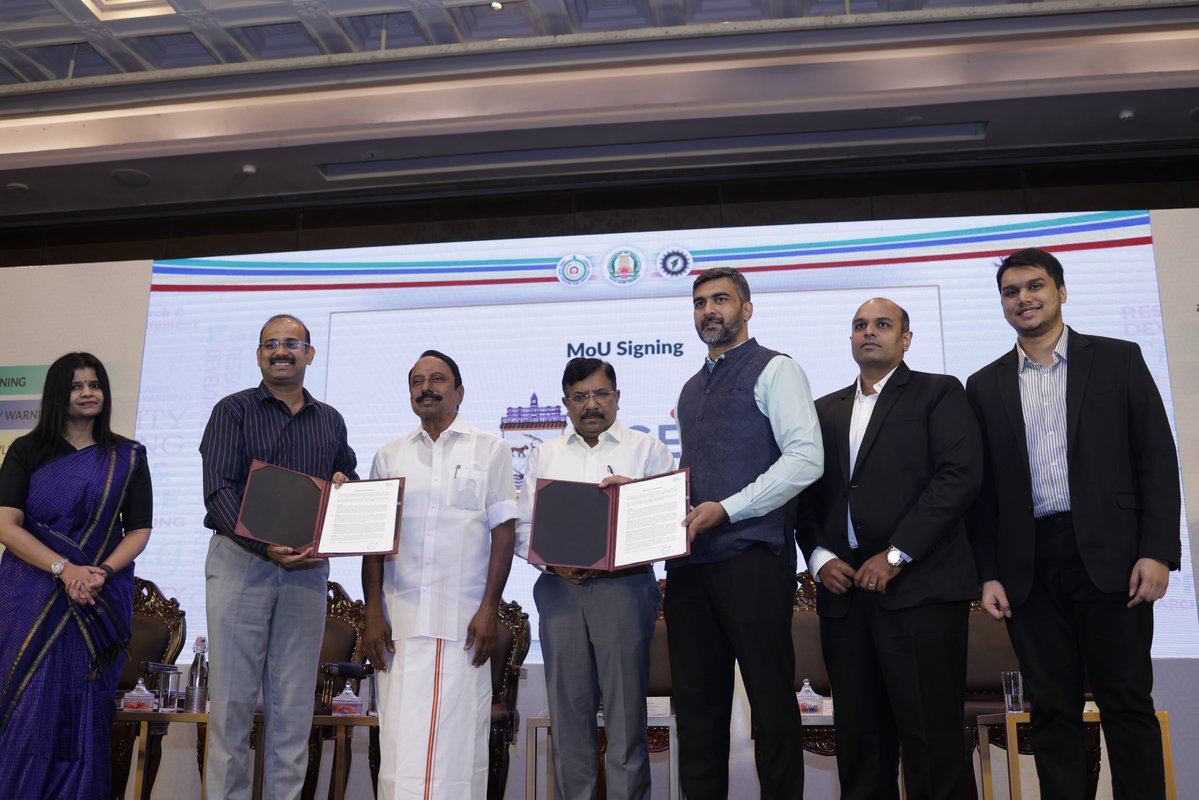
The event also marked the signing of a Memorandum of Understanding (MoU) between CEEW and the Greater Chennai Corporation, represented by Dr G. S. Sameeran, IAS, Commissioner, to establish a Project Monitoring Unit that will support the preparation of detailed project reports aimed at strengthening heat preparedness and reducing heat impacts in vulnerable wards of Chennai.
At the workshop, Dr Vishwas Chitale, Fellow, CEEW, presented key findings from the Tamil Nadu State Heat Action Plan, highlighting the state’s hazard, vulnerability, and risk indicators, and the pathways needed to move from heat risk assessment to implementation. The workshop brought together policymakers, scientists, and practitioners to examine what it will take to move from heat risk assessments to coordinated, state-wide action. Some key themes emerged:
🌡️Heat resilience must be embedded across urban planning, public health, infrastructure, and disaster management.
🏙️ Climate-resilient buildings, energy system resilience, and sustainable cooling require stronger cross-sectoral coordination.
🤝Moving from risk assessments to implementation will depend on institutional capacity, financing, and sustained collaboration.
Our thanks to the Tamil Nadu Disaster Risk Reduction Agency (TNDRRA) team for their continued guidance, and to the participating organisations: @mahilahsg , Indian Meteorological Department, Indian Institute of Tropical Meteorology, ARTPARK, @IRADe_Delhi, @UNEP, RIMES and others.
📘 Read the state Heat Action Plan: https://t.co/AB0Tuekz4V
@vishchi@Shravanverse
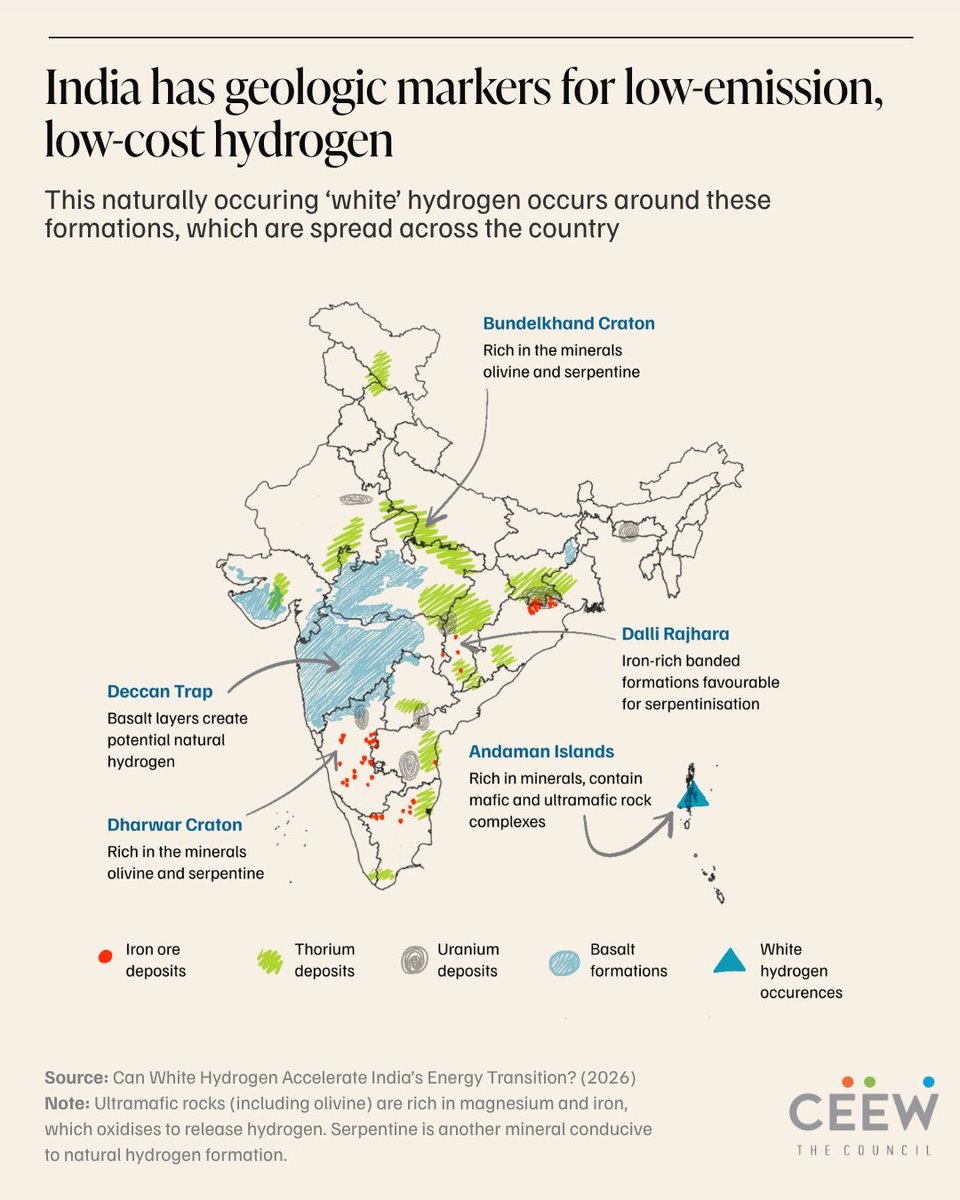
Naturally occurring hydrogen could be India's next clean energy frontier. Our latest report explores white hydrogen's potential to complement green hydrogen and strengthen energy security. White hydrogen can be used in refineries, ammonia production, power generation, and hard-to-abate industrial applications. Currently, it's at an early exploration stage globally—only one operational production well exists (Mali, since 2012)—making India's geological surveying critical before deployment.
Launched during our webinar today with leading experts: Dr Sudip Bhattachayya (@GeologyIndia ), Dr Isabelle Moretti (National Academy of Technology of France), Prof. Raj Kiran (IIT ISM), Dr Shubhangi Kala (@RystadEnergy), Dr Julien Bourdet (@GoldHydrogen), and more, we outline a strategic roadmap for India to unlock this resource.
The report recommends:
✓ Establishing a nodal agency with clear policy frameworks
✓ Conducting systematic geological surveys & prospectivity mapping
✓ Funding R&D and public-private partnerships
✓ Building international collaborations on exploration tech
📕 Read 'Can White Hydrogen Accelerate India's Energy Transition? Assessing Potential and Pathways' at https://t.co/FBSOzX47Js
✍️ Hashvitha Rajakumaran, Karan Kothadiya, and Deepak Yadav
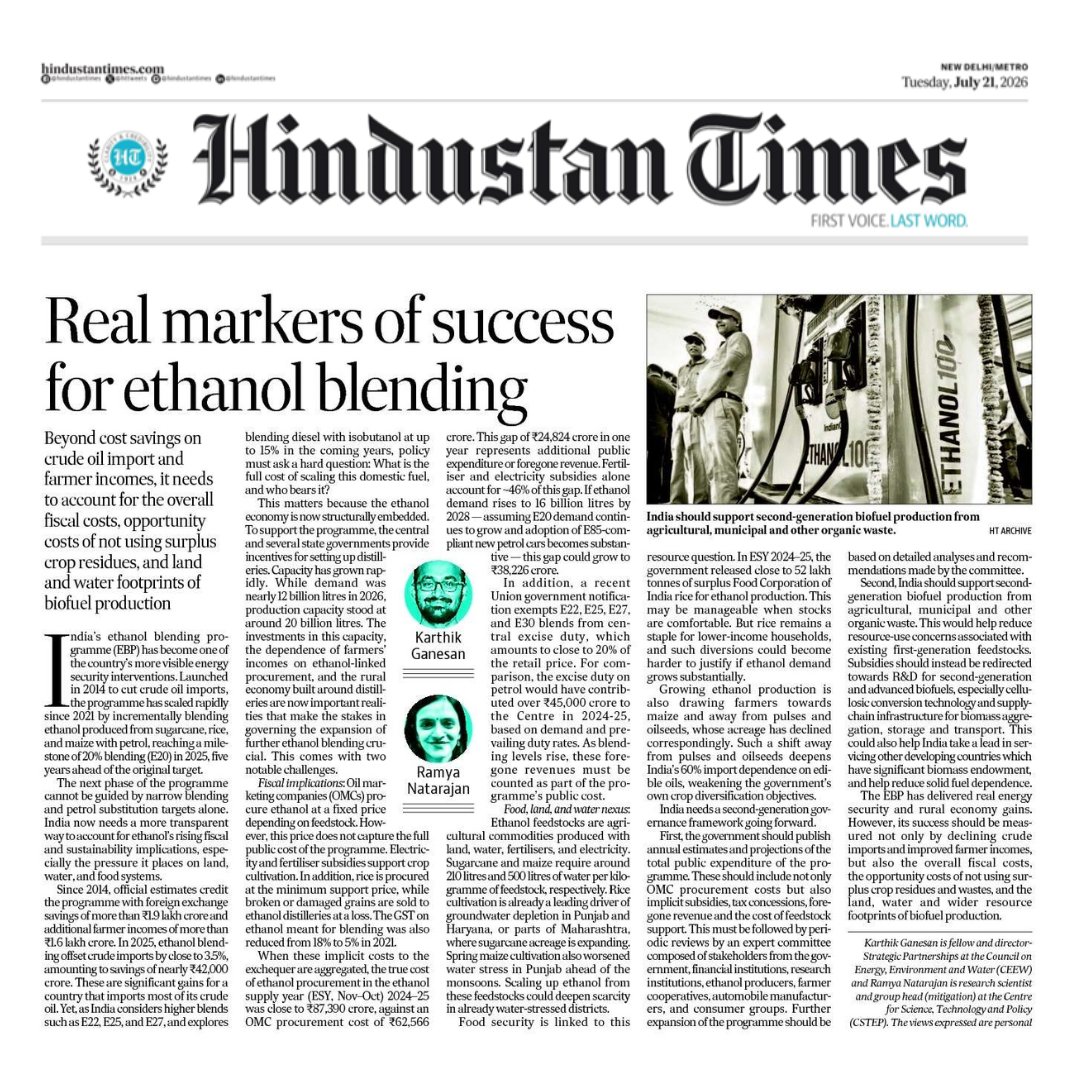
India's ethanol blending programme is now structurally embedded in the economy—and the debate around it deserves to move past the pump.
Ethanol production capacity has outpaced demand. The investments in this capacity, the dependence of farmers’ incomes on ethanol-linked procurement, and the rural economy built around distilleries are important realities that make the stakes in governing the expansion of further ethanol blending crucial.
India needs a more transparent way to account for ethanol's rising fiscal and sustainability implications, especially the pressure it places on land, water and food systems. That, not blend targets alone, is the real marker of success.
Read more in this #Opinion by Karthik Ganesan (@KaygeeAtWork, CEEW) and Ramya Natarajan (@CSTEP_India) for @htTweets 👇
Every year, millions of tonnes of materials—from agricultural residue and wastewater to construction debris, plastics and industrial by-products—are discarded long before they’ve delivered their full value.
What if we stopped treating waste as the end of the story?
Our #NewBlog unpacks how a circular economy can help India reduce resource dependence, create new industries, strengthen supply chains, improve livelihoods, and build a more resilient economy. In a first of its kind analysis, we show how six sectors alone hold the potential to build an INR 11.5 trillion annual circular economy market.
Read at: https://t.co/SDRLqyvJRp
Torrential rain has pounded south Gujarat this week. Some talukas, such as Umbergaon in Valsad, recorded more than 1,100mm of rain in just 16 hours. @Indiametdept has issued red alert for multiple districts, including in Ahmedabad.
CEEW's tehsil-level assessment of India's changing monsoon patterns found that 1 in 4 of India's tehsils have stopped having a "normal" monsoon altogether—swinging between drought years and flood years over the last four decades. Gujarat and Marathwada are among the worst affected.
Navsari, on Gujarat's coast, is a case in point. In July 2024, a single storm put nearly a fifth of the city underwater in an afternoon. Working with @NavsariNMC Municipal Corporation, we mapped the city’s flood risk ward by ward using 55 years of daily rainfall data, and indicators on hazard, exposure, and vulnerability. We found the danger was not evenly spread. Some wards could take an ordinary monsoon in their stride; others, a few streets away, could not.
This map is now the starting point of the city's new plan: fix the worst-off wards first, rather than spread a fixed budget evenly across a risk that was never even to begin with. We’re now extending the same approach to Ahmedabad and further examining urban flooding patterns in Delhi, Gurugram, Bengaluru, and Cuttack. As monsoon become more unpredictable due to climate change, every Indian city needs a plan that maps where the risk actually is, and plan for urban floods.
📘 Check out the Navsari City Action Plan for Flood Risk Management: https://t.co/a4wiBl8s7w
@NitinBassiN
At a recent @WorldBank Live event on AI for Clean Air: Scaling Smarter Solutions, CEEW CEO @GhoshArunabha shared how AI can help regulators move from complex datasets to faster, evidence-based decisions.
@iitgn@nipun_batra@mrafiuddin50
At a recent World Bank Group Live event on AI for Clean Air: Scaling Smarter Solutions, CEEW CEO Arunabha Ghosh shared how AI can help regulators move from complex datasets to faster, evidence-based decisions.
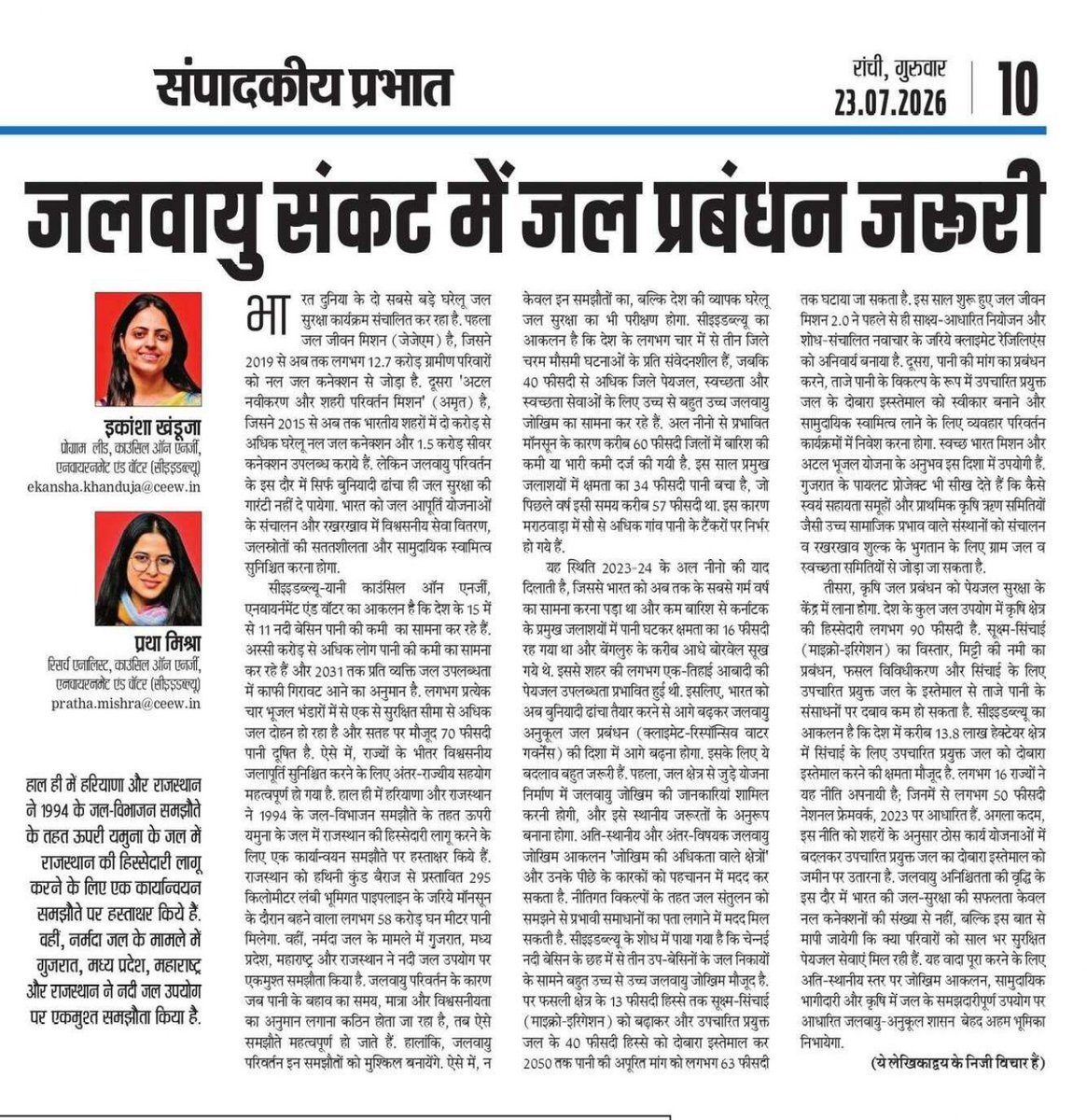
#Opinion | Water management is essential amid the climate crisis
Ekansha Khanduja (Programme Lead, CEEW) and Pratha Mishra (Research Analyst, CEEW) write for @prabhatkhabar
#Opinion | India's compressed biogas ambitions hinge on solving the scale challenge
India aims to build 5,000 compressed biogas plants producing 15 million tonnes annually by 2030. Current production: just 920 tonnes a day—1% of that target.
In @ETEnergyworld, Bhimashankar Shetkar (COO, NDDB Mrida Ltd) and Aishwarya Joshi (Research Analyst, CEEW) note that "Compressed biogas is far from a marginal technology." Yet developers face four persistent problems: unreliable feedstock, uncertain gas offtake, weak by-product markets, and poor access to long-term finance.
Their recommendation: standardise plant design to enable aggregation, secure feedstock through long-term contracts, and build markets for compressed biogas's by-products
Read more 👇
https://t.co/vwPRBkhEFZ via @ETEnergyWorld
#Opinion | Real markers of success for ethanol blending
Beyond cost savings on crude oil imports and farmer incomes, India's ethanol blending programme needs to account for its overall fiscal costs, the opportunity costs of not using surplus crop residues, and the food, land, and water nexus.
India's ethanol blending programme has scaled rapidly, reaching 20% blending five years ahead of target. But as the country considers even higher blends, Karthik Ganesan (Fellow and Director, Strategic Partnerships, CEEW) and Ramya Natarajan (Research Scientist and Group Head, Mitigation, Center for Study of Science, Technology and Policy ) ask in the Hindustan Times: "What is the full cost of scaling this domestic fuel, and who bears it?"
Their recommendation: transparent public accounting of the programme's true costs, and a shift towards second-generation biofuels from agricultural and municipal waste.
Read more 👇
Was it a good monsoon or a bad one?
It’s a question we ask every year, and increasingly, it’s the wrong one.
India’s monsoon is still reported through a national average. But an average across nearly 4,500 tehsils can hide a very different reality on the ground. This month’s UpChart decodes India’s changing monsoon through tehsil-level data, and what that means for cities planning to get ahead of the rains.
https://t.co/Ztyqmr8Ff9
In this week’s #CEEWExplains, Fiza Jha unpacks how the #WorldCup is pushing sportswear towards recycled materials—and why that’s only part of the solution.
From recycled polyester to next-generation biofibres, what we wear on the pitch could shape the future of fashion off it.