Seeking information on an IP, for whatever reason? @ipinfo at https://t.co/Yn73W41sli is a great tool that beats your standard WHOIS. Use their search in the web UI, use cURL to retrieve a dataset, or pay for upgraded packages for even more. I use this service to troubleshoot.
SpaceXAI and @cursor_ai are now working closely together to create the world’s best coding and knowledge work AI.
The combination of Cursor’s leading product and distribution to expert software engineers with SpaceX’s million H100 equivalent Colossus training supercomputer will allow us to build the world’s most useful models.
Cursor has also given SpaceX the right to acquire Cursor later this year for $60 billion or pay $10 billion for our work together.
Why can the Orion spacecraft send audio and video to Earth on the far side of the moon, but NASA can not communicate with Orion? I would expect a total communication blackout during this time.
"I think we’re in the 'this seems overblown' phase of something much bigger than Covid."
This must-read article on the AI inflection point: ✅ AI now has "judgment" and "taste." ✅ Knowledge work is being fundamentally restructured. ✅ 2026 is the year to become an expert.
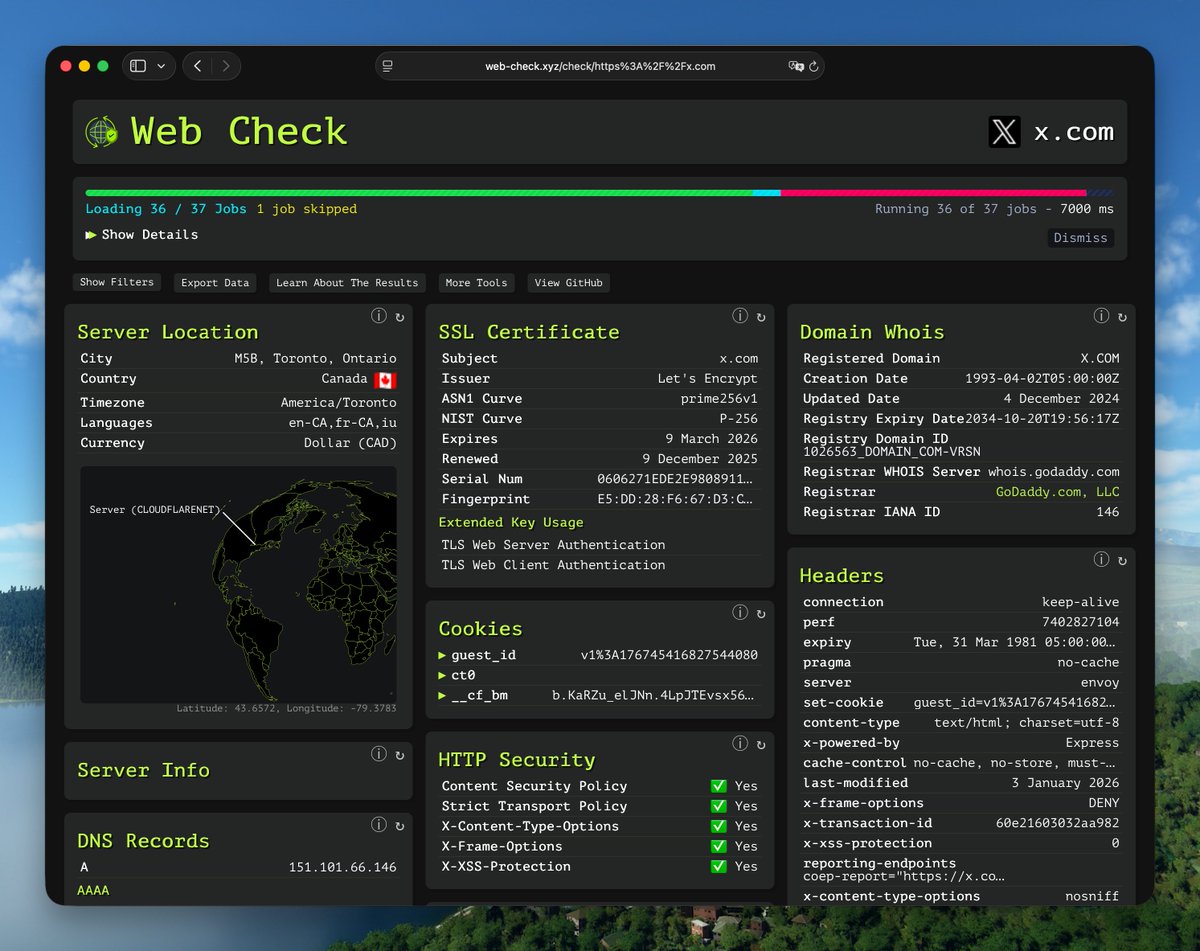
I recently discovered a super cool website inspection tool called Web-Check. It has a strong hacker vibe.
It lets you inspect almost everything about a website: IP details, SSL, DNS records, cookies, domain info, crawler rules, server location, redirect history, open ports, traceroute, DNSSEC, site performance, associated hostnames, and more.
https://t.co/A5B83COLK7
I have to wonder how much of the Meta priduct line failure comes from the horrible experience that is Facebook. I have low trust in anything Meta, specifically because of the quality and usability issues of Facebook.
I found a "Documentaries for Developers" series by CultRepo on YouTube at https://t.co/gryHgHSnCB . I watched Node.js and Python, both caught my interest. It Angular, React, Kubernetes, Vue.js, GraphQL, and more. Some are older, some are newer.
Troubleshooting Microsoft SQL Server performance issues differs when using AWS-managed vs. unmanaged instances. Take a look with me at one example case when troubleshooting high CPU on Amazon RDS with SQL Server: https://t.co/PZpihqZbWL
"Are we entering a world where anyone can code an app to solve their own problem?"
maybe... but...
everyone can cook a great dish in their kitchen...
... yet restaurants are thriving
#thoughtoftheday
Finding that installing #OpenVPN DCO on Ubuntu Server 22.04 LTS AWS AMI crashes the server and becomes unrecoverable. DCO is a feature that improves the performance of OpenVPN Access Server by offloading data channel encryption and decryption to the kernel space.
When spinning up #AWS#EC2 instances, EBS data volumes are not encrypted by default. Here are the reasons you may want to consider making that your default, along with where to find the setting. https://t.co/sc9gArn4jE
A co-worker of mine stated he's been using a paid version of ChatGPT using 4.5 for deep research, 3.5 Mini High and 4.0 for coding. He'd often max out the daily limit and get charged over-the-limit tokens. Someone suggested funding @openrouter credits to avoid this.
This look super exciting and useful! I do like the practical warnings that Sam gives, however. This will more than likely be a painful learning experience that we will evolve with.
Today we launched a new product called ChatGPT Agent.
Agent represents a new level of capability for AI systems and can accomplish some remarkable, complex tasks for you using its own computer. It combines the spirit of Deep Research and Operator, but is more powerful than that may sound—it can think for a long time, use some tools, think some more, take some actions, think some more, etc. For example, we showed a demo in our launch of preparing for a friend’s wedding: buying an outfit, booking travel, choosing a gift, etc. We also showed an example of analyzing data and creating a presentation for work.
Although the utility is significant, so are the potential risks.
We have built a lot of safeguards and warnings into it, and broader mitigations than we’ve ever developed before from robust training to system safeguards to user controls, but we can’t anticipate everything. In the spirit of iterative deployment, we are going to warn users heavily and give users freedom to take actions carefully if they want to.
I would explain this to my own family as cutting edge and experimental; a chance to try the future, but not something I’d yet use for high-stakes uses or with a lot of personal information until we have a chance to study and improve it in the wild.
We don’t know exactly what the impacts are going to be, but bad actors may try to “trick” users’ AI agents into giving private information they shouldn’t and take actions they shouldn’t, in ways we can’t predict. We recommend giving agents the minimum access required to complete a task to reduce privacy and security risks.
For example, I can give Agent access to my calendar to find a time that works for a group dinner. But I don’t need to give it any access if I’m just asking it to buy me some clothes.
There is more risk in tasks like “Look at my emails that came in overnight and do whatever you need to do to address them, don’t ask any follow up questions”. This could lead to untrusted content from a malicious email tricking the model into leaking your data.
We think it’s important to begin learning from contact with reality, and that people adopt these tools carefully and slowly as we better quantify and mitigate the potential risks involved. As with other new levels of capability, society, the technology, and the risk mitigation strategy will need to co-evolve.