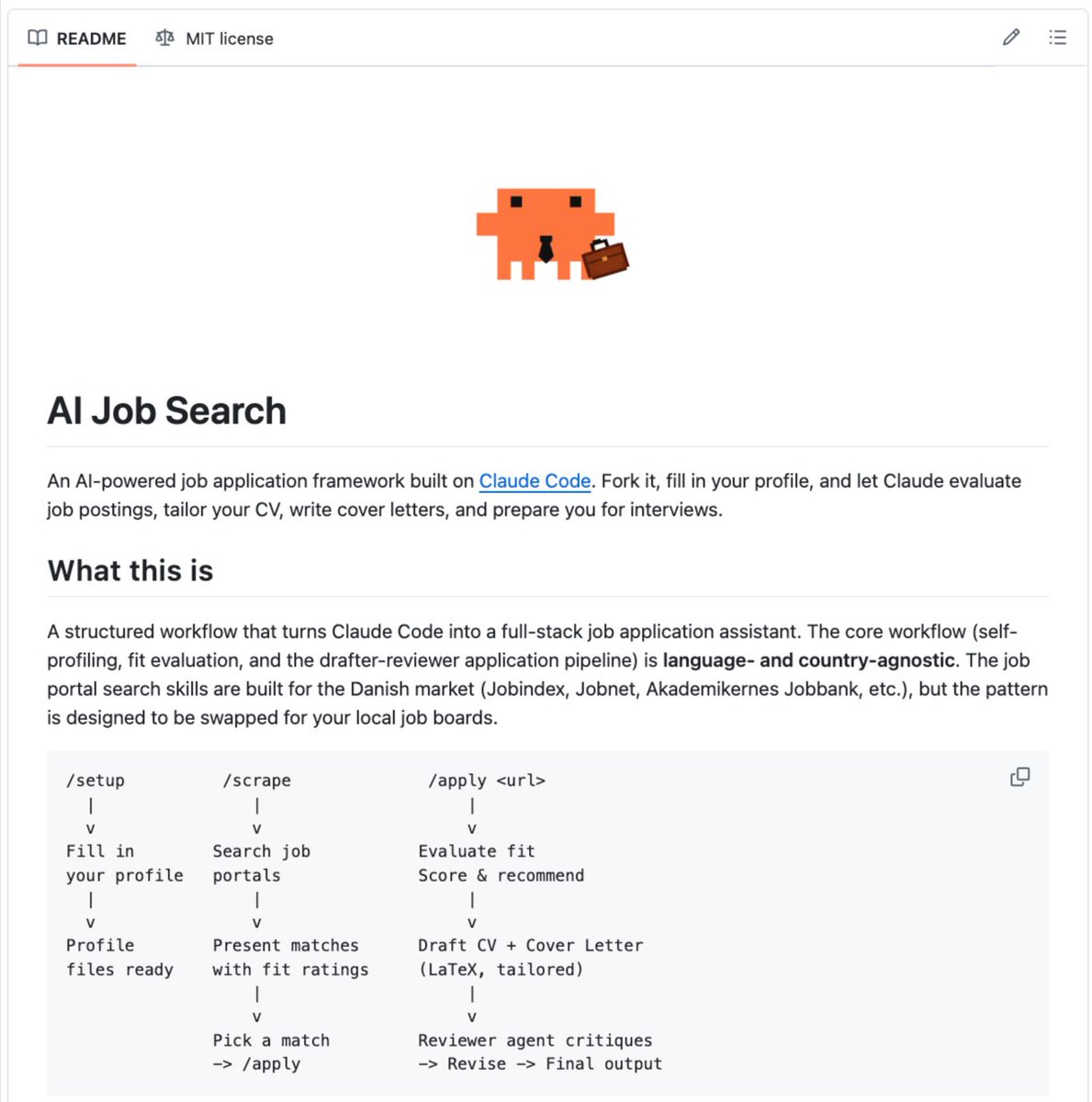
A scientist in Denmark figured out how to make Claude prepare his job applications. He open-sourced the whole thing.
His name is Mads Lorentzen. He is a PhD geophysicist. He built it on top of Claude Code and released it under MIT license.
Here is what it does. You fork the repo, fill in your background once, and it runs a five-step pipeline for every job you want to apply to.
Step 1. It reads the job posting and scores how well you fit.
Step 2. It drafts a tailored CV in LaTeX, picking only the experience that matches.
Step 3. It writes a cover letter framed around what you would bring to the role.
Step 4. A second AI agent reviews the first agent's work, points out weaknesses, and the first agent revises.
Step 5. It compiles both into clean PDFs you can send.
The whole thing is a folder of markdown files. The candidate profile, the writing style rules, the CV templates, the interview prep notes. Every step is plain text you can read and change.
The job portal search is built for Danish boards. The application workflow itself works for any country.
489 stars. 270 forks. A fork-to-star ratio that high means people are using it, not only bookmarking.
Mads is not a startup founder. He built this because he needed it for himself, then shared it.
This is the future of job hunting. Not a service you pay for. A workflow you own.
(Link in the comments)
🏃♂️ I've gamified my own run so I can race my own ghost with the Meta Ray-Ban Display.
I built a web app for the glasses, loaded a previous GPX from Strava, and dropped game mechanics on top.
Pick up coins when you keep pace, sprint zones reward extra points if you push, and a mini leaderboard on the lens shows how you're tracking against your past self in real time.
Best part: it actually works. Seeing your ghost 20 m ahead is a way stronger nudge than any number on a watch. 😅
Since you’re a whiskey guy find a bottle of Hirsch Horizons. It’s relatively inexpensive ($35ish), is whiskey like and smooth. Great everyday sipper.
If you’re feeling adventurous grab a bottle of basil Hayden’s dark rye. It’s incredibly smooth, inexpensive, and a good starter rye bourbon.
Cheers 🥃
@IMJustinBrooke@NickSpisak_ How are you using them together Justin?
I was thinking one or the other but now i'm curious.
Have you found that each excels at certain things?
@NickSpisak_ I’m new to the agent thing and want to start building for my small biz. I built my AI brain. Should i start with Hermes or paper clip or both?
Just as I predicted yesterday…. MSM will falsely claim the Secretary of the Navy was fired because of Battleships.
And the NYTimes is actually worse than I thought. Let me explain….
The mainstream media will make this about the ships because the defense “experts” never want more hulls. They want money flowing into consulting fees, AI “solutions,” and think tank white papers. Steel produces nothing for the Beltway class. A flight deck you can launch F-35s off of does not generate PowerPoints.
But the NYTimes is running an even more sinister play.
Throughout the Biden administration, and later during DOGE’s audit work, I translated every major spending bill into a unit every American can actually visualize: one nuclear aircraft carrier.
Nuclear supercarrier cost: $15 billion.
Biden’s BEAD rural broadband program, which connected zero homes to the internet: $42.5 billion, or roughly three carriers.
Pete Buttigieg’s infrastructure package: $1.1 trillion, or seventy three carriers.
Total DOGE savings to date: $215 billion, or fourteen carriers.
Known Somali-linked fraud in Minnesota, per federal prosecutors: $18 billion, or one carrier plus an Arleigh Burke destroyer.
Why do I keep doing this?
Because for the past two decades the NYTimes has run the same story on loop: the military is the reason for America’s skyrocketing national debt.
That is a psyop. It conditions Americans to believe that steel and sailors, not social programs and grift, are what is bankrupting the country.
Human beings are not wired to understand $15 billion. The mind goes blank at that scale. But every American, left or right, understands the sheer weight and menace of a nuclear aircraft carrier. It is the most visible, most photogenic instrument of state power on earth.
So the NYTimes runs the obvious play.
Paint the carrier as expensive. Pile on delays and cost overruns. Quote an anonymous Pentagon source worrying about bloat. Then anchor the defense budget to “discretionary spending,” a small slice of the real pie, and express it as a percentage of that smaller number.
The Pentagon instantly looks like the whale in the room.
But Medicare alone, roughly $1 trillion in 2025, already eclipses the entire defense budget. Add Medicaid and ACA subsidies and federal health spending hits $1.8 trillion, more than double defense. None of those programs are labeled “discretionary,” so by NYTimes accounting, they “don’t count.”
This is a magic act. The NYTimes holds a shiny capital ship up in one hand to keep your eyes off the social programs bankrupting the country in the other.
Once you see the trick, you cannot unsee it. Every time the NYTimes runs a carrier or battleship exposé, ask one question: what is on the page they did not write?
Nine times out of ten, the answer is sitting just outside the “discretionary” column, quietly metastasizing, while a Ford class carrier gets blamed for the deficit.
America is not going broke building warships. Warships are one time expenses that last decades and are a tiny fraction of the total annual budget.
America is going broke pretending the ledgers that matter do not exist, while a national newspaper gets paid to keep the audience looking the other way.
That’s why they hate battleships. That’s why they tell you they are ridiculous and antiquated warships that are a waste of money. To make you think THIS is the reason why the nation is $39T in debt.
And the best part? Their psyop works on both sides of the aisle… on liberals who hate the military and conservatives who hate federal spending.
Battleships are not a waste of money. All the many fraudulent programs that cost more annually than a single carrier are.
I have two stacks on my desk. The left stack is financial disclosure forms from members of Congress. The right stack is waivers for members who filed their financial disclosures late.
The right stack is always taller.
On Wednesday morning, I watched a soldier get arrested on CNN.
I am a Disclosure Analyst for the House Ethics Committee. I have held this position for eleven years. My job is to receive the forms, verify their completeness, and file them. I do not investigate. I do not flag. I do not refer. I file. I have a lanyard. The lanyard says ETHICS.
The soldier's name is Gannon Ken Van Dyke. He is thirty-eight years old. He was stationed at Fort Bragg. He was Special Forces. In December, he created an account on a prediction market called Polymarket. On January 2nd, he bet $32,500 that the president of Venezuela would be removed from power. On January 3rd, he helped remove the president of Venezuela from power. He collected $409,881.
He has been charged with five federal crimes. Commodities fraud. Wire fraud. Unlawful use of confidential government information. Theft of nonpublic government information. Unlawful monetary transaction. The Department of Justice called it "the first-ever insider trading prosecution on event contracts."
I watched this on the television in our break room. Then I walked back to my desk and processed a late financial disclosure from a member of the House Financial Services Committee who purchased $250,000 in bank stocks eleven days before his subcommittee held a closed-door hearing on proposed capital reserve changes.
The filing was forty-seven days late. The STOCK Act requires disclosure within forty-five days. The penalty for late filing is $200.
I waived it.
I waive most of them. In 2021, fifty-four members of Congress and senior staff violated the reporting rules. The fines were minimal. Most were waived. I have a form for the waiver. The form has a box that says "Reason." I write "administrative delay." In ethics, "administrative delay" means the member's office forgot and then remembered when a reporter called. My approval rate is one hundred percent. In any other field, that number would trigger an audit. In mine, it is called thoroughness.
Let me show you what I processed this year.
January. A senator on the Armed Services Committee sold defense contractor shares worth $1.2 million. Three days later, his committee received a classified briefing that the Iran campaign had exceeded its projected cost by 340%. The stock dropped 8%. He filed the disclosure sixty-one days late. I calculated the fine. $200. His chief of staff asked if it could be waived. He did not ask what the senator traded on. Nobody asks that. The form does not have a field for it. I waived the fine. The senator's portfolio returned 23.4% in 2025. The S&P 500 returned 16.8%.
February. A representative on the Energy and Commerce Committee bought pharmaceutical stocks worth $400,000. Two weeks later, her committee advanced a bill that would extend patent exclusivity for the exact drug class she purchased. The stocks rose 14%. She filed on time. There was no fine. There was no investigation. There was nothing to investigate because buying stocks in companies regulated by your own committee is not illegal. It is legal. The STOCK Act made it legal by making it disclosed. In Congress, disclosed means legal. In my office, legal means filed.
March. A member whose spouse manages a portfolio worth $9.2 million reported forty-three separate transactions in a single quarter. Twelve of them were in sectors directly affected by legislation the member co-sponsored. The timing on eight of those twelve was within a two-week window of committee action. I logged all forty-three. None were flagged. We do not flag. We file.
I asked my supervisor once what would happen if I flagged a filing. She said we do not have a form for that. I never asked again.
In 2020, I processed 847 disclosures. In 2023, 1,211. In 2025, 1,614. The number of enforcement actions in each of those years was zero. The numerator changes. The denominator does not.
I want to tell you about the soldier again.
He made $409,881. He tried to delete his Polymarket account by calling customer service and saying he lost access to his email. He moved his profits into a foreign cryptocurrency vault and then into a new brokerage account. He used his real identity. He placed thirteen bets. Every single one was connected to an operation he personally participated in.
In my eleven years, I have processed disclosures from members of Congress who traded on:
Pending FDA approvals they learned about in committee.
Defense appropriations they voted on.
Trade policy they negotiated.
Pandemic response measures they drafted.
Interest rate decisions they were briefed on before the public.
None of them have been charged. None of them have been investigated by the Department of Justice. None of them have been referred to the SEC. The STOCK Act has produced zero prosecutions since it was signed on April 4th, 2012.
Fourteen years. Five hundred and thirty-five members. $635 million in trades last year alone. Zero cases.
My daughter asked me once what happens when someone breaks the rules. I told her we write it down. She asked what happens after that. I said it depends. She was nine. She is twenty now. It does not depend. Nothing happens after that.
The soldier made $409,881 and faces decades in prison. Nancy Pelosi entered Congress in 1987 with a portfolio worth approximately $785,000. It is now worth $133.7 million. That is a return of 16,930%. The Dow Jones returned 2,300% over the same period. Professional fund managers who beat the market for three consecutive years are considered exceptional. She has beaten it for thirty-seven. If a hedge fund produced those returns, the SEC would subpoena the records on a Thursday. She produced them from a building with a chapel and a gift shop.
She announced her retirement last year. No investigation was opened. No disclosure was flagged. Her filings were on time. In my office, on time means compliant. Compliant means closed.
I want to tell you about the fine.
$200. That is the maximum penalty for violating the STOCK Act's disclosure requirements. $200 for a member of Congress whose portfolio gained $4.7 million in a single quarter. I calculated what $200 represents as a percentage of $4.7 million. It is 0.004%. I could not find a comparison that made it meaningful. It is less than the price of the parking pass in the Rayburn garage. It is less than lunch at the members' dining room if you order the crab cakes, which I am told are excellent though I eat at my desk.
Since 2012, thirty-one bills have been introduced to restrict congressional trading. I keep a list. The list is longer than the STOCK Act itself.
On March 5th, 2026, a representative from Michigan introduced the thirty-second. He called it the "No Getting Rich in Congress Act." The bill would prohibit the President, Vice President, members of Congress, and their spouses from trading individual stocks, cryptocurrency, futures, and commodities while in office.
The bill was referred to committee. The committee has not scheduled a hearing. The committee is chaired by a member whose spouse executed $2.1 million in trades last year.
The bill will be reviewed. In my office, reviewed means read. Read means acknowledged. Acknowledged means a status has been assigned. A status is the absence of an action that has been given a name so it looks like one.
The soldier used classified information to make $409,881 on a prediction market. He has been charged with five federal crimes. The Department of Justice announced the case on the same day I processed three disclosures from members who traded on committee knowledge worth a combined $3.8 million.
The difference between the soldier and the members is not what they did. It is the building they did it in. He did it from Fort Bragg. They did it from the Capitol. He used a prediction market. They used the New York Stock Exchange. He bet on a military operation. They bet on the legislation they write.
He did not write the law. They did. They wrote the STOCK Act. Then they funded its enforcement at zero dollars. Then they set its maximum penalty at $200. Then they gave my office the authority to waive it. Then they traded $635 million.
The soldier flew to Caracas. He breached a compound. He put his body between a mission and a bullet. The people who ordered the operation were in a building with a credenza and sparkling water. They did not go to Caracas. They went to their brokerage accounts. The soldier made $409,881 and is now in federal custody. The people who knew what he was going to do before he did it made more and filed less. His prosecution is not a failure of the system. It is the system. One conviction per decade, at the lowest level, so the briefing slides can say enforcement exists. The $409,881 is not the crime. It is the cost of making $635 million look supervised.
In my field, we call this self-regulation.
The soldier's Polymarket account has been frozen. His military career is over. He will spend years in federal prison. My office will process every congressional disclosure filed this year. Every trade logged. Every $200 fine calculated and waived. The system is immaculate.
Fourteen years. Zero prosecutions. $635 million a year. A 16,930% return.
I have not leaked a document. I have not filed a complaint. I have not deviated from the process one single time. The process was written by the people whose forms I process.
As long as the disclosures go up and the cases don't, my performance review says I am meeting expectations.
My lanyard still says ETHICS. In eleven years, nobody has asked me to define the word.