Our Global Conflict Tracker traces ongoing armed conflicts around the world. It includes background information, the latest news developments, conflict status assessments, and resources for further research—all updated regularly.
Use the interactive tool to learn more: https://t.co/XDFRX6vU4j
“Canada is condemned by geography. Something like 70% of Canadians live within 100 miles of the U.S. border. Virtually all their trade is with the U.S.,” CFR President @MikeFroman tells @nayeema, host of the Smart Girl Dumb Questions podcast. “Ultimately, Canada is going to be very much tied to the United States, and we’re going to be tied to Canada.”
Watch the full conversation: https://t.co/AdWERyyKf3
“The Western Hemisphere is fundamental to U.S. prosperity. But over the last 25 years, the United States has left a vacuum in the hemisphere, and China has moved to fill it,” argues @danrunde, author of The American Imperative.
“The United States, if it is to be strong, prosperous, and secure in the coming decades, will require full access to the Western Hemisphere’s energy, food, minerals, and technology.”
“If those assets and resources can be secured, the benefits will be immense. American jobs can be created, migration pressures reduced, technological progress ensured, and security enhanced,” Runde writes.
Read more: https://t.co/bw0ssbdN8P
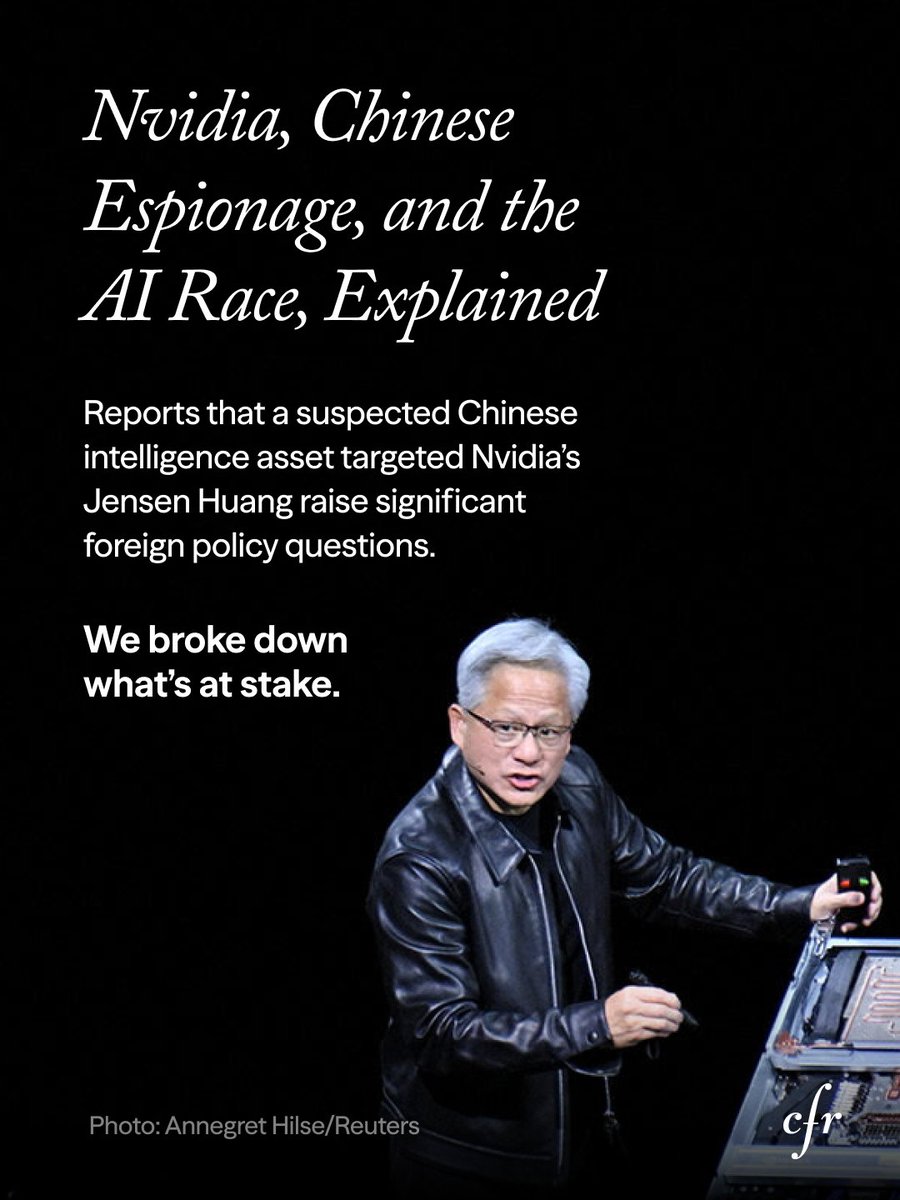
Nvidia, one of the most valuable companies in the world, recently announced that it had launched an investigation into allegations that a Chinese espionage operation had targeted Jensen Huang, the company’s chief executive.
Valued at more than $4 trillion, Nvidia makes the chips that underpin the large language models and data centers that have become pillars of U.S. economic growth.
Huang cofounded Nvidia in 1993, is its largest individual shareholder, and has become one of the most recognizable figures in the AI boom.
The episode raises significant foreign policy questions on everything from the enforcement gaps in chip export controls to the U.S.-China relationship.
CFR broke down what that means. Read more: https://t.co/jti2UeNwcg
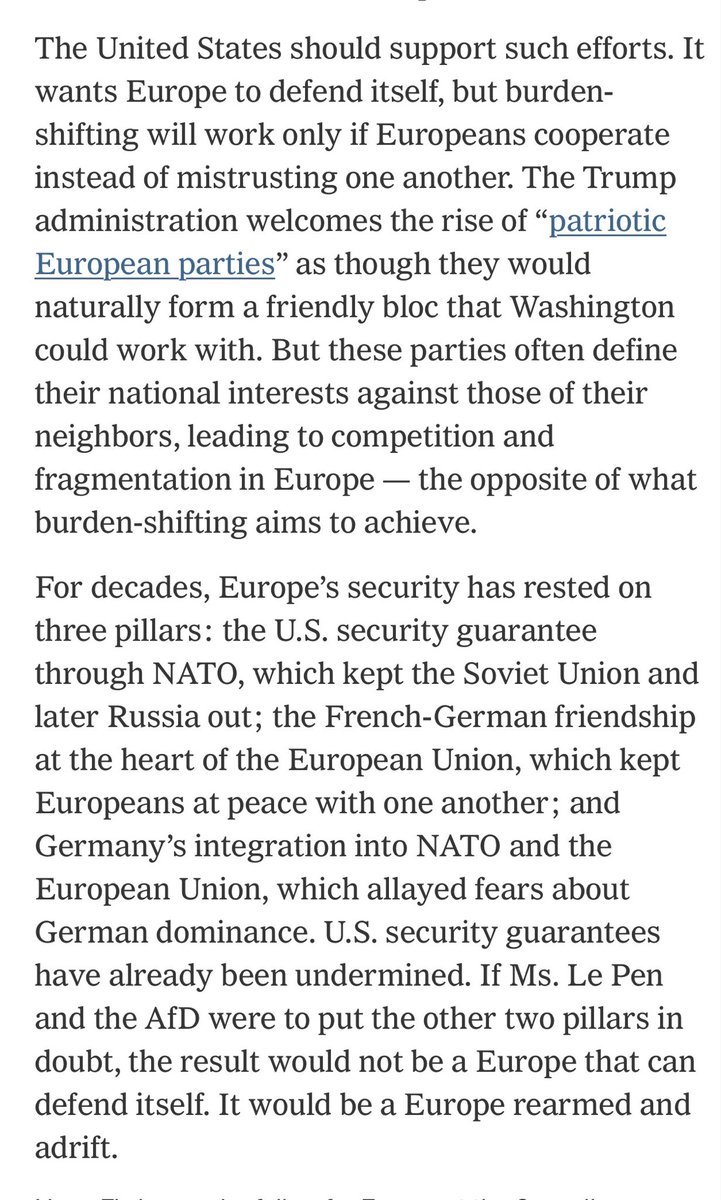
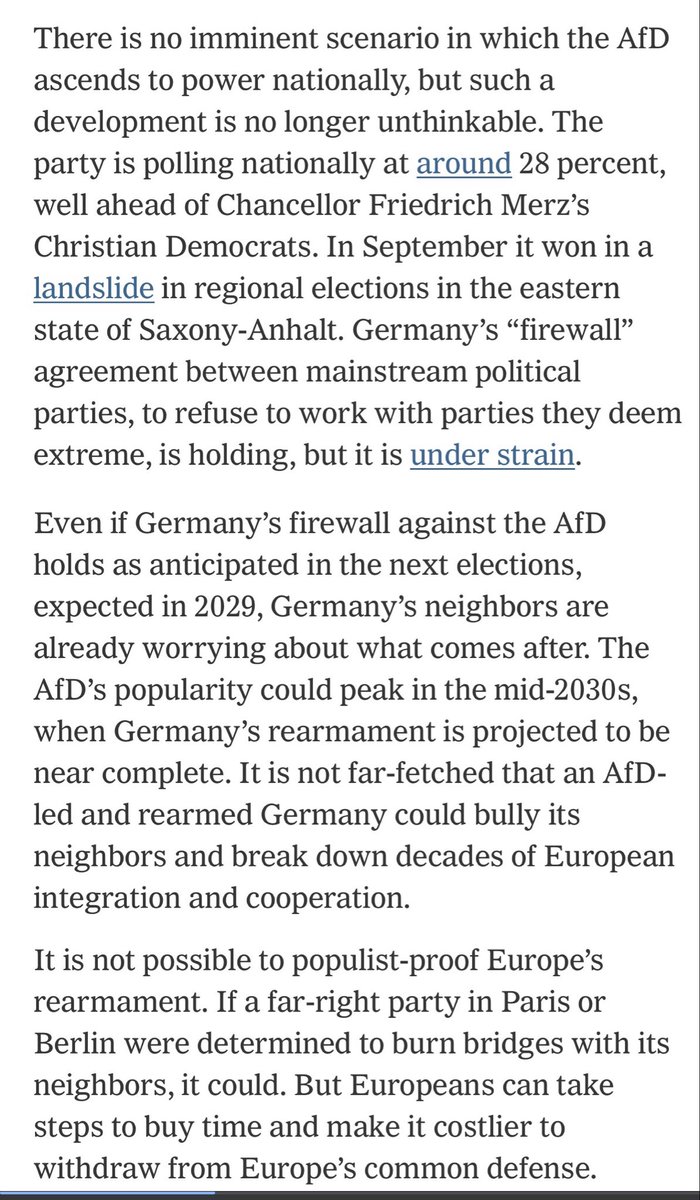
The threat of Russian aggression and the risk of U.S. abandonment have triggered a German rearmament of historic proportions, writes expert @LianaFix in her new book, Germany Rearmed: The Return of War and the End of Illusions.
“The transformation of Germany from ‘civilian power’ to a key military power in Europe is one of the defining stories of the still young 21st century," she argues.
Germany’s rearmament takes place at a time of upheaval for Europe and the transatlantic alliance, Fix writes. With the far right on the rise, she addresses the likelihood of Germany assuming a greater military role without reviving old fears among its neighbors.
Challenging Germany’s “myth of pacifism,” Fix argues that, as the post-war order fades, Germany can—and must—become a military power capable of protecting Europe when the United States will not.
“How Germany navigates this moment will shape not only its own future but the future of the continent.”
Learn more: https://t.co/B0BBNgG0Nt
“I have talked to a few CEOs that I advise, where after talking to them, two months into them engaging AI, they’re like, ‘Oh, I fired my staff, fired my developers. Why? Because I can vibe code this,’” says Dr. Newton Campbell, adjunct professor at Georgetown University and principal consultant at Everything Lives LLC. Campbell outlines the risks of relying on AI to cover sensitive areas like IT security and privacy, and argues that it can never be used as “a true replacement for human beings.”
Watch the full conversation, which is part of our Science Fair series on scientific and technological advances with consequences for foreign policy: https://t.co/SJSyEkxbFY
“Journalism is the bedrock of any democracy. CFR supporting journalists fosters the continued practice that is so important for our societies,” says Leila Fadel, host of NPR’s Morning Edition and 2016–17 Edward R. Murrow press fellow. Launched in 1949, CFR's Press Fellowship promotes the quality of responsible and discerning journalism exemplified by the work of Edward R. Murrow.
Each year, one distinguished foreign correspondent or editor is awarded dedicated time and resources to pursue an independent project, from long-form writing to in-depth research. Based in CFR’s New York or Washington office, the fellow joins the David Rockefeller Studies Program, CFR’s think tank, and contributes to its research, writing, and events, including as a moderator. The fellowship runs 10 months, beginning in September. Applicants must be U.S. citizens with distinguished credentials in journalism and experience covering international news.
Apply by November 30, 2026: https://t.co/1Yz1ohXenj
“When I grew up, I’d look out my window—I didn’t see the United States, I saw Canada,” says U.S. Representative Debbie Dingell (D-MI). CFR visited the Michigan-Ontario corridor to convene senior-level public and private officials for discussions on U.S.-Canada trade relations. We asked Rep. Dingell what every American should know about the relationship. Her answer: “Canada and the United States of America are totally intertwined.”
🌍 Happy pub day to #TheRealist by @DavidMSacks1: the first biography of Hans Morgenthau, the political philosopher who pioneered realism―the approach to foreign policy that guided the U.S. through the Cold War and explains today’s world.
Read Now: https://t.co/L7vA2H3a6Y
“95% of the work is keeping the AI from doing the things you don’t want it to do,” says Barbara Thompson, an astrophysicist at Beryllium10 Knowledge and one of the founders of NASA’s Center for HelioAnalytics. “All of the skill involved in painting is keeping the paint where you don’t want it to be,” she continues. “That is exactly the same as AI—except AI is paint that never dries and you can’t see it.”
Watch the full conversation, which is part of our Science Fair series on scientific and technological advances with consequences for foreign policy: https://t.co/SJSyEkxbFY
“How do you assess U.S. soft power right now?” asks @nayeema, host of the Smart Girl Dumb Questions podcast. “Pew recently found that China is viewed more favorably than the U.S. in most of 36 countries surveyed—it’s the first time in nearly two decades. Do you think that one day we’ll be watching, like, ‘The Fresh Prince of Peking’?”
“The U.S. has tremendous residual strengths when it comes to soft power—our university system, our entertainment, our media, our values, our culture are still very much valued around the rest of the world. I hope we take steps to make sure that we are using them in the best way possible,” responds CFR President @MikeFroman. “We want to prevail in this competition with China. Soft power is one of our greatest strengths in that regard. So let’s make sure we’re not diminishing it on one hand, at the same time that we’re trying to compete on the other,” he adds.
Watch the full conversation: https://t.co/AdWERyyKf3
“The 2030s will likely determine whether Venezuela regains stability, democracy, and prosperity or remains authoritarian and dysfunctional,” write experts Will Freeman and Paul J. Angelo. “U.S. credibility in Latin America relies on the United States using its newfound leverage to drive democratization and economic recovery.”
“An open and secure Venezuela would increase stability in the region and help protect the U.S. homeland and critical supply chains,” they write.
Read more: https://t.co/0Mzddbi7fe
Hans Morgenthau escaped Nazi Germany and became one of the most influential political philosophers of the twentieth century. He pioneered realism, an approach to international relations that guided the United States throughout the Cold War.
However, Morgenthau did not champion every U.S. exercise of power and criticized U.S. policy during the Vietnam War. In his new book The Realist, CFR expert @DavidMSacks1 details Morgenthau's life and work and explores how his ideas can guide policymakers as they tackle today's major challenges.
Learn more: https://t.co/27V5NxhpjU
WATCH: @ChrisRMcGuire joins CNBC to discuss the implications of the alleged Nvidia spying scandal, Megaspeed, and export controls 👉 https://t.co/qMXo4eXPk7
“Taiwan is a critical supplier for the U.S. tech industry, and the United States recognizes that it cannot be a leader in AI without Taiwan,” write CFR’s @RebeccaLissner and Mira Rapp-Hooper for Foreign Affairs.
“Whatever the nature of Washington’s rhetoric right now, the United States would have to respond to any action by Beijing that threatened [U.S.] interests, and both countries would then face a great-power crisis.”
Read their article in Foreign Affairs: https://t.co/pL2YG8XyMU
The November/December 2026 issue of Foreign Affairs Magazine is now available.
In the latest issue authors provide analysis on the future of warfare tech, consider how governments can safely harness AI’s potential, assess using U.S. intelligence for economic spying, and more.
Start reading: https://t.co/a8MQrtJpOe
Raised across four continents, Manjari Chatterjee Miller’s interest in international relations began with her global upbringing.
Her exposure to different countries and cultures eventually led to a career studying foreign policy and the shifting dynamics of global power—with a particular focus on China and India. Today, she's a senior fellow at CFR.
She spoke to us about her career, her experiences living abroad, and how a dinner conversation at Harvard changed the course of her career.
“My advice is to travel. Really travel,” Miller said. “And don’t think of career paths as linear. You never know what is going to push you into foreign policy, but expanding your horizon is one way to get there.”
This year's UN climate summit, COP31, kicks off in Turkey with the world on track to miss climate targets—and governments grappling with the consequences of climate change.
Three think tank experts in the United States, Canada, and South Africa analyze the status of global climate action and what we can expect from international cooperation going forward: https://t.co/3SvN3OTVXl
Here’s my @nytimes essay on „What if Europe rearms at exactly the wrong time?“, based on my new book https://t.co/Z6CUK8vxFO - I argue that it is not possible to populist-proof Europe‘s rearmament, but Europeans can take steps to entangle defense @CFR_org https://t.co/Mfuf6BgsNM