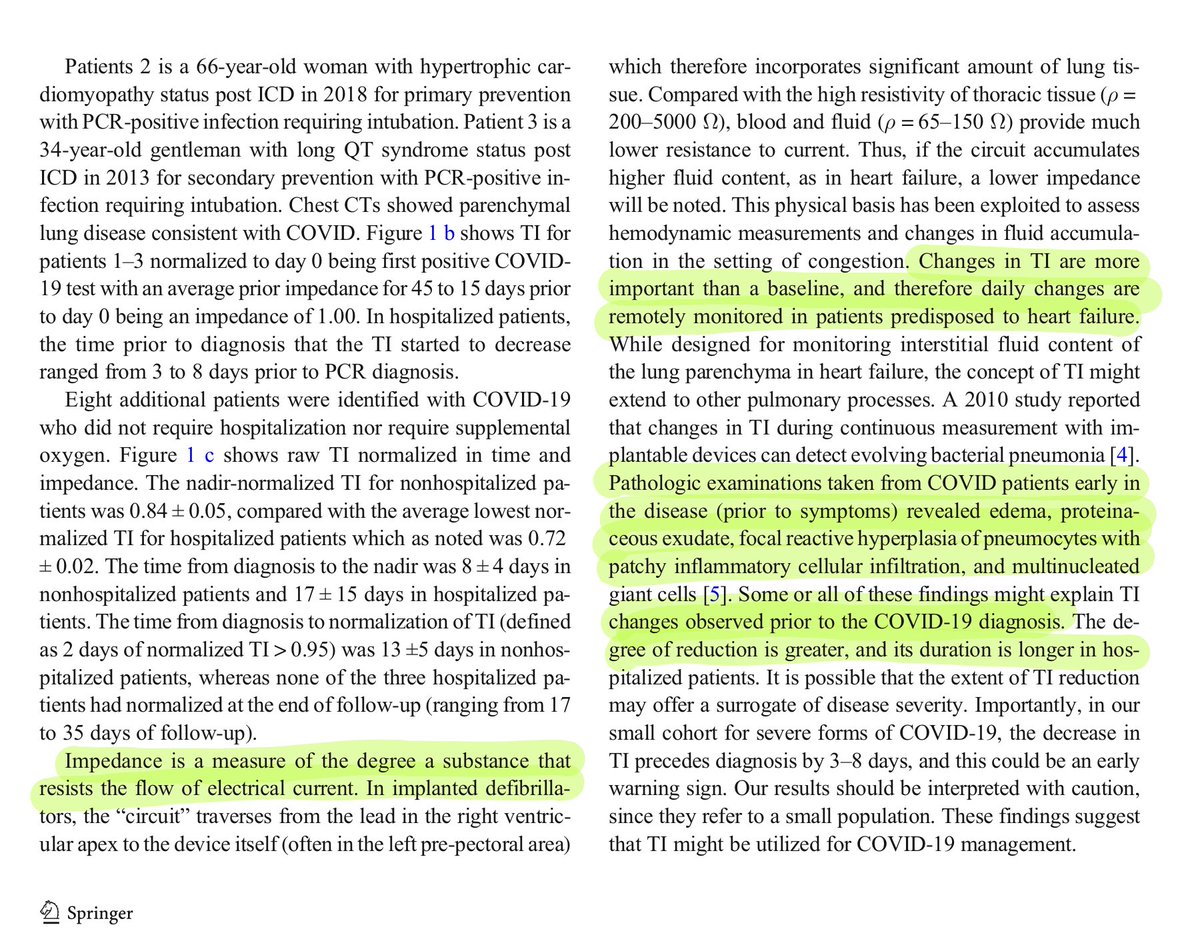
Looks like implantable sensors within devices measuring transthoracic impedance may have a role in tracking the lung pathology in #COVID. Nice work from Sunil Kanpur, @True_EP #EPeeps#Sensors#Cardiotwitter
May help detect and evaluate recovery from lung infection.
Real-world experience of leadless left ventricular endocardial cardiac resynchronization therapy: A multicenter international registry of the WiSE-CRT pacing system https://t.co/Y9lrxlvFOL
@AndyThornley@narrowQRS@SchakrabartiEP@AbbottCardio the thing is that we‘re happy to have it in our (ervery day) repertoir as a „bail out“ lead- but finally using it needs a huge effort or a good convincing strategy of the mdt rep :)
anyway- the use should be rare thinking of extraction i think!
@narrowQRS@SchakrabartiEP@AbbottCardio somehow i always have to think of the starfix (mdt) and I do have huge respect of lv leads with acitive fixation...but i‘ve heard that too...allthough I did not use it so far 🙈 #safethecs ;)
@narrowQRS@SchakrabartiEP@AbbottCardio so I am not a big fan of active fixed leads in the cs...i try to avoid it if there‘s (even) a (small) chance...and in this patient there was no need for an active fixed lead due to good wedging and good pacing thresholds...extracting an acitvely fixed lead in cs —> nightmare!
@ManoloMolina8@AbbottCardio that would have been a great idea too! thank‘s for sharing!
in out case the qrs duration has been reduced from 185ms (epicardial) to 140ms (lv)...
Transvenous Lead Extraction in Patients with Prior Extraction Procedures: Procedural Profiles and Outcomes, by @erikahuttce, @aymanhusseinmd, @omwazni and colleagues https://t.co/amCWvPLKWU
@SchakrabartiEP@naderjo@narrowQRS@rdschaller@Hapa_EP@seth_j_worley@VKutyifa using cephalic vein is totally different:
1: you do not need to puncture
2: the lead is not stressed due to the „anatomical“ access path#
3. every lead should be fixied seperately with its sleeve
BUT i‘ve aalso had noise due to isolation defects due to friction via cephalic...