In my latest @PsychToday post, I examine @AwaisAftab's attempt to rescue psychiatry on pragmatic grounds after conceding longstanding critiques of its foundations.
I argue the defence fails—and it leads not to reforming the psychiatric paradigm, but to moving beyond it.
https://t.co/7NdhEoeR0W
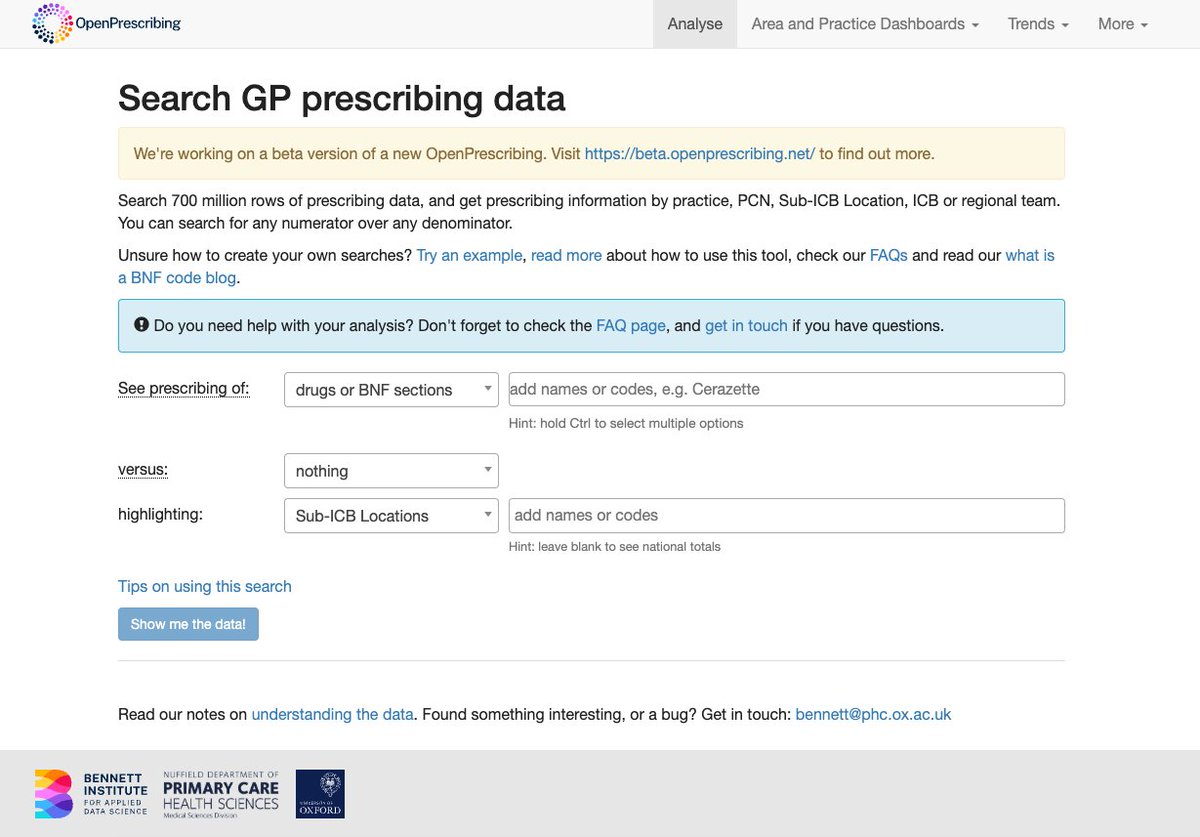
A team at Oxford built a search engine for every drug the NHS prescribes, and it has quietly saved the health service millions.
It's called OpenPrescribing.
The NHS publishes its full prescribing dataset every month. It's 700 million rows of raw numbers nobody could actually read. So Oxford built a tool that turns it into live charts in seconds.
You type a drug name. It shows you which practices over-prescribe it, which regions are slow to follow new guidelines, and where the money is being wasted.
→ Search any drug across any GP practice in England
→ Find safety and cost outliers instantly
→ 70+ ready-made quality measures
→ Updates monthly, automatically
→ Free, open source, MIT licensed
20,000 people use it every month. Doctors. Researchers. Journalists.
Public data that sat unreadable for years is now one search away.
https://t.co/U9KI0mUCAp
"In a bustling ballroom in an upscale hotel, Laura Friedman, 23, sat onstage to talk about her sex life. Specifically, sexual dysfunction.
The Vanderbilt University senior explained that after stopping antidepressants, she experienced what she described as a 'chemical castration,' with complete loss of feeling in her genitals.
She’s also lost her sense of emotional connection. 'I can't feel love for my own mother, which is the hardest thing on Earth.'"
#antidepressants #PSSD
ARTICLE LINK: https://t.co/m178U4cCJU
Make sure the Greater Manchester Basic Income Pilot happens.
Whatever happens next the people of GM deserve what they were promised in the 2024 manifesto:
“To bring forward a Basic Income pilot” ~ Andy Burnham
Tell them why it matters https://t.co/cqchNP7SV6
👁️The Government is about to unleash the “largest ever” roll out of live facial recognition surveillance, putting our rights & freedoms at risk.
Here are 5 reasons for YOU to join our fight to #StopFacialRecognition⤵️
The tide is turning – if not against Palantir entirely, then against the presumption that there’s no alternative to them.
The British people are saying no, and it’s working. Say no to Palantir in the NHS here: https://t.co/4G724CElC9
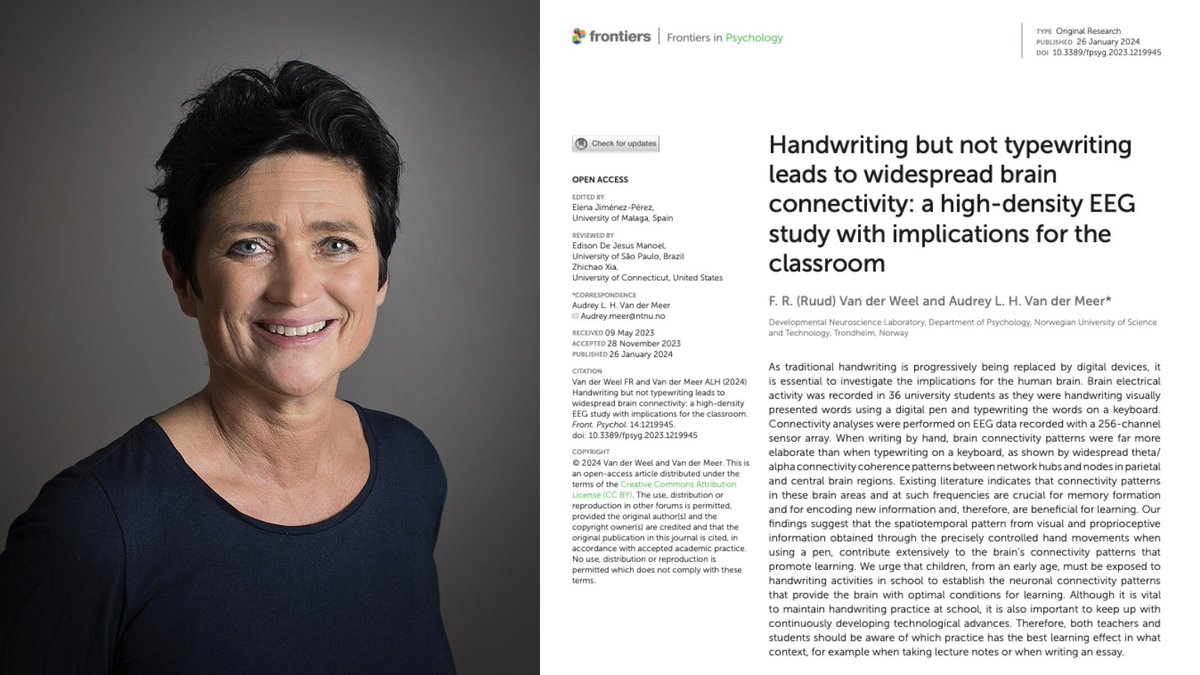
A Norwegian neuroscientist spent 20 years proving that the act of writing by hand changes the human brain in ways typing physically cannot, and almost nobody outside her field has read the paper.
Her name is Audrey van der Meer.
She runs a brain research lab in Trondheim, and the paper that closed the argument was published in 2024 in a journal called Frontiers in Psychology. The finding is brutal enough that it should have changed every classroom on Earth.
The experiment was simple. She recruited 36 university students and put each one in a cap with 256 sensors pressed against their scalp to record brain activity. Words flashed on a screen one at a time.
Sometimes the students wrote the word by hand on a touchscreen using a digital pen, and sometimes they typed the same word on a keyboard. Every neural response was recorded for the full five seconds the word stayed on screen.
Then her team looked at the part of the data most researchers had ignored for years, which is how different parts of the brain were communicating with each other during the task.
When the students wrote by hand, the brain lit up everywhere at once.
The regions responsible for memory, sensory integration, and the encoding of new information were all firing together in a coordinated pattern that spread across the entire cortex. The whole network was awake and connected.
When the same students typed the same word, that pattern collapsed almost completely.
Most of the brain went quiet, and the connections between regions that had been alive seconds earlier were nowhere to be found on the EEG.
Same word, same brain, same person, and two completely different neurological events.
The reason turned out to be something nobody had really paid attention to before her work. Writing by hand is not one motion but a sequence of thousands of tiny micro-movements coordinated with your eyes in real time, where each letter is a different shape that requires the brain to solve a slightly different spatial problem.
Your fingers, wrist, vision, and the parts of your brain that track position in space are all working together to produce one letter, then the next, then the next.
Typing throws all of that away. Every key on a keyboard requires the exact same finger motion regardless of which letter you are pressing, which means the brain has almost nothing to integrate and almost no problem to solve.
Van der Meer said it plainly in her interviews.
Pressing the same key with the same finger over and over does not stimulate the brain in any meaningful way, and she pointed out something that should scare every parent who handed their kid an iPad.
Children who learn to read and write on tablets often cannot tell letters like b and d apart, because they have never physically felt with their bodies what it takes to actually produce those letters on a page.
A decade before her, two researchers at Princeton ran the same fight using a completely different method and ended up at the same answer. Pam Mueller and Daniel Oppenheimer tested 327 students across three experiments, where half took notes on laptops with the internet disabled and half took notes by hand, before testing everyone on what they actually understood from the lectures they had watched.
The handwriting group won by a wide margin on every question that required real understanding rather than surface recall.
The reason was hiding in the transcripts of what the two groups had actually written down.
The laptop students typed almost word for word, capturing more total content but processing almost none of it as they went, while the handwriting students physically could not write fast enough to transcribe a lecture in real time, which forced them to listen carefully, decide what actually mattered, and put it in their own words on the page.
That single act of choosing what to keep was the learning itself, and the keyboard had quietly skipped the choosing and skipped the learning along with it.
Two studies. Two countries. Same answer.
Handwriting makes the brain work. Typing lets it coast.
Every note you have ever typed instead of written went into your brain through a thinner pipe. Every meeting, every book highlight, every idea you captured on your phone instead of on paper was processed at half depth.
You did not forget those things because your memory is bad. You forgot them because typing never woke the part of the brain that would have made them stick.
The fix is the thing your grandmother already knew.
Pick up a pen. Write the thing down. The slower road is the faster one.
…other desired communal forms of response and social care have been eroded and withdrawn over decades of isolating neoliberal policies that actively gut community to make room for profits. To demedicalize, we must build public infrastructure for social care—not cut medical care.
The concept of risk management is based on the assumption that dangerousness is an intrinsic feature of mental illness rather than a co-constructed set of circumstances based on the interplay between illness,social context and institutional structure. That's why it's stigmatising
Interview about our paper on reducing antipsychotics. Many people on long-term antipsychotics 'feel consigned to have a limited life because of the drugs’ effects. They want to have choices.' @markhoro https://t.co/dZmtrVXY0N. Paper in linked post.
Grass roots organisations put in time to create healthier communities for free and there are no practically free spaces to meet together. If Manchester wantes to be a healthier city we need community spaces that are accessible to all.
🚨 BREAKING: half of people in the UK have lost access to community spaces - with families in the most deprived areas losing them fastest.
Parks, libraries, leisure centres are essential for our mental and physical health.
We all need places to connect. Especially when life is tough.
Anders Sørensen, Danish clinical psychologist, used a perfect analogy at the MAHA Summit:
We’re doing the same thing with antidepressants that we did with that ridiculous parachute study. Most clinical trials last only 8 weeks, yet millions take them for years (median 5 years in the US). When people try to stop and suffer severe withdrawal, it gets labeled a “relapse” and they’re put back on the drug.
A 2019 systematic review and patient surveys (including Public Health England’s report) confirm that SSRI withdrawal symptoms can be severe, prolonged, and often misdiagnosed as relapse, especially with rapid tapering.
We’re basing long-term treatment decisions on short-term data, creating a hidden epidemic of dependence that many doctors still aren’t trained to handle properly.
What do you think — should we demand much better long-term safety data and proper tapering protocols before keeping so many people on these drugs for years?
Please do your own research and use your own judgment when listening to any claim — especially about medications and health.
Please do your own research and use your own judgment when listening to any claim — especially about medications and health, including from your doctor.
See filmmaker Katinka Blackford Newman’s very moving 8-minute film about how close she came to killing her two children after escitalopram (Lexapro, from Lundbeck), an antidepressant, made her psychotic: https://t.co/FIKnhcsZLD. And read her book.
Protracted withdrawal and PSSD are such severe, drug-induced injuries, they are difficult for the medical establishment to admit to, but, in fact, we have known drugs could do this sort of thing since Heather Ashton studied benzo withdrawal in the 1980s.