Happy to share that two papers from the Model Science team at Lexsi Labs have been accepted to EMNLP 2026 🎉
1⃣Main Track : AlignBeam
2⃣Findings Track : Provenance-Grounded Gating & Adaptive Recovery
#EMNLP2026#LLM#AIResearch
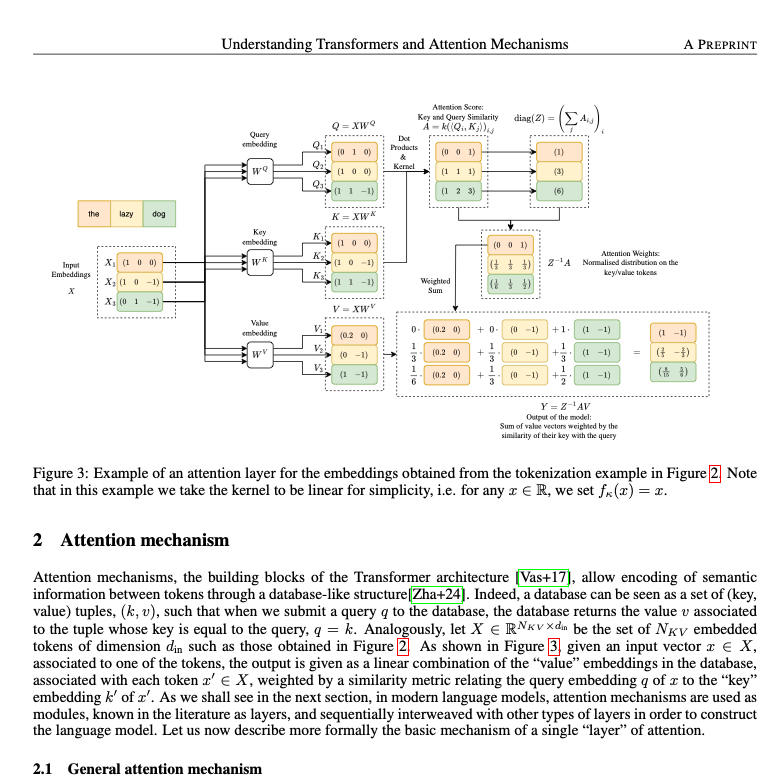
"Understanding Transformers and Attention Mechanisms" is a very interesting paper that presents the Transformer architecture from the perspective of applied mathematics.
It starts by representing text as vectors and explains mathematically how the attention mechanism processes these vectors to encode contextual information. It then develops Multi-Head Attention and shows how the main components of the Transformer architecture are constructed.
The paper also discusses more recent methods designed to reduce the computational and memory costs of attention, including KV caching, Grouped Query Attention, and Latent Attention. I think it is a useful reference for anyone interested in understanding Transformers beyond their high-level architecture and in seeing the linear algebra behind modern language models.
https://t.co/Rlun9QT7zx
We released skillpatch - https://t.co/QyaYnbx1DF, yesterday.
A student used it to create nice notes using my lectures on RLHF.
Now I don't need to create notes either! Feels like I have built my own clone.
Height of irony - I'm working to make myself redundant!
"Metis: Memory Foundation Model"
Most AI agents still use memory as an external RAG-style module, so the model retrieves old text instead of actually remembering.
This paper makes memory native to the Transformer. So past interactions are compressed into dynamic layer states and read through memory attention during normal forward passes.
The model weights stay frozen at inference, but its memory state updates without gradients, giving the model persistent memory inside the backbone.
Still early and lossy, but this is yet another paper with a big step toward agents that remember natively instead of outsourcing memory to a database.
“Weak-to-Strong On-Policy Distillation”
Strong models usually need stronger teachers for OPD, and that is hard to come by for frontier models.
So this paper shows you can improve a strong model using weaker models by distilling the logit direction between a weak positive and weaker negative model, not copying either one.
Post-RL minus pre-RL, 4B minus 0.6B, and correct hint minus wrong hint all create useful proxy teachers.
In their result, Qwen3-8B improves on math and code, and sometimes surpassing the 4B RL teacher it learns from too.
How can an LLM switch between low-, medium-, and high-effort reasoning? And how does an LLM learn to reason more or less?
I put together a “little” article explaining how these effort levels are implemented at inference time and during training.
Excited to share that two papers from our AI Safety & Alignment Research Lab at Lexsi Labs have been accepted at hashtag#ICML2026:
1. ALIGNBEAM: Inference-Time Alignment Transfer via Cross-Vocabulary Logit Mixing #AI4GoodWorkshopICML2026
2. C-ΔΘ: Circuit-Restricted Weight Arithmetic for Selective Refusal #MechInterpWorkshopICML2026
Congratulations to Chirag Chawla, Aditya Kasliwal, @pratinavseth , @SVinayKumar12 and the team!
Papers:
ALIGNBEAM: https://t.co/PdjMWtZRww
C-ΔΘ: https://t.co/acj4EhPS1F
“Latent Thought Flow”
This paper moves reasoning into continuous latent space, but instead of learning one hidden thought path, it learns a distribution over many paths.
Using a continuous GFlowNet, Latent Thought Flow gives more probability to latent trajectories that are correct and cheap, so the model can stop early on easy problems and think longer on hard ones.
In their experiments, they were able to obtain better accuracy while reducing reasoning length.
Grateful to share that 5 papers from our team were accepted to ICML 2026 workshops.
Two on inference-time safety & steering of post-trained models, and three on tabular foundation models.
Huge thanks to the amazing collaborators @Lexsi_labs + all co-authors!
Details below :
#ICML2026 #MachineLearning
@icmlconf