Very excited about the Link:NYC conference next week in New York. Excited to be bringing together the top TradFi and DeFi teams and their senior leaders to discuss the future of the new global financial system.
https://t.co/G8Sp2iLK8U
Developers shouldn’t have to build everything from scratch when creating onchain applications.
With CCIP, CRE, and ACE integrated into OpenZeppelin’s tooling, #Chainlink capabilities are closer to the workflows developers already rely on.
Less friction for builders.
Chainlink's Q3 momentum tells a much bigger story than most people realize.
While the market focuses on token prices, Chainlink continues expanding the infrastructure connecting global finance to blockchain networks.
Look at what happened in Q3:
→ CCIP 2.0 launched, bringing more flexibility, security, and control to cross-chain finance.
→ $15B+ migrating to CCIP, reflecting growing demand for institutional-grade interoperability.
→ $140B secured across onchain finance, highlighting Chainlink's expanding role in the digital asset economy.
→ Traditional finance: Engagement with DTCC, Swift, and other major financial infrastructure players.
→ Enterprise adoption: Infosys, Robinhood, and others integrating Chainlink infrastructure.
→ Regulatory engagement: Working with policymakers across the US, UK, and Hong Kong.
Think about what connects all these developments.
Tokenization needs reliable data. Banks need interoperability. Institutions need compliance, security, and infrastructure they can trust.
Chainlink is building across all these layers.
The next phase of blockchain adoption isn't just about bringing assets onchain.
It's about connecting those assets to the global financial system.
From DeFi to TradFi. From tokenization to institutional adoption.
The infrastructure is coming together.
Hyperchainlinkization.
https://t.co/ivYCnQJMih
TradFi adoption, major enterprise integration, and regulatory engagement are all moving in the same direction.
The shift from Web3 testing to actual global infrastructure is happening in real time.
Which of these updates do you think will drive the most enterprise adoption moving forward?
⬡ CHAINLINK Q3 MOMENTUM ⬡
• Launched CCIP 2.0
• $15B+ migrates to CCIP
• $140B secured across onchain finance
• TradFi adoption: DTCC, Swift, & more
• Enterprise adoption: Infosys, Robinhood, & more
• Work with policymakers across the U.S., UK, & Hong Kong
Chainlink Co-Founder Sergey Nazarov delivers the keynote at Link:NYC on October 29.
He takes the stage in the financial capital of the world, alongside DTCC, the CFTC, Swift, ICE, Fidelity, and more.
Apply to attend → https://t.co/xLqGuqRbgf
LINK:NYC
Here's what the start of the one day event will look like! Keynote to all things finance. October 29th with @chainlink.
See the full day agenda here: https://t.co/rqI6P82oas
$38 trillion in value transferred runs on OpenZeppelin standards, and that tooling now ships Chainlink CCIP and ACE as the default for ERC-20 and ERC-3643 tokens
OpenZeppelin is the standard most of the industry builds on, used by firms like BlackRock and Franklin Templeton, and S&P Global announced last month that it will acquire the company. As of October 20, CCIP and ACE are live natively in its Wizards and AI developer tooling. Teams on OpenZeppelin Defender also get a migration path to the Chainlink Runtime Environment, which will power OpenZeppelin's upcoming production-grade institutional solutions.
Regulated issuers should read the compliance part twice. ACE adds hooks for sanctions screening, KYC checks, volume limits and Secure Mint, and OpenZeppelin says those policies can be updated without redeploying the core token contract. Stablecoin and tokenized fund rules keep changing, so a token whose policy layer can change with them is easier to keep compliant.
Every issuer that picks those options starts with Chainlink in the stack from the first line of code.
Kamino is giving CCIP-secured collateral better terms than tokens on bespoke bridges
After an extensive security review, the Solana lending protocol said assets secured by Chainlink CCIP qualify for higher borrowing caps and LTVs, while tokens on bespoke, per-lane setups face lower caps and, in some cases, delisting. Kamino's reasoning is that a cross-chain token is only as safe as its weakest mint-and-burn setup, because unbacked supply created anywhere "flows freely into every market that accepts it."
CCIP gives Kamino one baseline to underwrite. Its default verifier set is 16 independent, security-reviewed node operators, and issuers who add their own verifiers under CCIP 2.0 do so alongside that set. Kamino also called CCIP the only widely used bridge with no funds-loss exploit on its record, and it already uses Chainlink Data Streams as a primary source of RWA pricing.
Its message to issuers planning a cross-chain expansion is to "choose infrastructure that lets a lending market underwrite you once and trust the result across every chain you touch."
Someone building a stablecoin or a tokenized fund opens the Wizard, turns on a cross-chain option, turns on a compliance option, and the contract comes out with Chainlink’s hooks already inside. Sanctions screening, KYC checks, volume limits. Rules that can change later without redeploying the token.
Every other bridge and every other compliance vendor now has to convince a developer to leave that flow and wire things by hand. Hard sell when the easy path is one toggle.
@LidoFinance already ran this play for one token, naming CCIP the official default for wstETH.@OpenZeppelin just did it for the whole toolbox.
The line I’d screenshot: “AI tooling” and “Skills” are on that list. Easy to skim past.
More contracts get drafted by AI coding agents every month. An agent doesn’t compare bridges. It reads the skill file and uses what’s in it.
The next wave of tokens won’t be picked by developers weighing options. They’ll be generated by tools that already made the choice.
Then there’s the timing
On September 17, S&P Global agreed to acquire OpenZeppelin. No terms disclosed. OpenZeppelin stays a standalone unit, and its CEO reports to the president of S&P Global Ratings
S&P said it wants to build onchain security assessments and benchmarks.
So the company that rates credit is buying the company whose code sits under most stablecoins. About a month later, that code ships with @chainlink inside.
I can’t prove it’s connected. But when the ratings world starts asking how a tokenized fund should handle compliance and cross-chain, the reference answer is already sitting there.
In June 2025, OpenZeppelin told Defender users the hosted platform would retire July 1, 2026, and pointed them to self-hosted Relayer and Monitor.
Now there’s a second door: a migration guide to Chainlink’s CRE.
Leaving Defender isn’t free. One competing migration guide says keys can’t be exported from Defender’s KMS, so every migration means new signer addresses and re-permissioning everything onchain. Whichever door a team picks, they’re rebuilding. That’s the moment Chainlink gets a shot.
The announcement says it “unites OpenZeppelin with the foundation of onchain finance.”
The smaller version is stronger. Chainlink became the easy option in the place where tokens get made. Easy options beat best options more often than people admit.
@OpenZeppelin just embedded @chainlink CCIP, CRE & ACE directly into their tooling.
That’s the same stack BlackRock, WisdomTree, Franklin Templeton, and most of the industry use. The tools that have already moved $38T+ now ship with @chainlink built in by default.
Securities already help institutions access financing. Now, tokenized assets can do the same.
#Chainlink Fulcrum enables institutions to finance and manage collateral across blockchains, 24/7.
Here’s how it works 👇
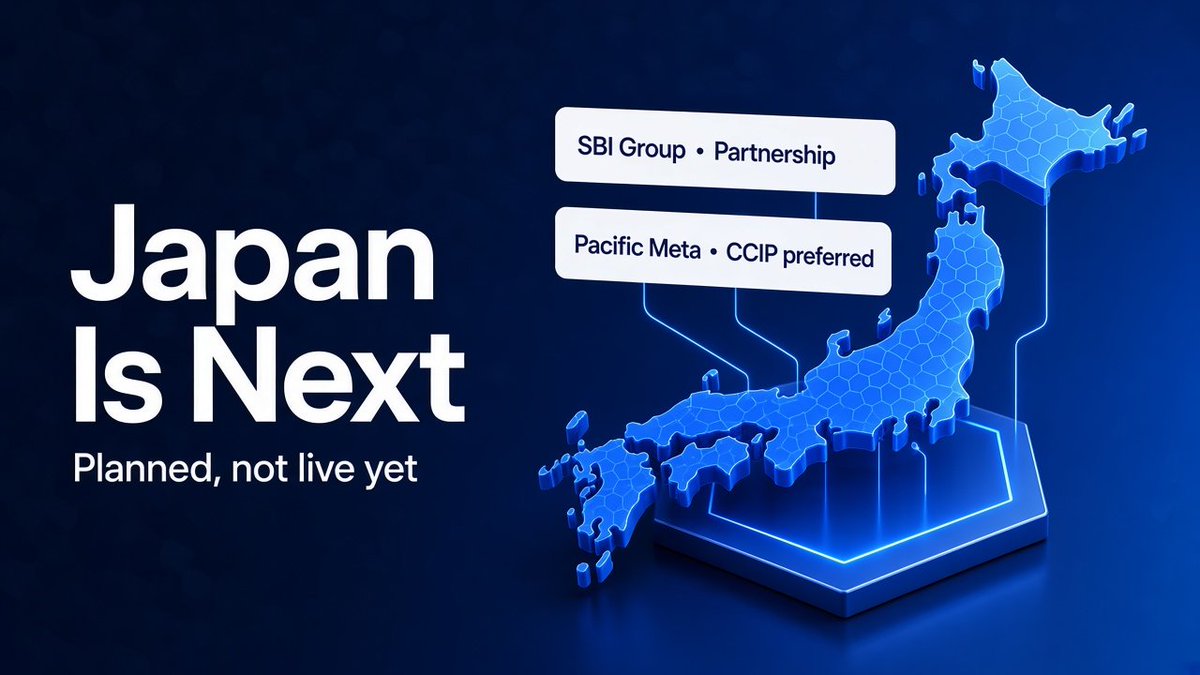
Japan is next on the map.
SBI Group signed a strategic partnership with Chainlink for tokenized assets and cross-border settlement, and Tokyo firm Pacific Meta made CCIP its preferred cross-chain tool. No Japanese bank is live yet, so watch for the first one.