Intersections: stablecoins, emerging markets, credit, and AI. Art of being human + the art of craft.
Double Sharp, founder/ceo; Field Co, ironman / founder
For most work I have ever done, editing is 90% of the effort. AI doesn’t change that.
Instead of “did you make this with AI?” you should really ask “do you stand by every word?”
Real slop is people saying things they don’t mean.
Context: AI built game around Lagos, Nigeria goes mega hype fast.
More context: Africa is the future of youth on planet earth.
Adjust your priors on what the future of culture might look like. This is fun.
5 MILLION PLAYERS IN JUST 9 DAYS!!! 😭🇳🇬👑🔥
WHAT IS HAPPENINGGGG!!! 🚀🚀🚀
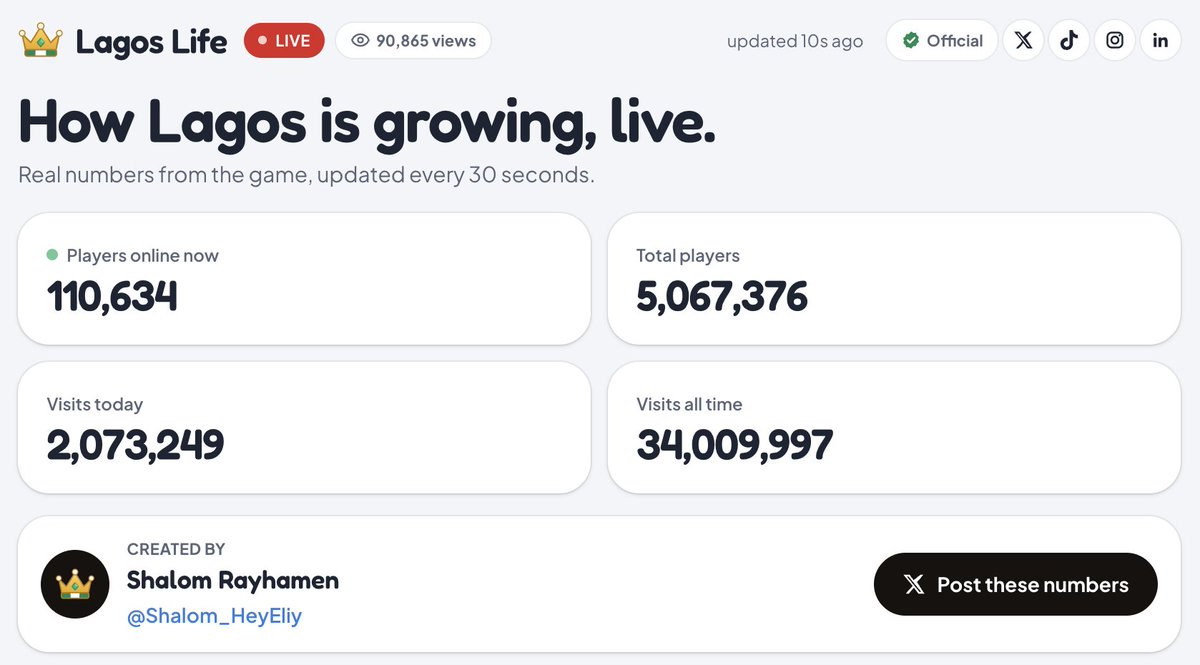
We just crossed 5,000,000 players on Lagos Life!
👑 5M+ players
🔥 110,000+ playing right now
🌍 34 MILLION+ visits
ALL IN JUST 9 DAYS!!!
What started as an idea is becoming something bigger than I ever imagined.
To every single person playing, sharing, building, and making noise about Lagos Life, THANK YOU! ❤️
And the craziest part? WE ARE JUST GETTING STARTED!
5M DOWN. 10M NEXT! 🚀👑🇳🇬
https://t.co/xMHi8ABIY3
#LagosLife
@benbarry@thefieldcompany Ben, I’m blushing. Though—I think the odds that the Field Co is directly making people happy in 50 years with our products is very high and I don’t know how many technology companies I could say that about
Related: political fault lines around things like Florida real estate development / disaster relief / federal emergency funds / lack of state income taxes
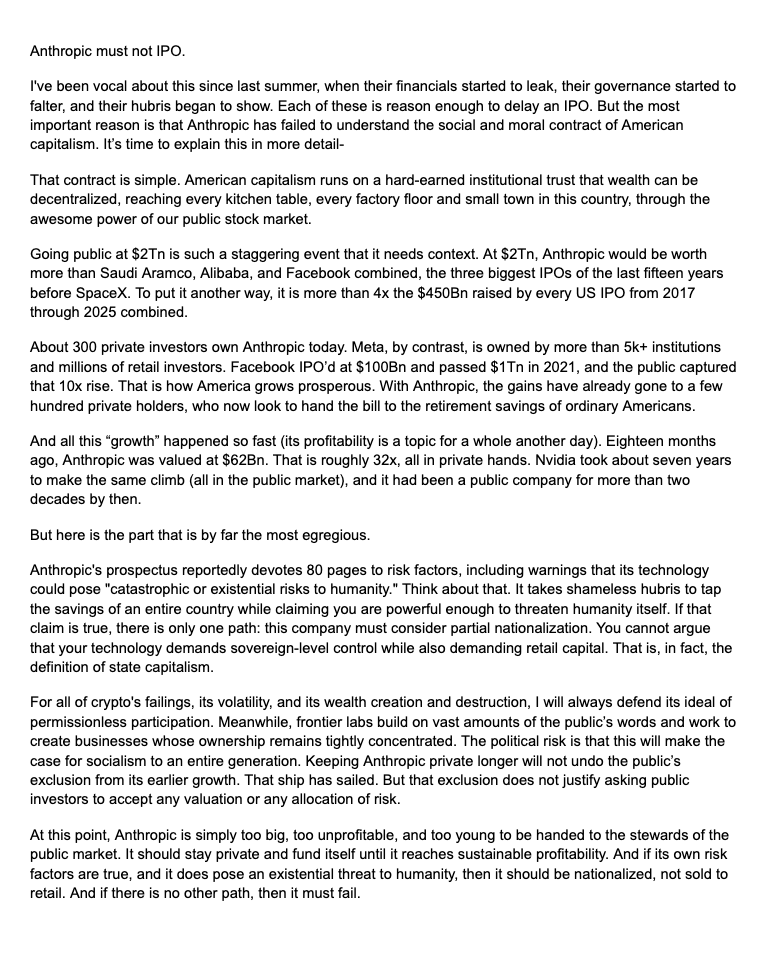
I’ve argued before Anthropic must not IPO on its current metrics. The bottom line is simple-
The might of American capitalism rests on a sacred social contract: if humanity must bear its risk, the public must also share in the prosperity, not just pay for it.
My thoughts below:
Never been to the opera before?
Now’s your chance. We’re giving away 70,000 free tickets to the @MetOpera at the iconic Lincoln Center. Go to https://t.co/LpKzEcL0V5 to enter the lottery. There’s not a bad seat in the house.
The degree to which it is frustratingly not possible to have an adult conversation about the inadequacy of current KYC/AML for the future (agents) and the present (2/3 of the world where the primitives are wrong) cannot be overstated
@lex_node AML/KYC are a big moat, especially for the biggest banks. Their cost of compliance is diffused along millions of clients (and trillions in balance sheet). The big banks will never campaign to eliminate it because it gives an advantage to the smaller ones.
@moseskagan@mwmoedinger@reseedrhett Starting with raising capital is often the path to cosplay building... the other path that leads to capital raising is just being genuinely obsessed with a problem where it's clear that's the path (currently on one of those where I have to sprint to a 10 figure balance sheet)
@moseskagan@mwmoedinger@reseedrhett I think it's always better to start from a place of seeing how it might work with self funding—and then being very real about how capital can be an accelerant and what that means
@kevinyzhang Def true / have noticed same. They also killed personas and accents... and while I get it on reserving compute for actual use, killed some joy for me and pushed me to build some of my own iOS flows for heavily used things
@austincampbell@7777chu@Revolut@inca_digital Who is doing internet native KYC right? What's the right model?
And—what should companies at intersection of emerging markets (bad KYC / no paper records), regulated old institutions (global banks), and onchain services work towards to get it right?
@snyatta Right product here likely needs a data graph on all actors / obligations around a given set of compute / and potentially uses that to create origination platform and a bidding structure to 'stripe' risk appropriately across multiple pools of capital
@snyatta The other huge issue at play here is the interconnectedness of risk—ie, when you talk to folks financing compute now the stories of 3 counterparties all coming at once for the same deal is wild...
@jevgenijs I get the Cloudflare argument. And the infra cost thing is real. But I don’t know that it actually gets at where / how great things online will be made. Unless it’s really only for footing the bill for infra
@jevgenijs Years ago, the COO of HBO wrote an amazing piece on why they couldn’t be on the iTunes Store. Their biz model required subscription to be able to invest in quality. This is likely true of why Substack has sort of worked.
"Bessent’s obsession. The entire funding base of the US government is, at the margin, LEVERED. The buyers are not holding the bonds with their own money.. they are holding them with borrowed money, rolled overnight, against collateral that gets marked to market daily."