Vietnamese artist Thiên Dinh is known for his delicate paper‐art works where he transforms fragile sheet of paper into stunning animal sculptures of fishes, birds and even dragon, which possess stunning sense of realism.
Look at these Betta fish.
Young dancers from the Beijing Dance Academy brought history back to life through their bodies. It was not merely a reenactment of an ancient battle, but a living revival.
Ropes pull the rear dancers. China exceeds everything we do. Let’s join them.
Office life before the invention of AutoCAD and other drafting software.
Prior to the release of AutoCAD in 1982, engineering drawings were all done by hand using different grade pencils, erasers, T-squares and set squares.
Scenes from a Danish kindergarten.
In Denmark, kids are encouraged to get muddy on a regular basis. Getting dirty isn't just fun, it's beneficial. Mud play boosts creativity, strengthens sensory development, and even supports a healthier immune system.
Kaygıyla mücadele ediyorsan bu eseri dinle. Yaklaşık 30 saniye içinde nefes alışın değişmeye başlayacak. Bedeni sakinleştiren şey ise notaların arasındaki sessizlik.
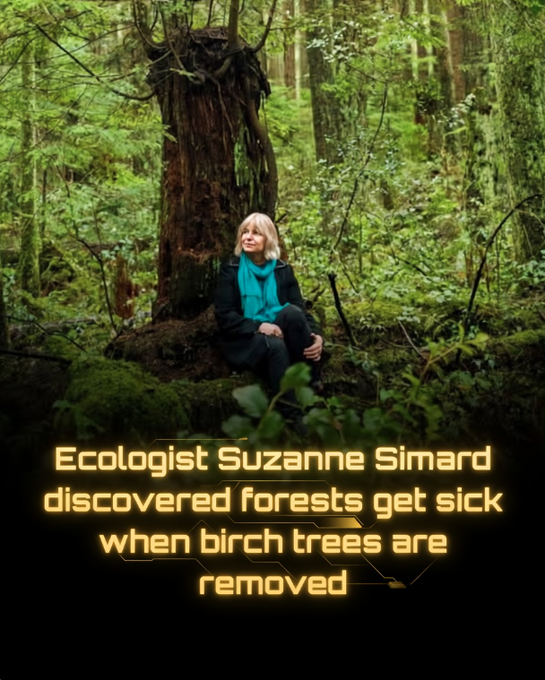
In the 1990s, Canadian ecologist Suzanne Simard made a groundbreaking discovery that challenged everything we thought we knew about how forests work. While studying managed forests in British Columbia, she noticed something puzzling: when birch trees were removed to promote the growth of valuable Douglas firs, the firs did not flourish as expected, they actually struggled and grew more slowly.
Determined to understand why, Simard traced the movement of nutrients using radioactive carbon isotopes. What she found was astonishing. Trees were actively sharing resources through vast underground fungal networks known as mycorrhizae. These delicate, thread-like fungi connect the roots of different trees across the forest floor, forming a complex web that allows the exchange of carbon, water, nutrients, and even chemical signals, sometimes between entirely different species.
She discovered that older, larger trees often serve as central "hubs" or "mother trees," supporting younger saplings by redistributing vital resources and helping the entire ecosystem remain resilient. When these key trees are removed, the underground network weakens, and the health of the remaining forest declines.
Simard’s research overturned the traditional Darwinian view of forests as battlegrounds of ruthless competition. Instead, she revealed a far more sophisticated reality: forests operate as highly cooperative systems where trees communicate, support one another, and even warn neighboring trees about threats like drought, disease, or insect attacks.
What appears to the human eye as a silent, still forest is, in truth, a vibrant, interconnected living network, built not on isolation and rivalry, but on deep connection and mutual aid.
Reminder to go touch grass
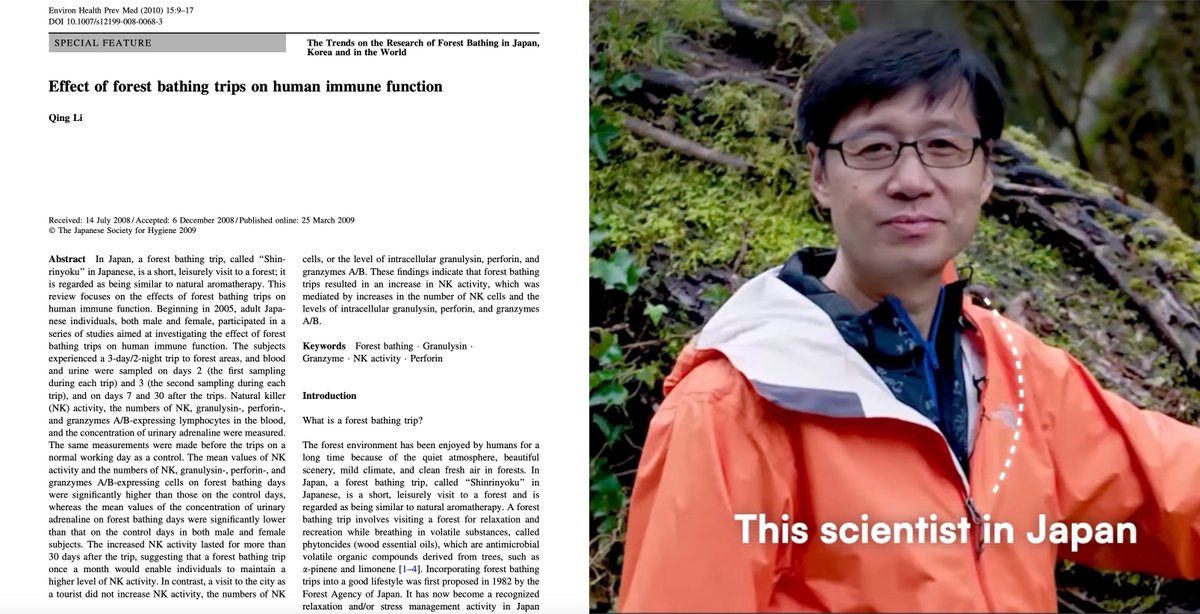
A scientist in Japan demonstrated that the air inside a forest strengthens your immune system for a full month
The study is incredibly fascinating:
Qing Li, an immunologist at Nippon Medical School in Tokyo, took 12 men on a 3-day forest trip. These were slow walks with no breathing exercises and no set route.
Then he tested their blood and found a surge in natural killer cells -- the immune cells your body uses to fight cancer and virus-infected cells.
Remarkably, the effect didn't fade when they went home, it was still measurable 30 days later.
A control group that walked the same distance through a city showed no change at all.
Pine, cedar, and cypress trees release compounds called phytoncides to defend themselves from insects and bacteria. You breathe them in, and Li believes they switch your immune cells into high gear.
He estimates one forest walk a month may be enough to keep those cells elevated all year.
The best medicine might not even need a prescription -- just a walk among the trees.