Neuroscience in Education (University of Cambridge). Neural Oscillatory Entrainment & Language Acquisition - from 8 weeks to 2.5 years - RECRUITMENT FINISHED.
Another day, another @CNEBabyLab preprint. This one describes infants' neural power, phase coherence, and phase angle in response to visual speech in the form of a (silent) talking head:
https://t.co/qHEsuQjR7w
#NSPeeps at #SfN21 want to see whether the @CNEBabyLab 's longitudinal infant EEG study measuring cortical tracking and phase amplitude coupling to sung speech in the 1st year predicted later language performance? Come to Poster B11, Nov. 13, 11:00am, Pres Num 108.34, @SfNtweets
This afternoon! If you're at #APAN2022 come talk to @AdamAttaheri about infant neural responses to speech and their implications for language development
At @apanhearing#APAN2022? Come see what I have been up to for the last 6 years @CNEBabyLab.
Poster 66, Cortical tracking and phase amplitude coupling to sung speech predicts language performance; data from infants and adults. 11/11 4:00PM.
If not, see you @SfNtweets#SfN22
At @apanhearing#APAN2022? Come see what I have been up to for the last 6 years @CNEBabyLab.
Poster 66, Cortical tracking and phase amplitude coupling to sung speech predicts language performance; data from infants and adults. 11/11 4:00PM.
If not, see you @SfNtweets#SfN22
I have a fully funded ESRC doctoral studentship available for October 2023 start. The PhD project is interdisciplinary across developmental cognitive science (infant learning) and neuroimaging (high-density fNIRS) co-supervised by @gemmabale 1/4
1/n I am really glad to share this very exciting finding on speech perception across the first year of life! This is the first direct measurement of phonetic encoding in infants in ecologically-valid settings (nursery-rhymes listening). Preprint: https://t.co/VwB3dDr1wL
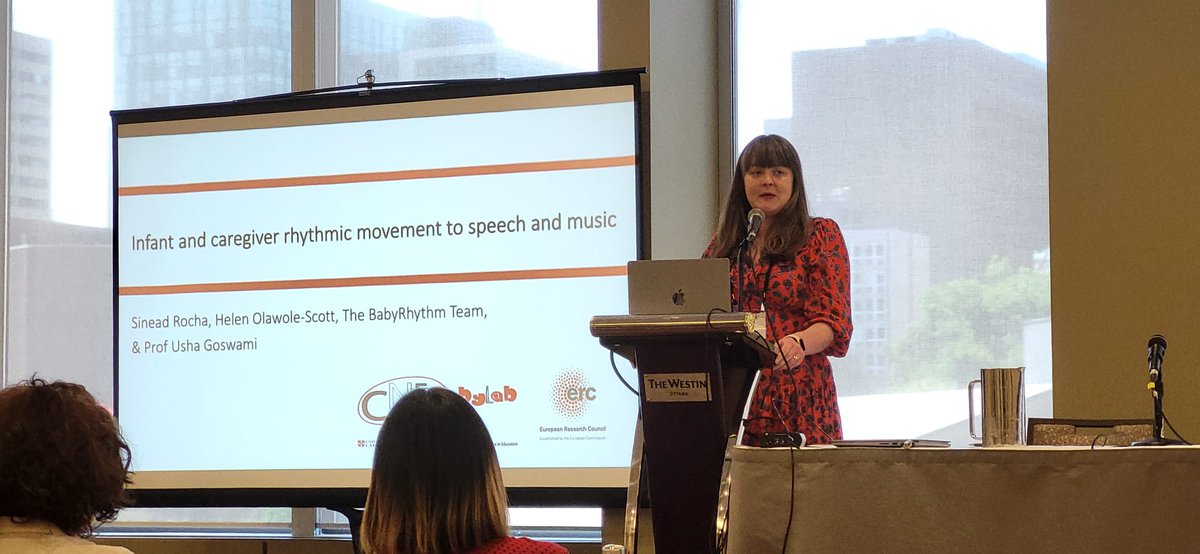
Big BabyRhythm day at #ICIS2022 as @RochaSinead reported on our infant/parent rhythm and language paradigms and @nichoisa spoke about our 2Hz rhythmic stimulation paradigm.
The New Methods in Infant Social Neuroscience workshop at #ICIS2022 was brilliant. Our team loved sharing our methods & hearing about everyone else's approaches.
At 9:45 on Sat 9th @nichoisa will present on infant cortical phase tracking and language acquisition in the Neuroscience II session, and at 11:45 @RochaSinead will present on our parent & infant mocap data in the Baby's Got Rhythm symposium.
The BabyRhythm team are travelling to @Infantstudies#ICIS2022. First up, @AdamAttaheri and @nichoisa will present on some of our EEG analyses at the New Methods in Infant Social Neuroscience workshop tomorrow (Thurs).
We have a new preprint, looking at the links between some of our core EEG measures of rhythm, and later language development. Check it out and keep your eyes peeled for more work linking brain and language over the coming months!
🚨🥁👶 It's the new preprint klaxon, repeating at a steady 2Hz!👶🥁🚨 We find that the preferred phase of infants' neural responses to simple, repetitive syllabic and drumbeat stimuli in infancy is related to their language performance at 12 to 24 months. https://t.co/CHMicHFnvE
Our work on infants' tracking of 2Hz stimuli has been published in the BUCLD proceedings: https://t.co/bakJHRpuMy
Find the pdf here: https://t.co/ts4irestCb
And stay tuned for upcoming preprints on 2Hz tracking, preferred phase and language acquisition!
Some final highlights from #WILD2022 before I forget! Great talk by @Dean_DSouza1, who really forced me to consider how different learning strategies might be most effective in environments of different complexities. (1/6)
A sneak peek at data I presented at #WILD2022 with @CNEBabyLab. First, we find an increase in EEG power at 2Hz in response to stimuli played... at 2Hz! Nothing unexpected. For younger babies, the peak is less prominent, less 2Hz-specific, and less distributed across the scalp.
Our research assistants Maria Alfaro e Oliveira and Carmel Brough presenting posters on their work examining BabyRhythm language outcome measures in depth.