Super detailed hands-on review. AI agents are popping up everywhere, but fully free and barrier-free ones like Zhipu’s AutoGLM are still rare. It’s a powerful browser agent that actively searches and retrieves content, like a lower-cost Manus with broader access.
FUNNIEST piece I’ve read on Chinese “tech”: the rise of ultra-short, vertical dramas in the US:
1/"The first wave of short dramas to hit the U.S. had the vibe of old-school Chinese web romances from 10+ years ago ... light sarcasm, face-slapping, water-throwing, and kneeling"
China is scaling their humanoid robot supply chains.
Costs are coming down rapidly.
AFAICT, the obstacles to adoption are haptics (ability to touch and hold) and viable use cases, not costs.
We think of robots as working in factories or warehouses but the homes of older people with high labor cost (and low immigration) countries seem like a better fit.
In a factory, if a humanoid robot can do it, a traditional specialized machine probably can too and traditional machines are much more efficient than both humans and humanoid robots for repetitive stable tasks. As an example, think of a printer. Humans and humanoid robots can both hand draw, but printers are more efficient than both.
However, in the homes of high labor cost countries there are plenty of older people who can’t do things in their own homes without the assistance of another person. Lifting something up, reaching for something, bringing something up the stairs etc. They could sporadically be using robots for that with speech-to-action inputs. This is a better use case for humanoid robots, which are safer than trusting another person with an old person.
This market will be like drones, even more than EVs, completely dominated by China.
From today’s current chaotic politics to advances in self driving EVs, Bitcoin, AI, drones, and soon humanoid robots, we live in exciting but uncertain times.
Life will be very different in 10 years.
The Chinese site for Manus still isn’t working—just now with more emphasis on Tongyi Qianwen’s backing. Hopefully Alibaba’s endorsement doesn’t end up backfiring this time🤔
Also, remember how Manus’s Monica was paid-only overseas, but then the China version went fully free? Maybe they’re doing the same playbook again? #Manus
$39 and $199 a month—with usage limits too. Not sure if people think it's worth it... But still way cheaper than those $7k invite codes from before lol
Three weeks ago we launched Manus in closed beta and we've been humbled by the love for Manus. Today, we want to share some updates about our beta testing with the Manus community.
1. Manus mobile app: https://t.co/vSiGz7f63K
2. Longer context and better multimodal capabilities
3. Manus will be powered by Claude 3.7 for all tasks (no fallback to 3.5 - big thanks to @AnthropicAI@googlecloud@awscloud)
4. A more stable sandbox (big thanks to @e2b)
5. Premium subscription plan beta test while maintaining limited free access
While we're working hard around the clock to scale our infrastructure and accommodate everyone, we've had to temporarily limit access to Manus during our this development phase. We are also working on optimizing our current usage rates to provide better value for our users.
We're incredibly grateful for your patience and continuous feedback during this beta phase which allows us to continue building a better Manus for everyone.❤️
Very inspiring. When Gemini 2.0 Flash dropped a few days ago, I was chatting with a friend about the same thing — why is such a useful model (especially when paired with NotebookLM and other tools) getting so little attention online?
One dev friend said, “Well, Google just sucks at marketing. Their products always feel unfinished.” But that got me thinking — is it really about marketing? Or is it something deeper? It’s not like Google can’t find good product managers...😳
In contrast, Chinese tech companies never slack off when it comes to refining UX and boosting efficiency. Their LLMs might not match US models in raw capability (yet), but their consumer-facing applications are iterating fast.
Was talking to a friend about this and we landed on a wildly overgeneralized (but kind of accurate?) take on US vs. Chinese entrepreneurs:
US: Spot a successful, profitable business? Great, now go build something inspired but different. Adjacent, or maybe orthogonal lol but God forbid you do the exact same thing.
China: See a business that works? Perfect, do exactly that, just faster, cheaper, better. Doesn’t matter what the business is, someone will clone it and undercut you before lunch lol
I think a lot of this comes down to how capital works. In the U.S., investors are like, “Okay, cool, but what’s your unique angle?” In China, it’s more like, “Why are you doing something new? Just take this proven model and do it better.” And even if you don’t get investment for your idea this is just baked into how you think about money
Obviously, this is a sweeping generalization. No two businesses are ever truly identical, and China has produced plenty of wild innovation. But broadly speaking these are the vibes
Wow, I didn’t even realize how important context window size is for coding until you mentioned it.
Actually, one key update in V3-0324 was the context length upgrade — from 64k to 128k — but it’s still quite far from Claude 3.7’s 200k max. So maybe it’s still not the coding winner just yet...
By the way, have you tried any other Chinese LLMs besides DeepSeek? Would love to hear how you’d rate them.🥺
DeepSeek V3 gets a “minor” version bump — but with major gains in both model size (671B → 685B) and performance.
Looks like DeepSeek R2 might be on the way.⚡️
#DeepSeek#ChinaAI
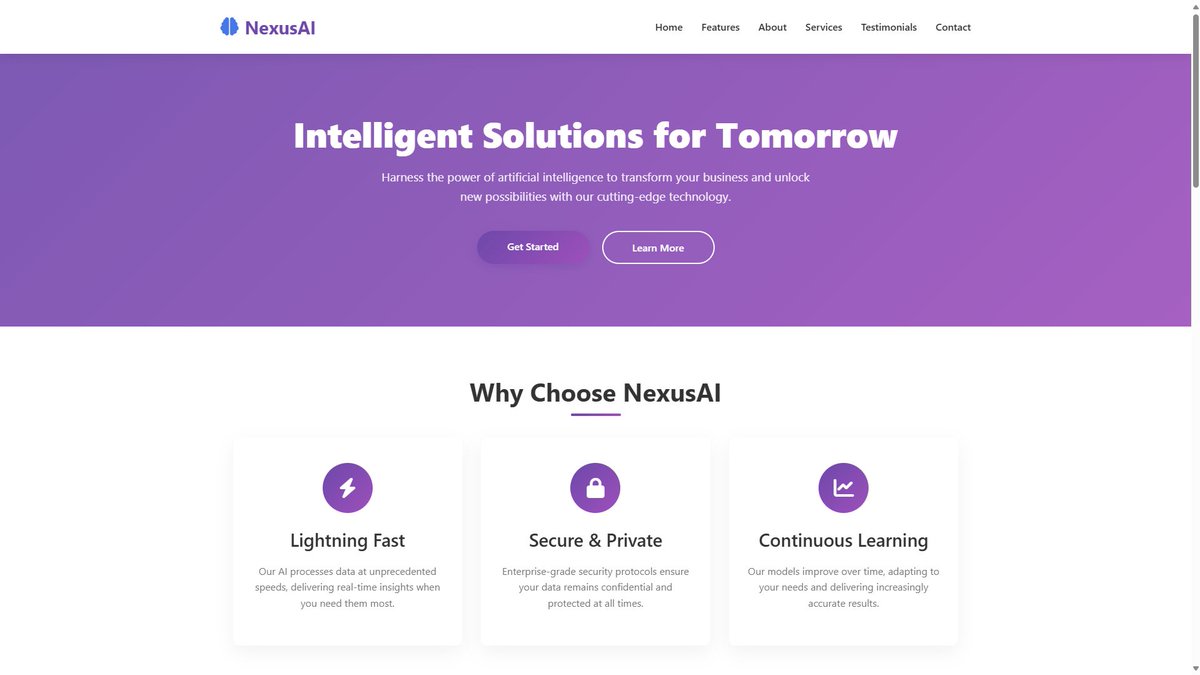
Anthropic and OpenAI are in trouble. DeepSeek V3 0324 update, which just dropped, is really cooking. It creates beautiful HTML5, CSS and front ends easily & for free. Here is the prompt:
Create a great-looking responsive front page for AI company. Include everything in one HTML5 file.
See screen shots for the mind-blowing result. Yes, all that images, including user stories and their faces and everything was done with that one prompt.
DeepSeek V3 0324 is the best non-reasoning model from DeepSeek and generally better suited for creative writing tasks, but now also to make HTML5 + CSS + front ends than R1. The resulting code for the above prompt was 958 lines in total, but it actually implemented an interactive web site, including all the images. And the result is mobile friendly as well.
The model is available for download, via API and via chat dot deepseek dot com.
@KuittinenPetri Yes, honestly they could’ve just called it V3.5, haha.
The improvement in coding ability is definitely the most noticeable.
I’ve seen quite a few users say it’s now on par with Claude 3.7 when it comes to programming — do you feel the same?
Alibaba just released Qwen2.5-VL-32B-Instruct on Hugging Face
further optimize this VLM with reinforcement learning and have found significant improvements in human preference and also mathematical reasoning
🚨 Xiaohongshu (aka #RedNote , often dubbed "China’s Instagram") just launched its AI search assistant: Diandian AI. What does this mean?
Back in early March, like many other Chinese internet companies, #Xiaohongshu announced it would integrate DeepSeek. Then… silence. But a few hours ago, Diandian officially went live — and it’s a big step forward.
Now users can @点点AI in the comments or enter questions in the chatbox. Diandian will search relevant Xiaohongshu posts and generate a thoughtful, consolidated answer using its “deep thinking” feature. In other words, real AI-powered life search is here.
Unlike general-purpose AI search tools, Diandian focuses on lifestyle content — think travel tips, food recs, everyday dilemmas — which fits perfectly with Xiaohongshu’s UGC-driven, life-sharing DNA.
As AI reshapes how we search, platforms are racing to embed LLMs directly into their ecosystems. Instead of manually sifting through posts, users now get curated answers in seconds. LLMs get richer content sources; super apps get smarter UX.
With #Tencent (WeChat) and #ByteDance (Douyin) already in the game, Xiaohongshu is officially joining the AI race. Can it surprise us next? 👀
See: https://t.co/uDjJLBnHB1
#AISearch #Chinatech #NextGenAI
NO, CHINA IS NOT AHEAD OF THE US IN AI
A myth is floating around that China is ahead of the US in AI. No, it's not. Here are the best models
Reasoner - o1
Coder - Sonnet 3.7
Instruct model - GPT 4.5
OCR - Gemini Flash
Real-Time - Grok 3
Video - Veo
Image - Flux Ultra
ZERO OF THESE MODELS ARE FROM CHINA. Almost ALL OF THEM are from the US
Sure, China has good open-source models, but they are used less than 1% in the real world.
DeepSeek’s breakout proves the power of young AI teams. Now Huawei follows suit—naming 30-something Wang Yunhe as head of Noah’s Ark Lab. As China’s AI race accelerates, a generational shift is underway, and Big Tech is betting on youth to lead the charge. 🔥 #AI#Huawei
ByteDance + Tsinghua’s DAPO just redefined what’s possible in LLM reasoning: 50 AIME points (vs DeepSeek-R1’s 47), using half the training steps—and it’s fully open-source. A bold strike at RL’s core pain points, with real math to back it up. 🚀 #ByteDance#DeepSeek#DAPO
ByteDance’s LLM team held an internal meeting where co-leaders Zhu Wenjia and Wu Yonghui, from Google, reaffirmed its goal to “explore the limit of intelligence” and vowed to “push forward open source”
https://t.co/16T0nWn9uL
There are often 2 big red flags for bad China analysis: framing "China" as this all-powerful entity behind all the events that occur in China, and attributing to this "China" the same type of zero-sum mentality as the U.S.
This post has both.
The notion that "China" is behind the popularity of Deepseek with a calculated strategy around the spread of open source in order to bankrupt Western tech companies is both reductive and disconnected from reality.
By all accounts, Chinese authorities were just as surprised as anyone else by Deepseek's popularity which came almost completely out of the blue, even in China. Their subsequent enthusiasm for open source AI isn't some mastermind strategy to destroy the West – the obvious primary explanation is that it's because open source is what the market wants, as evidenced by Deepseek's success.
And the framing of "China is trying to weaken us with open source" is legitimately hilarious. For the past couple of years, we've heard endless unhinged declarations from U.S. officials and AI entrepreneurs that AI is an "arms race" against China, that AI will finally allow the U.S. to "contain China," and similar rhetoric.
And what does "China" do in this supposed "arms race"? Literally offer its most advanced "arms" for free to the opposite camp – which is exactly what open source is – so everyone can fully benefit.
You'd think this would be seen as a gesture of goodwill or appeasement, but no. In its infinite paranoia and China hysteria, some Americans somehow manages to see even this as an affront and existential threat.
At heart, the reason why so much value was temporarily lost in the stock market (although it's largely recovered since) is because the U.S. wanted AI to be an arms race, and this narrative got undermined by Deepseek's release. Don't blame China for denying the tech war that the U.S. was hoping for!
Finally, portraying China as a zero-sum player is fundamentally wrong – especially in a post that simultaneously acknowledges China is a massive exporter while claiming they somehow want to bankrupt their customers.
If China actually wanted to bankrupt U.S. tech companies, maybe they'd start with those they have direct leverage on, companies like Apple, Microsoft or Tesla who have a massive presence in China. Instead, we see China continuing mutually beneficial relationships with these firms because – surprise – the world isn't actually a zero-sum game where one side must lose for the other to win.
Between China and the U.S., last I check the only one who's actively trying to bankrupt or at the very least neutralize the other's tech companies isn't China. The CHIPS Act, entity lists, the TikTok bans, Huawei restriction, 100% tariffs on Chinese EVs – these are all U.S. policies.
All in all, at heart what's really unsettling the West isn't that China is playing unfairly, but rather that it's a genuine competitor in a game where the U.S. assumed permanent dominance.
The panic isn't therefore about Chinese strategies being uniquely predatory – it's giving out its tech for free without any condition for crying out loud - it's about the unfamiliar and new feeling of genuine competition.
As such, this post's "analysis" reads less like an objective assessment of Chinese tech strategy and more like an attempt to rationalize why we shouldn't welcome technological advancement if it comes from the "wrong" country.
That’s where the real dividends of AI lie—not in a handful of elite labs, but in broad-based access, utility, and local adaptation. The fusion of open-source AI and open hardware enables that future.
Perhaps this can be considered alongside a report from earlier this month: Reuters revealed that China is preparing to issue guidance encouraging nationwide adoption of open-source #RISC_V chips.
RISC-V is fully open-source and not subject to sanctions. That makes it a strategic foundation for building an independent and self-sustaining ecosystem across chip design, manufacturing, operating systems, and software. It's not just about replacing sanctioned technologies—it's about systemically reducing dependency. Rather than trying to forever catch up within a closed, foreign-controlled system, RISC-V opens up a fundamentally different pathway.
That brings us to a similar question when it comes to AI: What is the real goal of developing AI in China? Is it to build a model that merely outperforms ChatGPT, but remains closed-source and controlled? #OpenSourceAI #ChinaTech #ChinaAI #Geotech
I’m super confused by all the confusion around Chinese open source. Besides the official govt stances since 2017 that I quote below, private companies like Alibaba have been encouraging open source internally since 2011. China doesn’t want tech monopolies, it wants tech to enable growth across society
China’s Policy on Open Source
In 2019, Huaon Intelligence Network published an article titled “The Development Status of China’s Open Source Software Industry in 2018: A Positive Outlook for Overall Growth”, which offered a detailed explanation of domestic open source policies. Below are selected excerpts:
In 2017, the Chinese government further deepened its understanding of open source and continued to strengthen policy support for the development of open source software. The Information Industry Development Guidelines explicitly stated:
“Support enterprises in forming alliances with universities, research institutions, and others to build industry-academia-research-application ecosystems in key areas, and actively participate in and establish open source communities.”
“Support open source and open development models,” with a particular focus on promoting the R&D and application of foundational software products such as cloud operating systems.
In the Software and Information Technology Services Development Plan (2016–2020), it was stated:
“Leverage open source communities to support and drive innovation, strengthen the application of open source technological achievements in innovation, and build an open, collaborative, and international open source ecosystem that is conducive to innovation.”
“Support the development of makerspaces, open source communities, and other new forms of collaborative innovation spaces.”
The plan also called for implementing the ‘Soul of Software’ initiative, with a key focus on “building an open source, open, and innovative technology product ecosystem.”
⸻
China’s Open Source Planning
On March 12, 2021, Xinhua News Agency released the full text of the 14th Five-Year Plan for National Economic and Social Development and the Long-Range Objectives Through the Year 2035, where “open source” was explicitly included for the first time in a national five-year plan. Relevant excerpts are as follows:
“Focus on critical areas such as high-end chips, operating systems, key algorithms for artificial intelligence, and sensors. Accelerate breakthroughs in basic theories, foundational algorithms, and equipment materials, along with their iterative application.”
“Strengthen the integrated R&D of general-purpose processors, cloud computing systems, and core software technologies.”
“Advance the strategic layout of cutting-edge technologies such as quantum computing, quantum communication, neural chips, and DNA storage. Promote cross-disciplinary innovation between information science and foundational disciplines like life sciences and materials science.”
“Support the development of innovation consortia such as digital technology open source communities, improve the intellectual property and legal systems related to open source, and encourage enterprises to open up software source code, hardware designs, and application services.”
Similarly, following the recent popularity of open-source models like DeepSeek, many state-owned enterprises have been urged to build up computing power. Maybe this isn’t just about competition.
In a fully open-source AI ecosystem, countless IoT devices can be integrated with low-cost access to high-quality AI capabilities. That kind of accessibility can dramatically boost efficiency across industries. Whether it's logistics, smart manufacturing, healthcare, or public infrastructure, AI + IoT under an open framework allows for scalable, inclusive technological deployment.