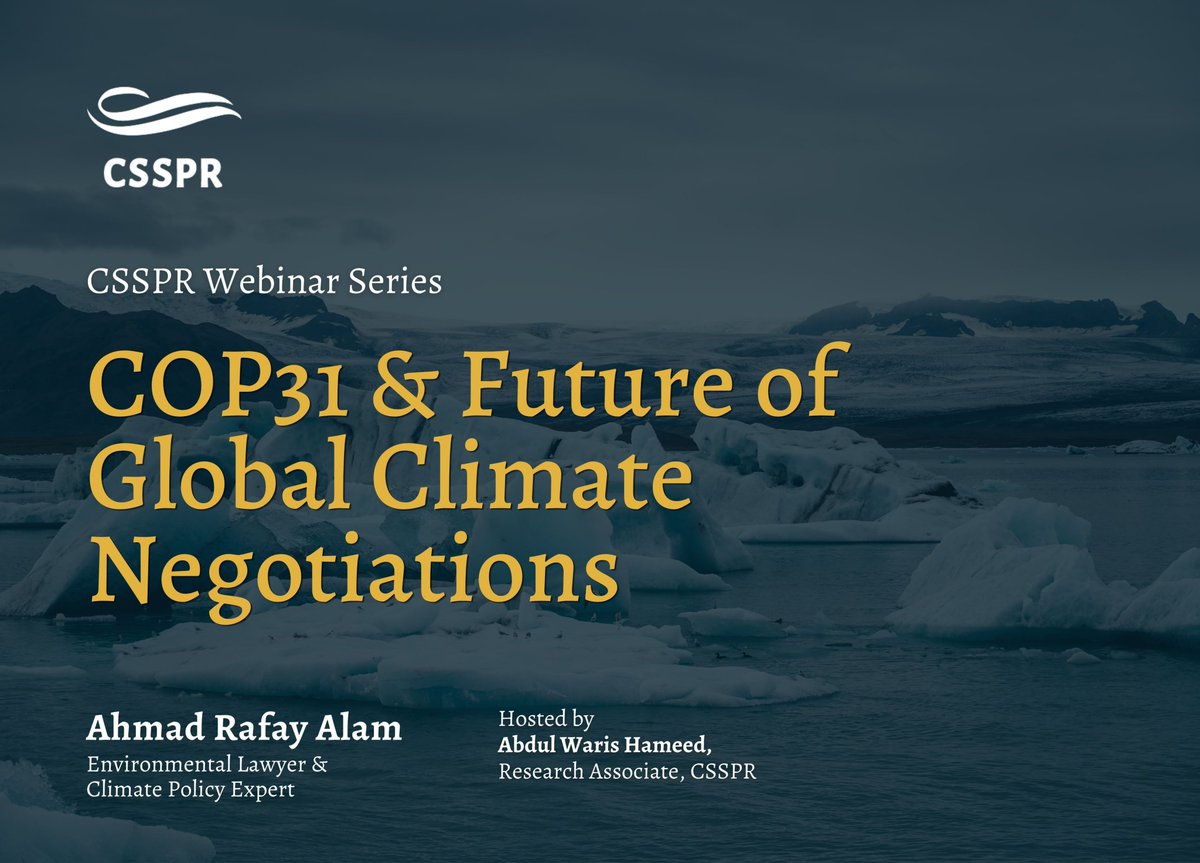
In the latest episode of the CSSPR Webinar Series, @A_WarisHameed hosted @rafay_alam for a conversation on the failure of COP31 and what it informs us about the state of climate negotiations.
https://t.co/RUFW0AU1dn
The latest Pakistan Risk, Incident, and Security Monitor (PRISM) SITREP gives a brief overview of terror-related incidents across Pakistan between October 16 and 31, 2026.
Author: @MoazamAliUmrani ; Editor: @mubasharizvi.
In the upcoming episode of the CSSPR Webina Series, @A_WarisHameed , Research Associate, CSSPR, will host @rafay_alam for a conversation on COP31 and what lies ahead for climate negotiations?
In a new episode of the CSSPR Webinar Series, @syedalizia1992 , Deputy Director, CSSPR, hosted Prof. @ProfSAzodi for a discussion on his new book entitled "Iran and the Bomb: The United States, Iran, and the Nuclear Question."
https://t.co/G65AuRxPAV
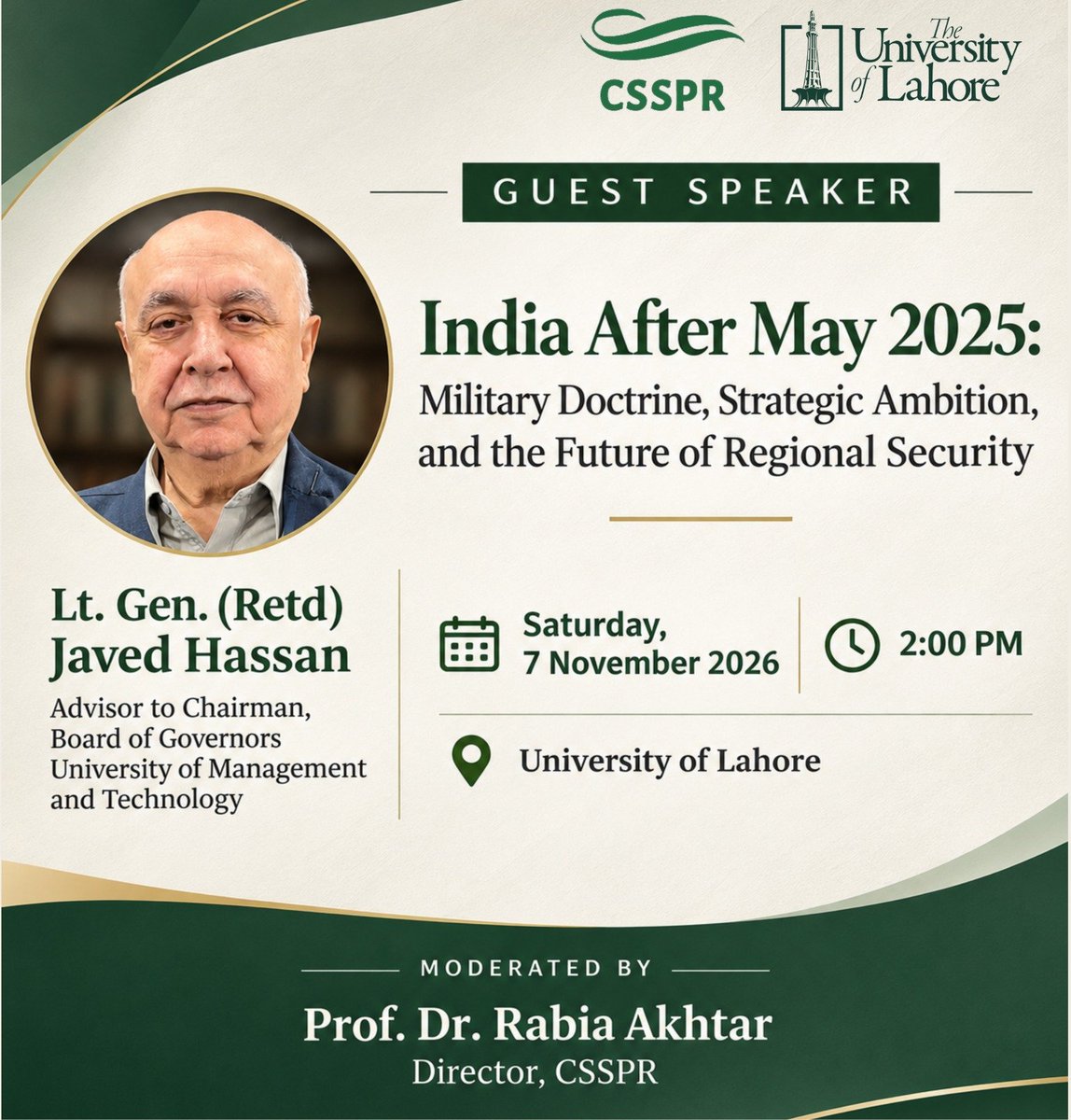
On November 7, CSSPR will host Lt.Gen. Javed (Retd), Advisor to the Chairman of the University of Management and Technology, for a discussion titled "India After May 2025: Military Doctrine, Strategic Ambition, and the Future of Regional Security."
Pakistan Risk, Incident, and Security Monitor's (PRISM) latest SITREP, authored by @Muhammmadsulem1 and edited by @mubasharizvi , surveys terrorist incidents all over Pakistan from October 1 until October 15, 2026.
Safdar Ali,@ilmmomcr7 Research Assistant, CSSPR, writes about the strategic instability and escalatory risks surrounding the weaponization of space, and how recent U.S. disclosures regarding on-orbit weapons heightens the risk of miscalculation.
https://t.co/9ZExiTplIX
In the 99th episode of Infocus with Ejaz Haider,@ejazhaider held a conversation with Dr.@reidpauly on why powerful states so often fail to coerce weaker states and how aggressive tactics and the "assurance delimma "push weaker adversaries toward defiance.
https://t.co/m9Wt7vdmPN
Noor Fatima (@fatimawariss ), Research Assistant, CSSPR, writes on the predicament Armenia finds itself in due to its in-betweeness.
https://t.co/FKf4FRIPu4
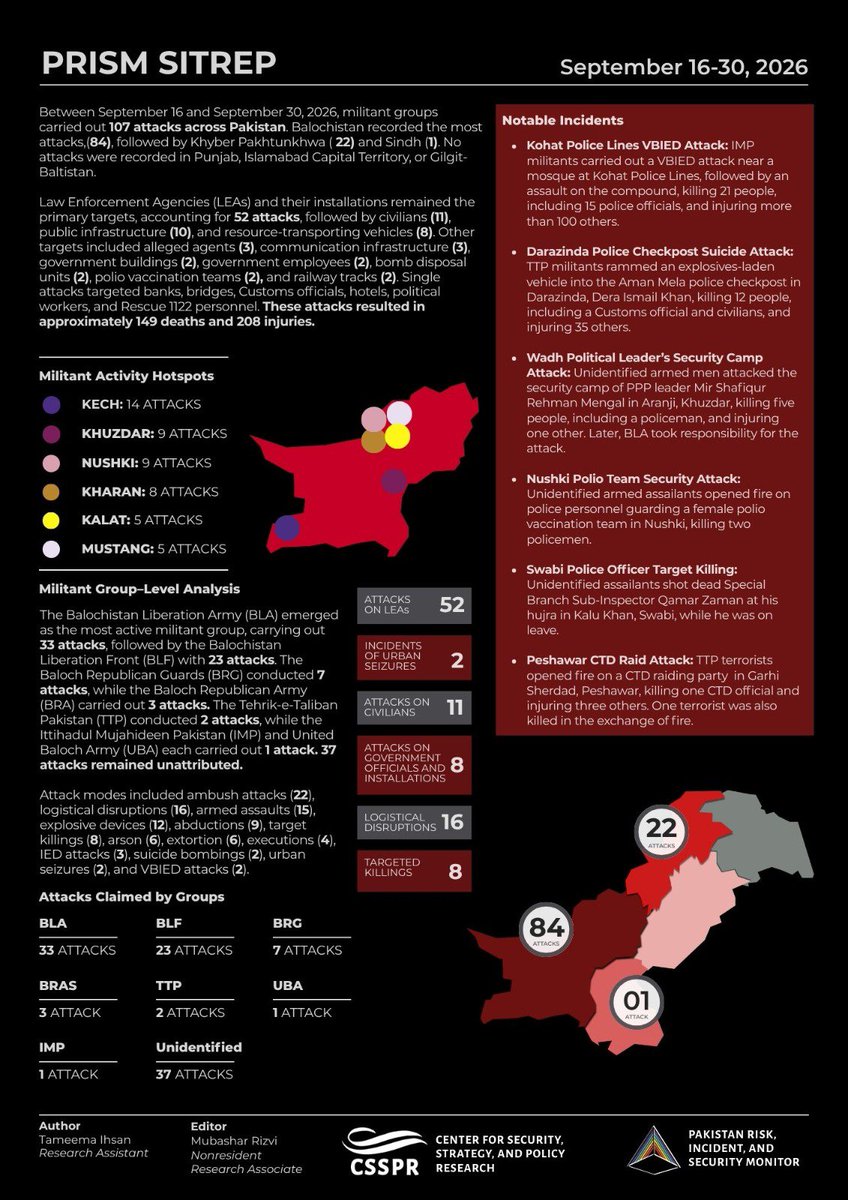
PRISM's latest SITREP,authored by Tameema Ihsan @tameemaihsan and edited by Mubashar Rizvi @mubasharizvi , surveys terrorist incidents across Pakistan from September 16 until September 30, 2026.
Tameema Ihsan(@tameemaihsan) writes about the changing contours of female militancy in Pakistan and gives policy recommendations to curtail the deleterious consequences.
https://t.co/zfxIlJFRc1
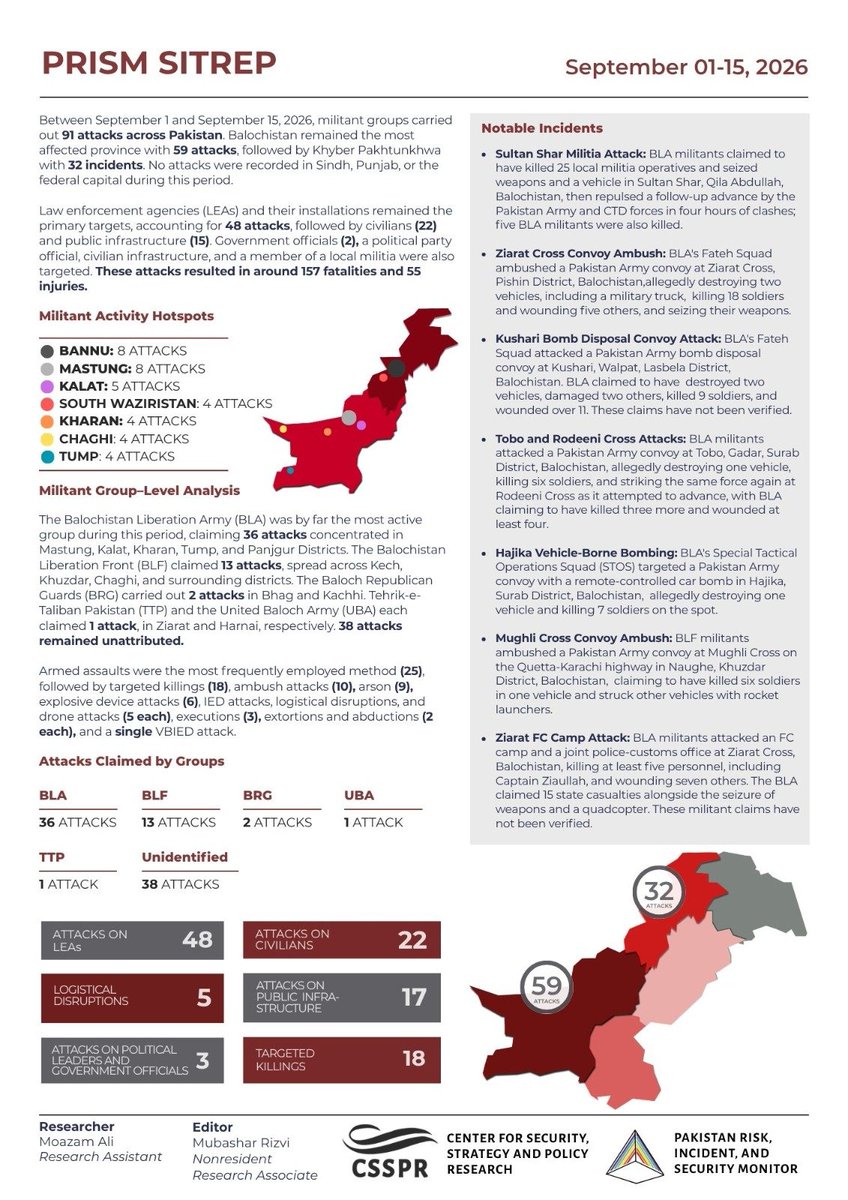
The latest Pakistan Risk, Incident, and Security Monitor (PRISM) SITREP surveys terror-related incidents across Pakistan from September 1 until September 15, 2026.
Author: @MoazamAliUmrani
Editor: Mubashar Rizvi
Zahra Fatima (@ZahraFatima166 ), Research Assistant, CSSPR, writes about the structural factors that militate against applying the Korean War model to the Ukraine War.
https://t.co/QX8EpkWXN3
I'm pleased to share my first publication for @CSSPR_UOL.The piece examines why the Korean Armistice cannot serve as a model for ending the war in Ukraine, citing differences in strategic context and nature of the battlefield.
Read here:https://t.co/asfAdJQHKF
Abeer Falak(@AbeerFalak42324 ) and Noor Fatima (@fatimawariss) write on the diminishing coercive utility of Western sanctions on Russia and Iran.
https://t.co/XOFIEpkXCT
Pakistan needs to take charge of, and set the narrative on, the Makkah Alliance, argues @Rabs_AA ,adding that it must continue to facilitate diplomacy and dialogue.
Convergence of national interest is the first element of a defense agreement, argues @AirCommodoreR ,adding that the second and third are the commonality of threats and credibility, respectively.
@AirCommodoreR Turkiye has a lot of exposure to Western technologies, notes @AirCommodoreR. Pakistan has a battle-hardened military, and Saudi Arabia has the financial muscle.