@SecretoDefi Estoy sobrecolateralizado respecto al préstamo pedido en hype para estar próximo a la liquidación tendría que valer hype más de 100$ y veo dificil que hype suba y que eth se quede rezagado, pero gracias por la info estaré al pendiente
The best part? Have you ever wondered why there’s a QNT Sepolia testnet faucet? Gateway operators will need to scoop up some test QNT to stake in their test gateways. Plenty of information about how staking and payments are handled will be recorded in Sepolia blocks. It’s not just the docs that will teach us; the transactions on this testnet, and later on mainnet, will show us how the engine really works.
1 | Patented foundation
Quant’s patents Secure Multi-Distributed Ledger System (EP 4002180) and Blockchain Communications & Ordering (US 11842335) describe an off-chain controller that monitors many blockchains, filters forks, time-stamps every event with one global clock and anchors a single Merkle-root hash back on chain.
2 | What Overledger is
The controller is live as Overledger. A single HTTPS/JSON API faces the user; on the south side sits a registry of gateways that read blocks, submit transactions or call smart-contracts on each connected ledger.
3 | Gateway design
Gateways follow the SATP draft in ISO TC 307. Operators bring their own connector and hardware keys, pass KYC and run TLS. One connector per chain is enough to join a new network.
4 | Ordering engine
Overledger’s patented engine builds a verification set, assigns a canonical sequence number to every transaction and stores batches in an off-chain hash chain. A batch hash is a few hundred bytes, so anchoring it on Ethereum or Polygon costs minimal gas.
5 | Audit immutability
Anyone can fetch a raw batch from the gateway cluster, recompute the root and confirm it matches the on-chain value. Cross-chain automation gains a public, tamper-proof audit trail.
6 | Enter Fusion
Overledger Fusion elevates the idea to a multi-chain roll-up. Permissioned Fusion nodes execute thousands of cross-chain calls, compress them into one Merkle root and ask Overledger to anchor that root on every Layer 1 involved.
7 | Roll-up flow
① Gateway streams a transaction to a Fusion node.
② Each node calculates a Merkle root.
③ Nodes run a consensus vote (patent speaks of super-majority signatures, implying a BFT style such as PBFT/HotStuff).
④ Overledger posts the agreed root to each Layer 1. Latency is sub-second; finality equals the target chain’s block time.
8 | Native-asset model
Fusion changes only ordering and atomicity. Tokens remain on their home chains, so a USDC swap ETH→Polygon is one composite event with no wrapped assets or manual bridges.
9 | User-side fees
A user opens a Treasury channel by locking QNT. The channel tracks deposit_u (fees) and deposit_d (dispute bond). Every API call burns a milli-QNT voucher off-chain. Users never need ETH or MATIC.
10 | Node staking
Fusion nodes also stake QNT. Higher stake attracts more routed traffic and fees; an invalid batch signature triggers automatic slashing by the Treasury contract.
11 | Developer workflow
Call POST /createPayment with your Org-ID and API key. Overledger enforces policy, selects gateways, drafts a QNT voucher, forwards to Fusion. When the batch hash lands on chain Overledger fires a webhook: settled. No smart-contract deployment or gas juggling.
12 | Compliance controls
• Location whitelists keep data in approved jurisdictions.
• Payload encryption protects private fields inside batches.
• The public hash chain lets regulators replay every step.
13 | Why Layer 2.5 is different
Accelerates multiple Layer 1s in one pass, removes the need for wrapped tokens, offers one API whether you move ERC-20s on Ethereum or ISO 20022 docs on Corda.
14 | Component roles
Patents deliver the linear timeline. Gateways are the pluggable adaptors. Overledger is the router and global clock. Fusion provides high-speed multi-chain execution. QNT is both fuel and security bond.
15 | Bottom line
Layer 2.5 is the practical roll-up of Quant’s patented architecture, combining public-chain security, cross-chain reach and near real-time speed in one unified developer stack.
1)Think of each blockchain as its own airport. Every airport handles flights (transactions) locally, in its own schedule. That works fine until you need to coordinate flights across multiple airports at the same time.
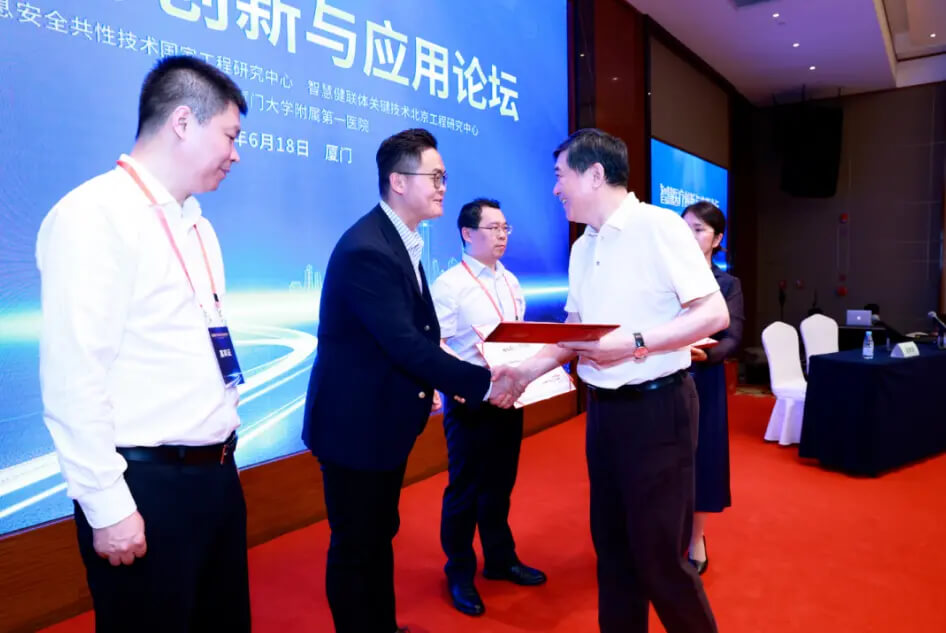
1/7 🚀 Transforming healthcare in China by $TRIAS! On June 18 2023, at the Smart Medical Innovation Forum in Xiamen, a major milestone was achieved in integrating blockchain and privacy-computing technologies into healthcare. Let's dive into how Octa is leading the way. 🩺✨